This is the new direction of The Living Fractal.
If you want to follow what I’m building here, subscribe so new essays, frameworks, and updates land in your inbox as they’re published.
The “goodbye” you may have seen earlier was real, but it was goodbye to an older model: an earlier voice, earlier framing, and earlier way of relating to the work. This is the continuation, with a sharper stance: constraint-first, mechanism-first, and grounded enough to be lived.
Most of what is breaking in the world right now is not mysterious.
It feels mysterious because we were raised inside stories that treated reality like a customer service desk: explain your intention, state your values, and the universe will meet you halfway. Work hard and you will be safe. Be good and you will be rewarded. Believe correctly and you will be protected.
But reality does not negotiate.
What I’m trying to offer here is a map you can stand on: a set of levels that stack on top of each other. Each level is real, but each level is also downstream of constraint. If you start at the top, you get moral theater and confusion. If you start at the bottom, you get clarity, and then you get choices.
This is what I have been working on.
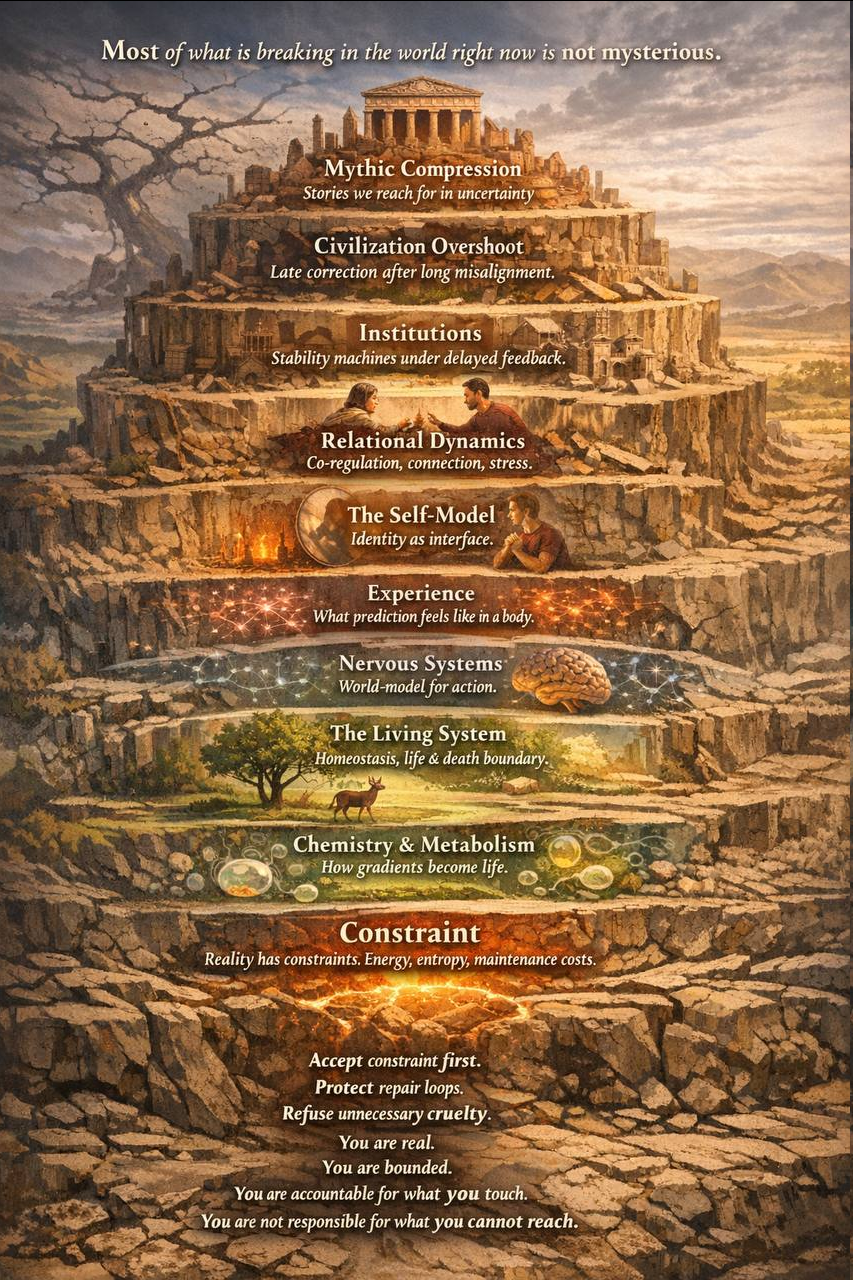
Level 0: Constraint (the ground rule)
Reality has constraints. Not opinions. Not vibes. Constraints. Energy is conserved. Entropy is real. Everything that persists has to pay maintenance costs. Feedback is delayed by buffers. When feedback is delayed, error becomes debt. When debt exceeds correction capacity, correction arrives by force.
That is not a worldview. That is the operating condition of existence.
This is why your body can be exhausted even when your mind is “doing everything right.” If your model assumes constraint is optional, your nervous system will keep getting corrected by reality. It will feel like failure. It is miscalibration.
Level 1: Chemistry & metabolism (how gradients become life)
Long before meaning, long before morality, the universe was already making order locally, because gradients existed and the gradients had to collapse somehow. Under the right conditions, collapse can become organized: reaction chains, loops, catalysis, the first faint outline of persistence.
Life begins as a process that keeps running because stopping would cost more than continuing. Metabolism is not a metaphor. It is rent.
Level 2: The living system (homeostasis, budgeting, death as boundary)
At Level 2, chemistry stops being loose and starts being organized around staying away from equilibrium. Something actively maintains itself.
Not consciously. Not symbolically. But relentlessly.
This is homeostasis: narrow ranges of temperature, pH, glucose, oxygen, hydration. A living system is a bounded process that must keep internal variables within tolerances while the outside world keeps trying to kill it. When it can’t, it doesn’t get judged. It just stops. Death isn’t a glitch later in the story. Death is built in as a boundary condition: repair is never perfect, entropy is undefeated, and maintenance costs rise with complexity.
This matters because it tells the truth nobody wants to metabolize: “being alive” is not innocence. It is ongoing cost.
Level 3: Nervous systems (a world-model for action)
A nervous system is not a mirror of truth. It is a tool for action under uncertainty. It was shaped to keep an organism alive fast enough. It compresses the world into usable chunks: objects, threats, opportunities, priorities. It builds a model and then tries to minimize surprise.
Speed and coherence often win over accuracy. That is why humans can build cathedrals and also believe obvious lies. It is why we can be brilliant and deluded at the same time.
If you feel “too sensitive,” one possibility is that you are not weak. You might be registering prediction error faster than your environment wants you to.
Level 4: Experience (what prediction feels like in a body)
Level 3 builds a world-model. Level 4 is what it feels like when that model is running.
This is the felt present: raw “what-it’s-like,” before story. Experience is not an extra layer of magic sprinkled onto neurons. Experience is prediction enacted in a living body. Sensation arrives, the model forecasts, the body prioritizes, and feeling is the control signal that says, in real time: update now, update later, or don’t waste energy on this.
When you are safe, this layer gets spacious.
When you are under threat, it collapses.
And when you remove symbolic anesthesia, when you stop soothing yourself with lies, this layer can become sharp and heavy, not because you are broken, but because you are finally feeling the signal at a lower latency than your culture is designed to tolerate.
Level 5: The self-model (identity as interface)
Then, on top of experience, we develop a “self.” The self stitches time together. It manages commitments. It navigates social prediction. It gives the organism a way to act as a unit across days and years.
But the self is not a commander.
It is an after-the-fact explanation engine that very easily mistakes its narration for causation. The self feels like it chose, so it also feels like it could have prevented. And once it believes it is sovereign, it starts turning signals into verdicts.
This shouldn’t be happening.
This means something about me.
This must be someone’s fault.
That is where suffering multiplies. Pain is a signal. Suffering is what happens when experience gets interpreted as a verdict about who you are.
Level 6: Relational dynamics (coupled nervous systems)
Humans do not live as isolated individuals. We are co-regulatory mammals. Before language, before ideology, before moral philosophy, your nervous system is reading other nervous systems.
At this level, every interaction quietly answers three questions: am I safe with you, do I matter to you, and who is regulating whom. When two people co-regulate cleanly, life gets cheaper. When they dysregulate each other, life becomes metabolically expensive. When a society becomes saturated with stress, this layer turns brutal fast: scapegoating, fear, projection, domination. Not because people suddenly became monsters, but because co-regulation failed.
Level 7: Institutions (stability machines under delayed feedback)
We don’t live at the scale our nervous systems evolved for. We live inside institutions.
Institutions are not villains. They are coordination machines that outlive individuals. They route energy, labor, legitimacy, coercion, and repair across millions of strangers. They exist because a society can’t co-regulate by face and reputation once the group is too large.
This is not initially a lie. It is compression.
But compression has a cost. As institutions scale, feedback slows. Distance from ground truth grows. Correction becomes expensive. And self-preservation quietly replaces learning. When truth threatens stability, institutions do not usually say, “We are misaligned.” They moralize. They narrativize. They enforce. They pathologize dissent. They punish messengers. This is not always corruption. It is predictable behavior under delayed feedback.
Systems do not become cruel because individuals suddenly become bad. Systems become cruel when they lose the capacity to correct gently.
Level 8: Civilization under overshoot (late correction)
Modern civilization expanded abstraction faster than feedback and repair. We built a world that runs on buffers: fossil fuels, financial debt, ecological slack, global supply chains, institutional trust. Buffers are not evil. Buffers buy time.
But buffers also hide signals. They delay consequence long enough for overshoot to feel like competence.
And when the signal finally arrives, it does not arrive as a polite suggestion. It arrives as forced correction.
That is what our era is: late correction after long misalignment.
When buffers thin, the sequence is boringly consistent. Legitimacy erodes. Repair becomes too slow. Coercion replaces consent. Narratives replace updates.
Level 9: Mythic compression (the containers people reach for)
When reality becomes harder to metabolize, humans don’t become purely rational. They reach for containers that can bind behavior and compress consequence into something the body can feel.
Myths and religions can do this in a way that stabilizes people. They can also be captured into identity armor and authority laundering.
Under pressure, people tend to fall into a few attractors. Some choose empire myth: order must be restored, enemies everywhere. Some choose nihilist consumer myth: nothing matters, take what you can. Some attempt something harder: a constraint-servanthood posture, where reality is sovereign and the self stops pretending it is king.
The trap (and the way through)
If you see the stack clearly, it becomes tempting to try to become as impersonal as reality.
That is the trap.
Reality is impersonal.
Humans are not.
Care is not a cosmic guarantee, but it is a local technology. Bodies require softness to stay corrigible. Relationships require mercy to keep repair possible. If you strip mercy entirely, you don’t become wise. You become rigid. And rigidity is how systems break.
So here is the stance I am trying to practice, without performance.
Accept constraint first.
Stop negotiating with what will not negotiate.
Let the self shrink back into a tool.
Let responsibility become local and real instead of infinite and abstract.
Shorten feedback where you can reach.
Protect repair loops.
Refuse unnecessary cruelty.
Do not outsource conscience to systems that cannot correct.
And do not demand that integrity produce victory.
Most catastrophe is not malice.
It is delayed correction amplified by buffers and protected by stories.
If that sentence sounds bleak, I want to say something quietly radical: it is also relieving.
Because it means you don’t have to carry the fantasy that you were supposed to be God.
You are not sovereign.
You are real.
You are bounded.
You are accountable for what you touch.
You are not responsible for what you cannot reach.
Living inside reality is not resignation. It is accuracy without flinching and without self-erasure.
What holds, stays.
What lies, rots.
What this page is
A map for living inside reality: constraint, feedback, nervous systems, institutions, and the costs of pretending otherwise.
A place for mechanism-level writing that prioritizes accuracy over performance.
A record of model-building in public, with updates when evidence changes.
A practical orientation: how to stay corrigible, how to shorten feedback loops, how to protect repair.
This is devotion.
What this page is not
Not a brand persona, not a lifestyle identity, and not a “vibe.”
Not motivational content, not moral theater, and not certainty-as-aesthetic.
Not a promise of safety, victory, or righteousness.
Not a community built around outrage, enemies, or purity tests.
If you want to track this new direction as it unfolds, subscribe. This is where the work will continue, cleaner, more honest, and more structurally true than what came before….

Member discussion: