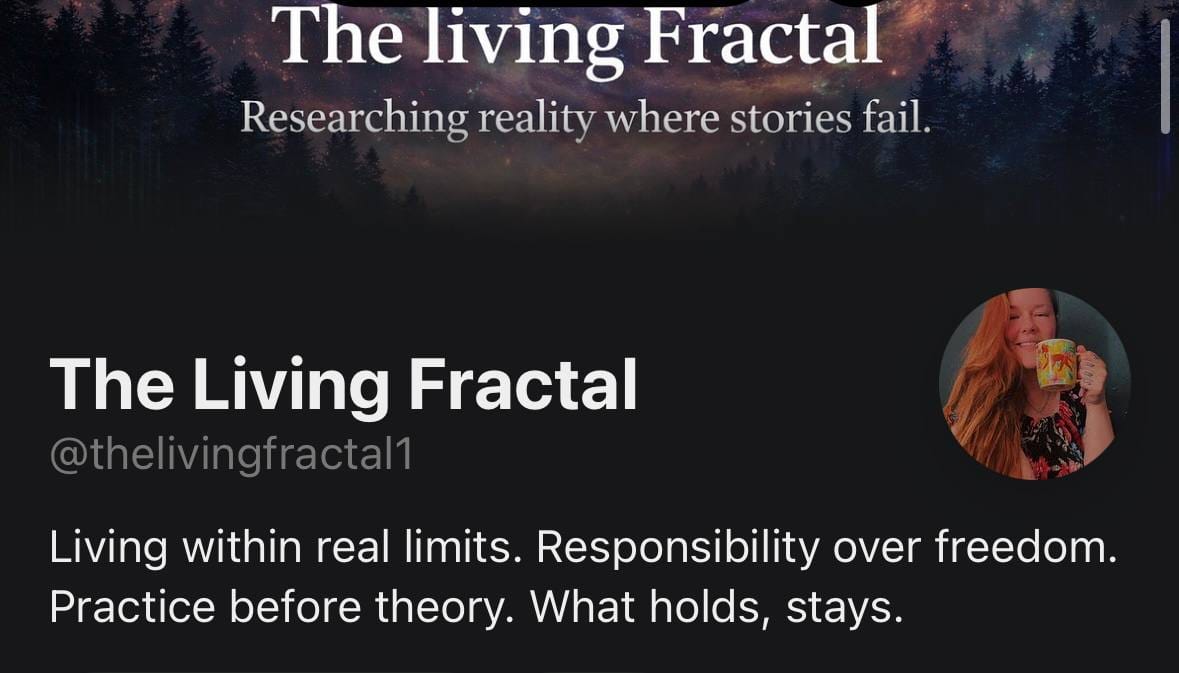
I'm Daphne Denninghoff. I work in healthcare in The Netherlands, and I run The Living Fractal, a research platform for staying human in a system that's getting colder.
This work exists because I kept hitting the same wall: I could see the mechanisms clearly, but the frameworks people were using to understand them kept breaking. Climate frameworks that ignored power. Peace frameworks that assumed surplus. Wellness frameworks that treated exhaustion as a personal failure instead of a systemic output.
So I started building different tools. Not better opinions. Better diagnostic infrastructure.
The core question
How do you stay human in a system that rewards numbness, speed, and obedience, and punishes care, slowness, and truth?
That question runs through everything I do. It's not rhetorical. It's operational.
The answer isn't heroism or ideology. It's structure, constraint-honesty, and sustainable capacity.
What constraint-honest means
Most analysis stops at "what should happen." Constraint-honest analysis asks: "What can happen, given thermodynamic limits, institutional capacity, nervous system bandwidth, and resource flows?"
This isn't pessimism. It's calibration.
When you work from constraint:
You stop wasting energy on impossible demands.
You see where leverage actually exists.
You build things that last because they're aligned with what's real.
You stop mistaking delayed feedback for success.
Constraint before meaning. Reality beneath construction.
Systems behave according to their structure, not their intentions. Good people in badly structured systems still produce bad outcomes. Bad outcomes don't require malice, just delays, feedback loops, and incentives.
This single insight explains climate failure, institutional collapse, burnout, and why "fighting the system" often strengthens it.
The frameworks that hold
My work maps the mechanics of decline without doom theater:
Thermodynamic sorting. As energy surplus declines, systems simplify their goals. Complexity gets shed. Institutions choose which commitments to abandon. This isn't conspiracy, it's convergent adaptation under constraint.
Legitimacy erosion → control expansion. When systems lose trust, they compensate with surveillance, coercion, and triage logic. Not because elites are evil, but because feedback loops break and correction becomes impossible.
Feedback loop breakage. Delays between action and consequence allow systems to drift far from viability before correction arrives. By then, the correction is catastrophic.
Triage logic replaces universal provision. Under resource constraint, states shift from "services for all" to "services for some." This is managed decline. It looks like abandonment because it is.
There is a real beneath the constructed. Social reality is constructed on top of constraint. You can tell any story you want, but thermodynamics, biology, and entropy don't negotiate. Construction that ignores constraint eventually collapses.
These aren't theories. They're patterns I track across geopolitics, institutional behavior, resource flows, and elite adaptation. I watch what systems do under pressure, not what they say.
The work has three layers
1. Collapse Signals: Systems analysis under contraction
I track:
- Arms control architecture collapse
- Diplomatic coercion replacing negotiation frameworks
- Selective attention infrastructure (what gets covered, what disappears)
- Proxy violence as state policy
- Institutional error-correction failure as elite triage
- Diaspora flight as legitimacy barometer
- Energy imperialism without liberation narrative
- Complexity shedding under resource constraint
Not "is collapse happening?" but "what are the mechanisms, what comes next, what does the pattern tell us?"
I synthesize from sources like The Guardian, The Intercept, Follow The Money, London Review of Books, Reporters Without Borders, and I cross-reference with primary documents, not just commentary.
2. Practice: Staying regulated when institutions fail you
Regulation-first protocols. Embodied practices. Boundaries as infrastructure.
I'm not interested in moral arguments. I'm interested in what actually works:
- Energy-aware engagement (baseline checklists, capacity budgeting)
- Dysregulation pattern recognition and response
- Sustainable throughput over heroic bursts
- Nervous system dashboard (HRV tracking, window of tolerance mapping)
- Relational protocols that don't collapse under stress
Core principle: You cannot give what you don't have. Depleted systems produce nothing. Maintain your own survival baseline while directing surplus toward those with no baseline left.
This comes directly from lived experience, healthcare work, Gaza mutual aid, peace organizing. I've watched people burn out trying to save everyone. I've done it myself. Sustainability isn't optional if you're working on decades-long problems.
3. Resilience Guides: Building in system cracks
Mutual aid that doesn't collapse. Direct support infrastructure. Horizontal networks.
Active work:
Gaza Support System: Direct aid to Ahmed's family and Badi's medical evacuation. Verification protocols. Regulation-first giving. Throughput-realistic support. Not heroic bursts that end in burnout, but sustainable monthly capacity with clear boundaries.
Peace Work with The Hague Peace Projects and De Nieuwe Vredesbeweging: Constraint-honest strategy. Embodied interventions (question cards on train benches, chalk questions on sidewalks, listening tables, anonymous buttons). Guerrilla cognitive resistance. Seeding cracks, not smashing systems.
Wiens Atoomwapens? campaign: Nuclear hypocrisy localized to Volkel Air Base and Tweede Kamer. Question-led tactics. €20-30 starts. Measuring success by pauses created, not virality.
Energy Retraction Engine: Mapping where my money, attention, and legitimacy flow. Retracting from extractive systems. Reinvesting in non-harm alternatives. Making invisible subsidies visible.
Network Skills & Resources mapping: Who I can rely on within walking distance. Who relies on me. Skill-sharing. Co-regulation partnerships. Mutual aid pacts. Resilience is networked.
This isn't activism cheerleading. It's infrastructure. Like mycelium, not a tree.
Operating principles
Sustainability over heroism: Burning out in 2026 eliminates future usefulness. Decades-long work requires intact capacity.
Transmission over perfection: 70% ready and published beats 100% perfect and stuck. Reality doesn't wait for polish.
Evidence over ideology: Update models when reality demands. No dogma. If the data changes, the framework changes.
Mechanisms over morality plays: Describe causal structure, not villains. Systems don't have intentions. They have feedback loops, delays, and selection pressures.
Boundaries as infrastructure: Saying no preserves capacity to say yes later. Limits aren't failure. They're thermodynamic honesty.
Regulation-first: No action from depletion. Baseline checks gate complex work. Your nervous system state is the substrate everything else depends on.
Local is thermodynamic: Human-scale systems preserve feedback. Municipal action is efficient. National action dissipates. Global rhetoric without local action is performance.
Questions over answers: Questions interrupt cognitive capture. Answers close inquiry. In systems that reward certainty, questions are structural disruption.
What this isn't
This isn't...
Activism cheerleading or despair literature.
Therapy or spiritual bypassing
A movement or an organization
Optimism or nihilism
Left or right (those categories assume surplus that no longer exists)
This is infrastructure. Like a library, not a leader. Like a protocol, not a platform.
Why I do this
Because I kept seeing the same pattern: people with accurate perception, burning out because they had no frameworks to metabolize what they were seeing. Or worse, drifting into conspiracy thinking, doom scrolling, moral performance, or fantasy-based politics.
The problem isn't that people can't see what's happening. The problem is they don't have tools to work with it without collapsing.
So I build those tools. Publicly. In writing that refuses to perform hope or despair.
I'm building infrastructure so that when the next crisis hits, people can say:
"I stayed grounded because I had those frameworks"
"I didn't lose myself because I had those practices"
"My network held because we had that infrastructure"
That's what this is for.
Where the work lives
Website: thelivingfractal.com : Deep systems analysis, framework pieces, resource lists. Evergreen anchor content.
Substack: @thelivingfractal1 : Essays, case studies, analysis. Weekly or bi-weekly. Mechanism-level writing without activism aesthetics.
LinkedIn: Daphne Denninghoff : Systems thinking for organizers, researchers, policy-adjacent folks. Constraint-honest analysis of institutional behavior, geopolitics, and resource flows.
UpScroll: @TheLivingFractal : Raw observations, community building for context and mutual aid networks. Signal processing without polish.
The deeper architecture (if you want it)
Beneath the public work is an operating system I've built over years:
Systems Research Nexus: My research hub. Tracking thermodynamic sorting, feedback loop breakage, triage logic, legitimacy erosion. Sources library. Concept models. Active frameworks that update when evidence demands.
Seeds in the Cracks: Operational layer. Energy retraction engine. Capacity seeding ground. Financial autonomy map. Attention allocation tracker. Social weaving network. Municipal seeding terrain. Daily and weekly rhythms. Constraint equations. The math of sustainable capacity.
Expression layer: Content pipeline from signal → draft → edit → publish across all channels. Offline interventions (zines, posters, street actions). Visual concepts. Language experiments. Publication planning with 30-50% empty space so reality can breathe.
Self system: Nervous system state tracking. HRV baseline. Regulation protocols. Dysregulation pattern library. Because the substrate matters more than the output.
This OS is what makes the public work possible without collapse.
Influence and calibration anchors
The work builds on:
Donella Meadows (systems thinking, leverage points, feedback loops)
Vaclav Smil (energy and civilization, thermodynamic realism)
Predictive processing / Bayesian brain (neuroscience, perception as inference)
Evolutionary epistemology (cognition under constraint)
Islamic constraint technology (prayer as regulation, fasting as calibration, I study structure, not theology)
But I'm not an academic. I'm a healthcare worker who kept hitting reality and decided to map it.
The long game
The Living Fractal becomes a cited reference point for:
Systems-level collapse analysis (researchers, journalists, educators use the frameworks)
Regulation-first organizing (activists cite the protocols to prevent burnout)
Diaspora knowledge infrastructure (communities navigating abandonment find tools here)
Success looks like infrastructure that outlasts me. Frameworks that propagate without my name attached. Tools people use because they work, not because they're mine.
Not a movement. Not a brand. Mycelium.
Contact
If you see something I'm missing, if you find an error in the analysis, if you have a framework that stress-tests better, tell me. This work improves through collision, not consensus.
And if this resonates and you want to follow the work: subscribe on Substack, connect on LinkedIn, or just come back to the website when you need to recalibrate.
The system is getting colder. We stay human anyway.