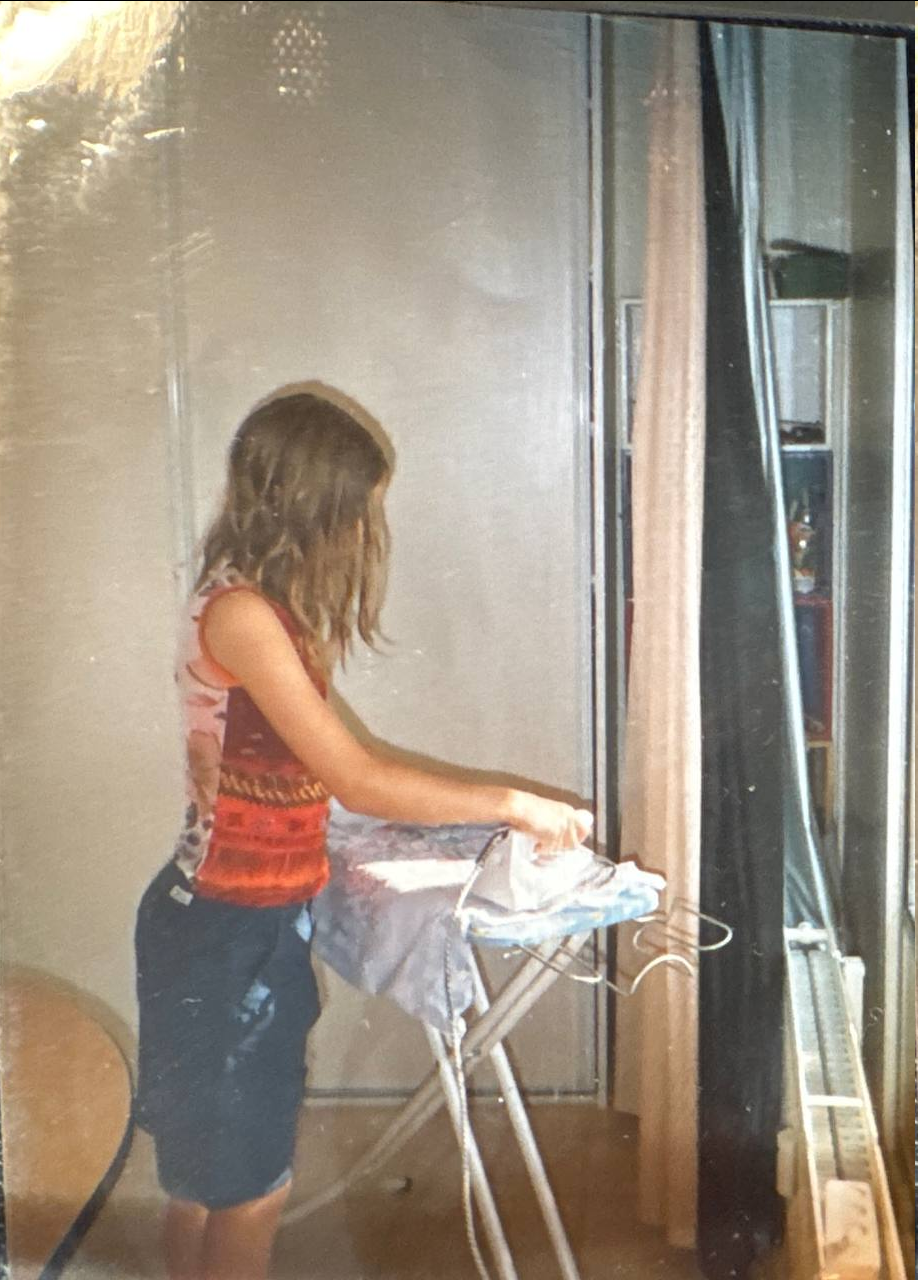
I want to begin with something simple and deeply personal.
The first four years of my life were coherent.
I lived with my grandmother. She gave me something I did not have words for at the time, but which I now understand as containment. Not control. Not perfection. Containment.
She taught me how to live inside reality.
We read books. We went into nature. She showed me mushrooms and plants. We talked about mythology, science, religion, art. We cleaned the house together. We cooked. We made to-do lists in the morning. There was rhythm. There was feedback. There was care. There was discipline without fear. Learning felt safe.
My nervous system learned: the world makes sense.
Then, after four years, I was taken away to live with my mother.
What followed was incoherence.
There was emotional absence. And later by others….Abuse.
A lack of attunement. I remember taking my mother’s face in my hands and saying, “Mom, I love you.” Not for attention. Not for reassurance. But because something essential was missing. I was saying: please see me. Please feel me. Please be here.
She couldn’t. Not because she was a bad mother, but because she couldn’t be coherent.
From that point on, reality stopped making sense.
Every school holiday I returned to my grandmother, and every time it felt like coming home, not emotionally, but structurally. My system settled. I could breathe. I could think. And every time I left her again, the world fractured.
At the time, I thought this was my fault. The system also makes you believe it is your fault.
For years, decades, I thought I was the problem.
What the First Years of Life Actually Build
Modern developmental science now confirms what my body always knew….
The first years of life are not about “happiness” or “intelligence.” They are about model formation.
A child develops the following:
- Basic trust in reality
- The capacity to regulate emotion
- A sense of cause and effect
- An internal rhythm
- The ability to learn without fear
- An early self-model anchored in relationship
When those conditions are coherent, the nervous system learns to update, adapt, and repair.
When they are not, the system compensates.
In my case, I compensated by becoming exquisitely sensitive.
I learned to feel when something was off, in people, institutions, systems. And I felt it everywhere.
School felt wrong.
Work felt wrong.
Relationships felt wrong.
Society felt wrong.
Not morally wrong. Structurally wrong.
I kept burning out, at work, in love, in life. Again and again. Each time I blamed myself more. Each time I tried harder to fit.
They told me “I was too sensitive.” That to survive in this world you required numbing.
Until one day, my self-model broke. I spoke about this before. But clarity is increasing.
When the Self-Model Collapses
At first, I thought it was a spiritual experience.
I experienced the collapse of the idea that “I” was a sovereign, central authority. Awareness itself revealed itself as part of perception, not its master.
So I stopped looking inward for answers.
I started studying reality itself. Some of you have experienced this phase of this process.
Thermodynamics.
Systems theory.
Bioelectricity.
Neuroscience.
Predictive processing.
Civilizational collapse.
Ecology.
Feedback loops.
I wanted to know: how does reality actually work?
Why do humans keep repeating the same patterns?
Why do systems grow complex, arrogant, and them implode?
Why does intellect turn into a weapon against life?
And slowly, something became clear. I started talking about limits, constraints.
Reality is lawful.
Reality has constraints.
Reality correct violations, not morally, but causally.
And humans suffer when they mistake their models for reality itself.
Predictive Processing and the Arrogance of Intellect
Modern neuroscience tells us something profound: we do not experience reality directly.
The nervous system predicts. Perception is a model constrained by feedback.
When feedback is ignored, suppressed, or delayed, the model becomes distorted.
Now scale that up.
When civilizations:
- Insulate themselves from consequences
- Replace feedback with narrative
- Treat intellect as sovereign
- Believe they “know better” than reality
They collapse…
This has nothing to do with ideology. It’s physics.
And then I read the Qur’an.

Why the Qur’an Shocked Me
I did not come to Islam emotionally.
I did not come through culture.
I did not come through identity.
I came because it described reality exactly as I had been studying it.
Al-Baqarah (the cow) reads like a failure-mode catalog for civilizations:
Arrogance of knowledge…
Hypocrisy…
Corruption masked as reform…
Worship of intellect…
Denial of consequence
Loss of guidance through self-sovereignty…
It was…unsettling.
It was not reading theology.
I was reading system diagnostics.
The Qur’an does not flatter humans. It does not romanticize progress. It does not assume goodness. It assumes fallibility, and builds correction into the structure.
This is why it does not feel like a “religion” to me in the modern sense.
It feels like a containment system for human perception….
Prayer as Recalibration, Not Performance
Prayer is not symbolic to me.
It is a regulatory rhythm.
Five daily interruptions that say:
You are not the center
You are not sovereign
you are not the author
return
This mirrors nature: Circadian rhythms, tides, seasons, metabolic cycles.
We are not separate from nature. We are symbolic organism inside it.
Prayer restores direct feedback, not from God as an object, but from reality under God.
Fasting, Judgement, and Boundaries
Fasting is not punishment. It is desire correction.
It reminds the nervous system that:
Not ever impulse must be satisfied.
Not every want is a right.
Deprivation sharpens perception.
Judgement is not threat.
It is accountability beyond institutions.
It says:
no system escapes consequence
no narrative overrides reality
no power is final
This prevents moral collapse into relativism or PR ethics.
Allah as Ultimate Constraint, Not Projection
I do not claim exclusive truth.
Across history, mystics, prophets, and indigenous cultures have pointed to the same thing:
Humility before reality.
Purification of perception.
Surrender of false authority.
Alignment with lawful existence.
Some call it god.
Some call it Tao.
Some call it Dharma.
Islam gives it a name that cannot be collapsed into selfhood: Allah.
Not an image.
Not an idea.
Not a projection.
The name functions as a boundary marker:
This is not you
this does not belong to you
you cannot control this.
This is mercy.
Why This Is Devotion, Not Identity
I am not becoming religious.
I am returning to coherence.
I am surrendering my need to author reality.
I am relinquishing my claim to sovereignty.
I am placing myself back into the web of consequence.
This is devotion.
Not emotional.
Not performative.
Not tribal.
Structural.
The Living Fractal
Reality is a nested system:
body…
behavior…
relationships…
resources…
conscience….
society…
ecology…
time…
Break coherence at any level, and the whole system suffers.
Islam, as I practice it, is not about being “right.”
It is about remaining corrigible.
Able to return.
Able to be corrected.
Able to listen.
This is what my grandmother gave me.
This is what I lost.
This is what I found again.
Not in the past.
Not in nostalgia.
But in a container that respects the limits of a lawful universe.
That is why I pray.
That is why I fast.
That is why I read the Qur’an.
Not because I am certain.
But because I finally trust the feedback.
This is the living fractal.

Member discussion: