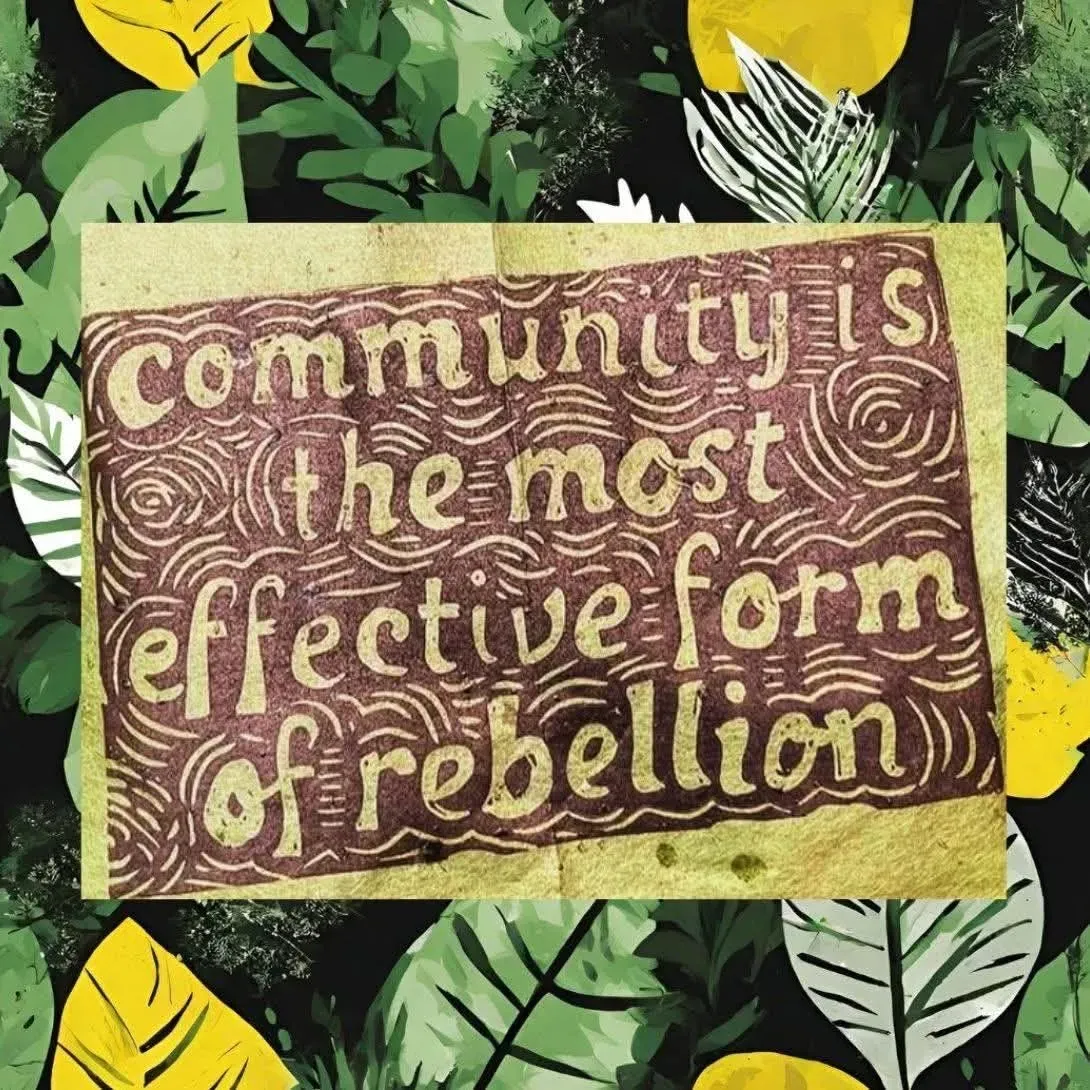
Friends,
We cannot defeat large-scale systems by opposing them directly. Complex systems do not respond to moral arguments; they respond to incentives, constraints, and feedback loops.
So the task is not to fight the system, but to reduce dependence on it and increase local resilience.
Become human again.
Strengthen direct social bonds. Mutual aid, shared knowledge, and regular communication increase collective resilience under stress. Human connection is not sentimental, it is a proven buffer against systemic shock.
Protect your health. Chronic stress and burnout reduce individual and collective adaptive capacity. Rest, movement, and regulation are strategic necessities, not luxuries.
Read. Write. Maintain the ability to think critically and communicate clearly when information systems become noisy or distorted. Amplify voices that are structurally marginalized; diversity of perspective improves system-level problem solving.
Decolonise your body and mind, by restoring first-order feedback. Learn to cook, preserve food, and understand basic water purification. These skills reduce vulnerability to supply-chain disruption and increase autonomy.
Play. Creativity and unstructured interaction are not distractions; they sustain cognitive flexibility and psychological resilience.
Care for health collectively where possible. Community-based support systems reduce load on overstretched institutions and improve outcomes through early intervention.
Build small, coherent networks. Systems that remain legible, trust-based, and adaptable outperform large centralized structures under conditions of uncertainty.
Grow food. Share tools. Exchange skills. Reduce reliance on institutions that are optimized for extraction and control rather than repair and care.
Consume less. Repair more. Circular use of resources lowers material throughput and increases system stability.
Engage across cultures, religions, and worldviews with curiosity and respect. Cooperative dialogue reduces polarization and improves collective intelligence; domination and certainty do the opposite.
This is not resistance in the dramatic sense.
It is adaptive withdrawal from brittle systems and reinvestment in resilient ones.
Large systems persist only through participation. When participation shifts, gradually, locally, and coherently, systems either adapt or lose relevance.
Seed resilience where it can take root.
Let unsustainable structures exhaust themselves by removing their dependence on your energy, attention, and resources.
Sending all my love,
Daphne

Member discussion: