
Looking back without disowning ourselves
In early 2025, I wrote an article asking whether what we were living through was collapse or evolution. This was when I had just started my official website. I was not writing from a steady place. My internal world was unstable, and the language I reached for reflected that: large frames, sharp claims, and a hunger for coherence.
This is a rewrite from 2026.
Not because I want to “fix” the earlier version, but because I can now see what it was trying to do: name overload while standing inside it. Some instincts were sound. Some metaphors carried more weight than the evidence could support. And some lines were offering comfort where accuracy would have been more useful.
What follows is not a grand theory. It is a cleaner description of a pattern that keeps appearing across scales: systems saturate, perception narrows, and people behave in ways that make sense under sustained stress.
What is actually failing
Much of what gets labeled “collapse” looks, up close, like saturation.
Modern institutions were built for slower feedback loops, stable surpluses, and a world in which disruption was episodic rather than continuous. That world no longer exists. We are running high complexity on thinning margins, and the consequences show up as delayed decision-making, brittle supply chains, legitimacy eroding faster than alternatives can consolidate, and defensive, image-protecting behavior in systems that once adapted.
This is not a moral failure. It is what happens when maintenance costs rise and response time fails.
Beneath much of the ideological noise, the dominant constraint keeps reasserting itself: energy. The cost of complexity. The cost of coordination. The cost of keeping everything “normal” when the conditions that supported normality are gone.
What prolonged stress does to societies
When populations live inside uncertainty for long enough, collective behavior begins to resemble a sustained stress response.
People do not become irrational. They become overloaded.
You see it in shorter attention spans, reduced tolerance for ambiguity, and the rise of absolutist narratives, both utopian and authoritarian. You see it in arguments that collapse into identity contests, because identity starts to feel like the last stable surface.
One of the most underestimated dynamics here is perception lag.
Many people can sense that old guarantees no longer apply, but sensing instability is not the same as understanding it. Without updated models, the mind reaches for what it can metabolize quickly: simplified explanations, enemy narratives, nostalgia, rigid roles.
This is not because most people are bad. It is because most people are carrying more input than their systems can integrate.
What helps at the individual level
I used to write about nervous system regulation as if it were a threshold, cross it and life upgrades.
That framing does not hold.
A more accurate description is smaller and more useful: regulation is maintenance. It does not make you immune. It does not solve structural problems. It does not confer moral superiority.
What it does is quieter.
It improves signal-to-noise. With more capacity, you can hold uncertainty without immediately collapsing into a story. You can notice what is happening before deciding what it means. You can stay in contact with reality longer.
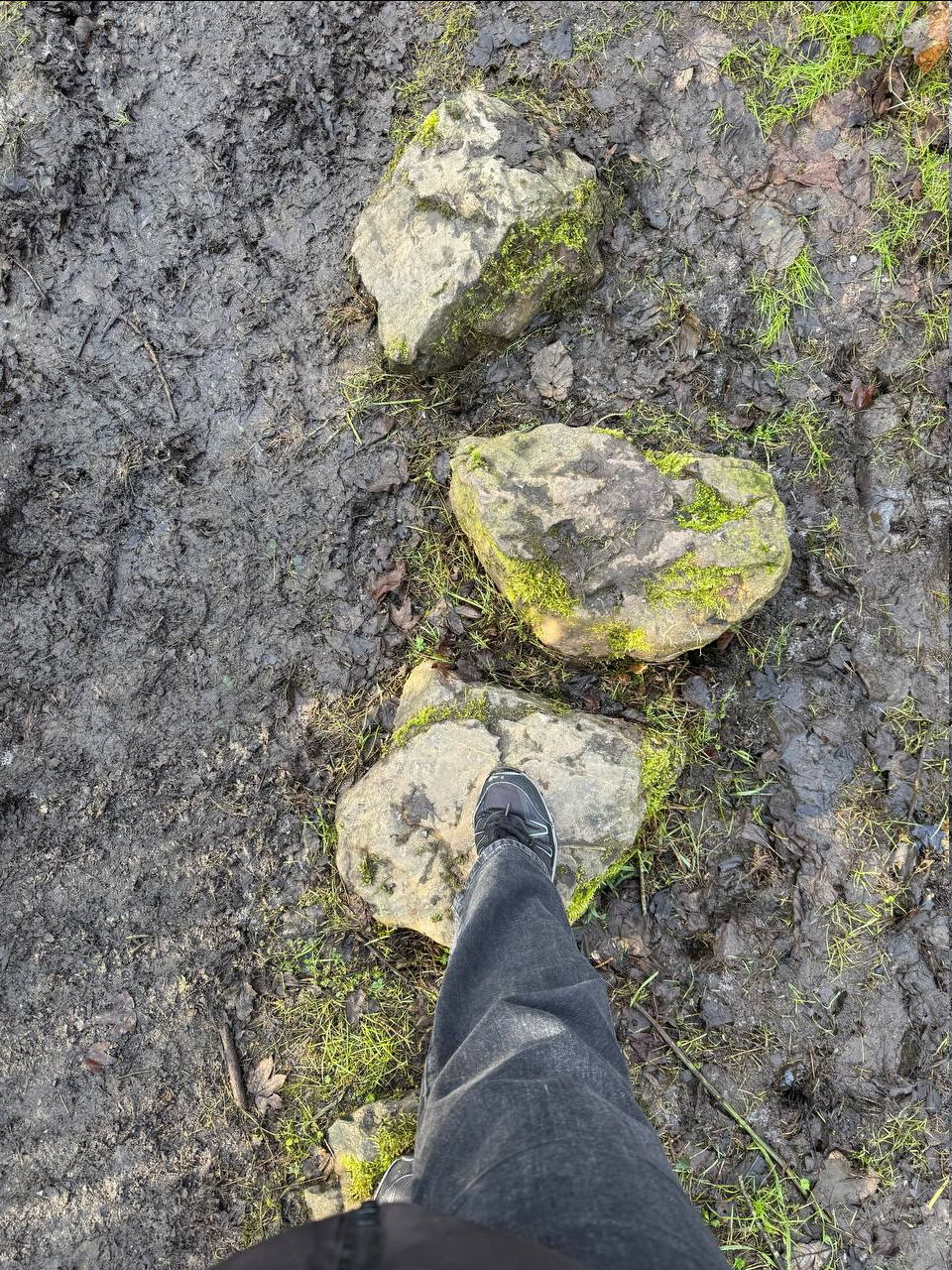
One of the most reliable ways to support that capacity is unglamorous and well-documented: movement.
Walking, carrying, lifting, repetitive physical work, rhythm, not as optimization, but as an outlet the nervous system expects. When that outlet disappears, symptoms rise. Not because people are weak, but because the body has nowhere to put what it is holding.
What I won’t claim anymore
I won’t claim that collapse is inherently evolutionary.
I won’t claim that decentralization automatically produces coherence.
I won’t claim that individual regulation replaces collective responsibility.
Evolution is selective, not benevolent. Some outcomes degrade. Some fragment. Some adapt. Many do not.
What still seems true
Systems built for stability fail under acceleration.
Stress narrows perception at every scale.
People behave worse when overloaded, not because they are worse.
Embodied regulation increases functional agency.
And in an environment where signals are noisy and incentives are distorted, sense-making matters more than belief.
Not collapse or salvation, but selection
The world is not ending, and it is not ascending.
It is entering a prolonged phase of selection under constraint.
Some structures will persist in degraded form. Some will fracture into smaller, more local systems. Some people will adapt perceptually. Some will not.
The most valuable capacity right now is not predicting the future or winning a narrative. It is staying sane, grounded, and perceptually accurate long enough to respond rather than react.
In 2024, I was trying to name something while standing inside it.
In 2026, I can say it more plainly: understanding does not guarantee safety, but misunderstanding reliably multiplies suffering.
Not mysticism.
Maintenance.

Member discussion: