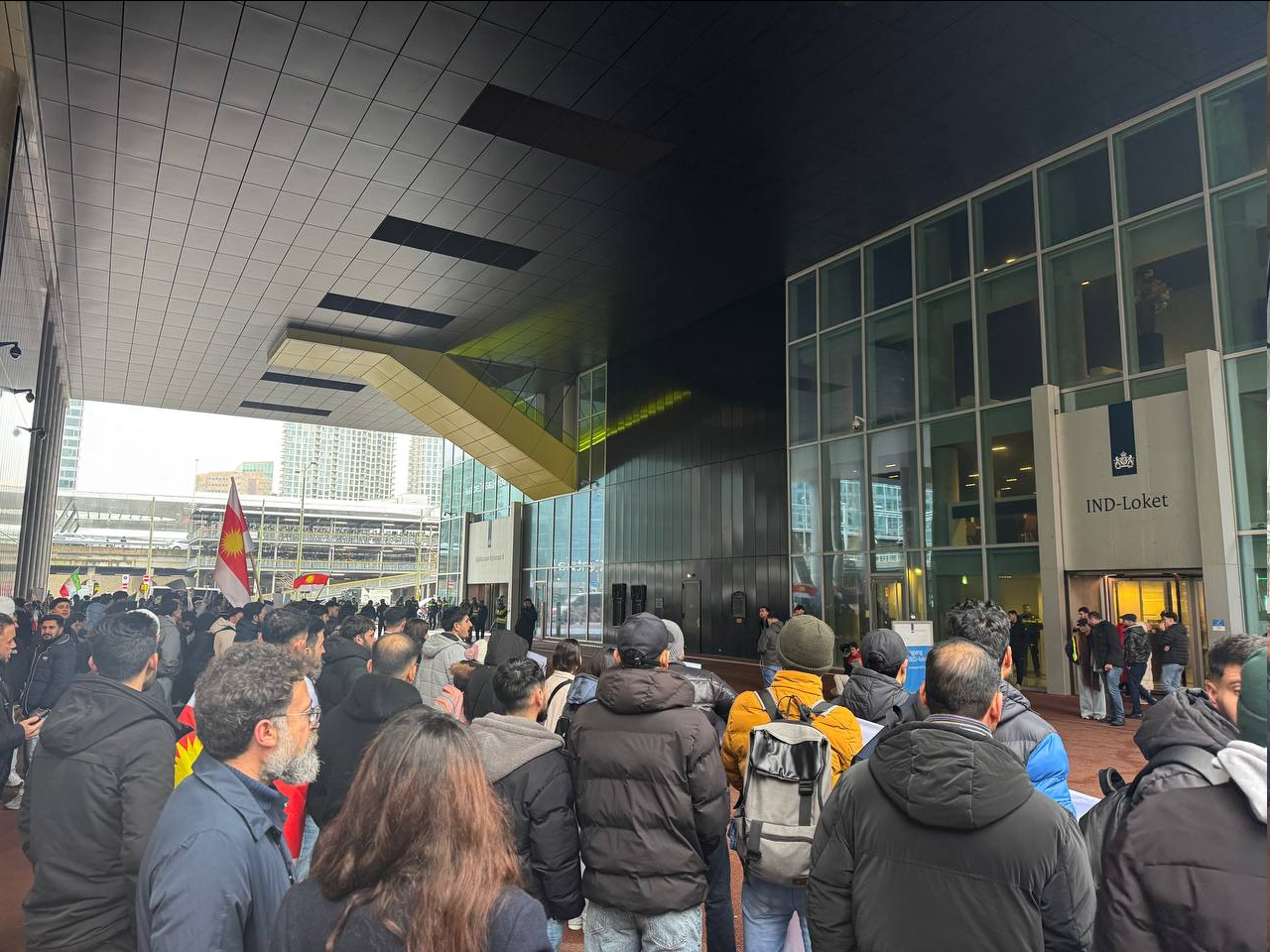
I hadn’t planned to be at a Yazidi protest. I talked with one man for minutes. They consented for me to write about this.
Part of the series: Witnessing Without Sides
I hadn’t planned to be at a Yazidi protest.
I had just come from peace talks in The Hague, conversations about systems, militarization, capitalism, media, and the familiar language of geopolitics. When you’re around the Ministry of Foreign Affairs, protests are common. Most people walk past them. I almost did too.
But this time I stopped.
I realized, with a quiet kind of shock, that I didn’t actually know who the Yazidis were. Not really. I knew the word. I knew “ISIS did something horrible.” That was the extent of it.
That gap, not knowing, is the point. Entire peoples can be erased not only by violence, but by absence from our mental maps. The Yazidis have been living in that absence for centuries.
This is an attempt to correct that, not by taking sides, not by creating villains and saints, but by telling the story as honestly as possible. Because all people matter. And because humanity has not changed as much as we like to believe.
Who are the Yazidis?
The Yazidis are an ethno-religious community indigenous to northern Mesopotamia, primarily the Sinjar region in what is now northern Iraq, with communities historically spread across parts of today’s Iraq, Syria, Turkey, Armenia, and Iran.
They are not Muslims, not Christians, and not Jews, though their religion contains elements that predate all three.
Yazidism is an ancient, oral religion with roots in:
Pre-Islamic Mesopotamian belief systems
Zoroastrian influences
Local Sufi traditions
Indigenous cosmologies tied to land and seasonal cycles
It is not a proselytizing religion. You are born Yazidi; conversion in or out is traditionally not permitted. This has helped preserve the religion—but it has also made the community extremely vulnerable.
Their central spiritual figure, Melek Taus (the Peacock Angel), has been consistently misinterpreted by outsiders, often deliberately, as a “devil figure.” This misinterpretation has been the single most lethal idea in Yazidi history.
Why the Yazidis were targeted
The Yazidis were not persecuted because of what they did.
They were persecuted because of how power systems treat difference under constraint.
Across centuries, the same justifications repeat:
They were labeled heretics
They were accused of devil worship
They were considered outside the protection of dominant religious frameworks
They were viewed as landholders without powerful allies
They refused forced conversion
This made them an easy target whenever:
Empires consolidated
Religious orthodoxy hardened
Resources became scarce
Central authority weakened
Persecution of the Yazidis is not an anomaly. It is a pattern.
Historically, Yazidis speak of 72 to 74 genocidal campaigns (”firmans”) against them under various rulers, Ottoman, local emirates, and later modern nation-states. Whether the exact number is symbolic or literal almost doesn’t matter. The continuity of violence does.
The message, repeated over centuries, was simple: you are allowed to exist only conditionally.
The 2014 genocide: what actually happened
In August 2014, fighters from Islamic State attacked the Sinjar region.
This was not random violence. It was explicitly ideological.
ISIS declared the Yazidis “infidels” outside the category of protected religious minorities. That designation enabled, in their framework:
Mass executions of men and elderly women
Forced conversion or death
Systematic sexual slavery of women and girls
Abduction and indoctrination of children
Erasure of cultural and religious sites
Thousands were killed. Thousands more were enslaved. Many remain missing.
This genocide has been formally recognized by the UN and multiple international bodies.
And here is the uncomfortable truth: ISIS did not invent the hatred. It inherited it.
The ideas that enabled the genocide, dehumanization, religious absolutism, doesn’t-count-as-human logic, were already there.
This is not a story about Islam
This matters, so I’ll be precise.
The Yazidi genocide was committed by Islamists, not by “Islam” as a lived, diverse, human religion.
There are:
Muslims who sheltered Yazidis
Muslims who fought ISIS
Muslims who were also killed by ISIS
There are also:
Christians who have committed genocide
Buddhists who have committed genocide
Secular states that have committed genocide
Institutions kill. People under certain constraints kill. Religions, like all human systems, can be weaponized.
This story is not about condemning a faith. It is about confronting what humans do when certainty, power, and fear align.
The Yazidis today: displacement without closure
Today, many Yazidis remain:
Displaced
Unable to return safely to Sinjar
Living in camps or diaspora
Without justice, restitution, or reconstruction
Trauma did not end when the fighting stopped. Trauma calcifies when the world moves on.
The situation in the Netherlands
In the Netherlands, Yazidis arrived primarily as refugees from ISIS violence.
Here is the quiet cruelty: Some Yazidis are now facing revocation or uncertainty of residence permits, under the assumption that parts of Iraq are “safe enough” to return to.
This ignores:
Ongoing insecurity in Sinjar
Lack of infrastructure
Unresolved mass graves
Continued targeting and discrimination
The impossibility of return for women who survived sexual enslavement
A genocide survivor being told to “go back” because the map looks calmer is not neutrality. It is bureaucratic amnesia.
This is why they protest. Not for attention. For survival.
What this reveals about humanity
If you’re looking for moral comfort here, you won’t find it.
Humans have not fundamentally changed.
We still:
Create in-groups and out-groups
Rationalize violence through stories
Forget inconvenient victims
Care selectively, based on proximity and narrative fit
What has changed is scale, and speed, and our ability to look away while knowing.
The internet gives us something unprecedented: the ability to let people speak without intermediaries.
That is why this matters.
No sides. No purity. Just truth.
This is not about choosing the “right” victims.
This is not about ranking suffering.
This is about refusing to let any group disappear quietly.
There are beautiful Yazidis. There are beautiful Muslims. There are beautiful humans everywhere.
And there are humans, everywhere, who do terrible things under certain constraints.
If we want peace, not slogans, not aesthetics, not moral performances—we have to start with truth.
Even when it’s uncomfortable. Especially then.
I don’t know how to end a genocide.
I don’t know how to undo trauma or restore what was stolen. I don’t know how to make the world pay attention to every atrocity equally, or how to make bureaucracies remember what they would prefer to forget.
But I know this: every person who stops, who listens, who refuses to look away, that’s a small act of repair.
Not salvation. Not solution. Just repair.
The Yazidis are still here. They are still protesting. They are still demanding to be seen, not as symbols or political props, but as people who deserve safety, dignity, and the right to exist without condition.
That’s not too much to ask.
And if we can’t manage that, if we can’t even manage to remember—then we should stop pretending we’ve learned anything from history at all.
Does this kind of writing matter to you?
If you want more pieces like this, mechanism-level, brutally honest, and free of moral theater, I’d be grateful if you subscribed.
I write about the systems that shape our world, the violence we look away from, and the small acts of repair that might still be possible. No fluff. No tribe. Just truth, as clearly as I can see it.

Member discussion: