Can I Reach for God Without Deceiving Myself?
What if existence itself is sustained by something beyond our understanding? An exploration of consciousness, the possibility of God, and the difficult balance between longing for connection and remaining faithful to truth.


On existence, consciousness, the possibility of God, and the fear of reaching toward something that may never answer.
What sustains existence?
What if everything that exists depends upon something more fundamental than itself?
I don't mean something that created the universe billions of years ago and then left it to unfold. I'm asking whether existence itself is continuously sustained by something beyond the changing, contingent reality we encounter.
Not simply what caused everything to begin, but what, if anything, makes its continued existence possible.
I've wondered about this for years. And somewhere along the way, another question emerged: if there is something sustaining existence, would it be worthy of orienting my life toward?
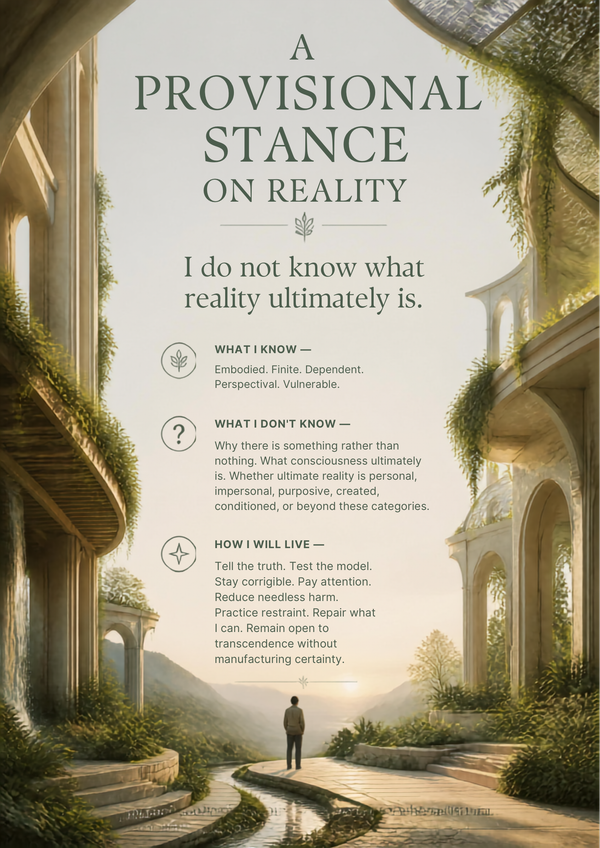
I don't know whether such a reality exists. I don't know whether existence requires an ultimate foundation at all. But I find the question difficult to abandon.
The limits of experience
Through meditation and careful observation, I became increasingly interested in how experience arises. Sensations appeared and disappeared. Attention shifted. Memory and interpretation shaped what I perceived. Even the apparent observer seemed inseparable from the processes being observed.
I could not locate an independent self standing outside experience. What I encountered was something changing, embodied, and relational.
Introspection has limits. My observations cannot establish how consciousness ultimately works, much less settle the fundamental nature of reality. But they taught me something important: an experience can be genuine without my explanation of it being correct.
I can experience love without knowing everything about the person I love. I could experience something that feels divine without knowing whether its source is God. I don't want to confuse intensity with evidence.
From contingency to the Absolute
Everything familiar to me seems to exist through relationships and dependencies. My body depends on biological processes and an environment that sustains it. My identity has developed through memory, embodiment, language, and relationships with other people.
Love can be genuine and still end. Beauty can be profound and still disappear. A moment can be fulfilling without providing permanent fulfillment. Impermanence doesn't make these experiences meaningless.
But does the entire network of dependent existence have a foundation beyond itself?
Perhaps reality simply exists without further explanation. Perhaps dependence continues indefinitely. Perhaps there is something necessary upon which everything else depends. I cannot establish which possibility is true. And even if a necessary ground exists, nothing immediately establishes that it is conscious, benevolent, or capable of relationship.
What if the Absolute is relational?
Human beings are relational creatures. Not merely because we enjoy companionship, but because relationships help constitute who and what we are. Our bodies depend upon interactions; our identities emerge through engagement with the world.
That made me wonder: if relationality is so fundamental to human existence, might the ground sustaining existence also be relational?
This is not a logical necessity. A relational universe does not demonstrate a personal God. Physical systems can be relational without consciousness or love.
Yet Christianity makes an extraordinary claim: that the ultimate source of existence is a God who knows, loves, and can be known. In Trinitarian theology, relationship belongs eternally to divine life. Through the Incarnation, Christianity claims this transcendent reality entered human history.
I find these ideas fascinating. But fascination is not conviction. I am investigating what Christianity proposes, not claiming it is true.
The frightening possibility of being known
The possibility that the ground of existence might be personal does not merely interest me intellectually. It frightens me. And it awakens something I have longed for.
I think many human beings want to be deeply known: not simply admired, but encountered in their contradictions, vulnerabilities, uncertainties, and imperfections.
What frightens me most is not the possibility of being known. It is the possibility of reaching toward that relationship, beginning to trust it, and finding only silence.
I am afraid of allowing myself to hope for something so fundamental, only to discover that the relationship existed entirely within my own mind.
That fear does not demonstrate that God is absent. But neither does my longing demonstrate that God is present.
Prayer without certainty
I have tried praying. Sometimes the prayer is little more than an admission of uncertainty. I don't know whether anyone is listening. I don't know whether the reality sustaining existence, if there is such a reality, possesses awareness or intention. But I have wondered whether it might.
An unexpected coincidence can feel significant. A moment of peace can seem like an answer. I cannot dismiss these experiences merely because they are subjective. But I cannot treat them as reliable evidence of divine communication simply because they feel meaningful.
Human perception is interpretive. We recognize patterns, construct narratives, and assign significance. I know I can become attached to an interpretation because I want it to be true.
I want to remain open to reality without deciding in advance what reality must be.
What would justify trust?
Even if I eventually became convinced that existence depends upon an ultimate ground, I would still need to investigate its nature. Is it conscious? Is it good? Is it capable of relationship? And if so, what would justify trusting it?
These questions cannot be answered merely by defining God as loving. They require philosophical examination, engagement with religious traditions, and careful consideration of what counts as evidence.
Christianity offers answers that I am beginning to explore. But I don't want to adopt those answers simply because they offer the possibility of being loved. I want to know whether they are true.
Remaining open
For now, I find myself somewhere between skepticism and hope. I cannot honestly claim to believe that God exists. But neither can I claim to have established that no ultimate ground exists, or that such a ground could not be personal.
I am willing to investigate. To study. To question. Perhaps even to pray. And to allow my understanding to change when I encounter good reasons for changing it.
I don't know whether the Absolute can know me. I don't know whether anything hears when I reach toward it. But I am beginning to recognize that uncertainty does not necessarily require me to abandon the inquiry.
I can hope without claiming knowledge. I can investigate without manufacturing belief.
Perhaps the question is not whether I can make myself believe in God. Perhaps it is whether I can remain genuinely open to discovering what exists, even when I cannot guarantee that the answer will comfort me.