Taking Experience Seriously Without Turning It into Proof
A reflection on perception, systems, and religion: how to take an experience seriously, examine its interpretation, and act without claiming more than we know.

An unanswered message can become a story very quickly. A few hours pass. There is a tightening in the chest. A sentence forms: they are pulling away. Before anyone has explained anything, silence already has a meaning.
The feeling deserves attention. The explanation still needs checking. Keeping those two things separate is one place to begin the current direction of The Living Fractal.
In September, I described this site as an archive in transition. The question now is what that transition asks of the writing itself. For me, it begins with making the distance between experience and explanation more visible.
Three different kinds of statement
Consider three sentences: “I felt afraid when no reply arrived.” “I think the silence means rejection.” “This experience reveals something fundamental about what human beings are.”
The first describes a reported experience. The second proposes an interpretation of a particular situation. The third reaches toward a much wider account of reality. Each can matter, but each asks for a different kind of support.
Even the first sentence is not a perfect recording. It is an account made in language, perhaps after the feeling has passed. Still, it makes a narrower claim than knowing another person’s intention, or knowing what all human experience ultimately is.
The trouble begins when we move between these levels without noticing. “I felt it” becomes “I know what caused it,” and then “I know what it proves.” The explanation inherits the force of the experience without having earned the same confidence.
Staying close to what happened
In the unanswered-message example, a more careful description might be: a message was sent; no reply has arrived; fear appeared; rejection is one possible explanation. The other person may be busy, unsure what to say, or choosing distance. More information is needed to distinguish those possibilities.
This does not make the fear foolish. It makes room to respond to it without treating it as a reliable report of someone else’s mind. One can acknowledge the feeling, ask a question when appropriate, and leave the explanation unfinished.
The same discipline can apply to an experience of stillness, awe, prayer, or a changed sense of self. Something may have mattered deeply. Describing that significance does not require deciding immediately what the experience establishes about consciousness, God, or the structure of reality.
What a systems model can show
Much of the earlier writing here approached human life through constraints, feedback, and the conditions that make action possible. Those questions remain useful. What demands attention? What resources are available? What is being rewarded? What happens when a person or institution has little room to recover?
A systems model can help organise these questions. But using the vocabulary of energy, feedback, or constraint does not by itself establish a mechanism. If I describe attention as a budget, I need to say whether I am offering a metaphor, a practical model, or a measurable claim. These are different uses of language.
The model should remain answerable to the situation. It can reveal a pattern while leaving out history, relationships, or meanings that matter to the people involved. If every possible outcome can be made to confirm it, I need to ask what would count against it.
That is a question I want to bring to my own archive. Earlier essays sometimes made broad conclusions from a compelling framework. Their dates and assumptions matter. Keeping them available does not require carrying every conclusion forward.
Religion, meaning, and the reach of a claim
Religion belongs in this inquiry because it raises questions about experience, practice, belonging, obligation, and what exists beyond what we can directly observe. Those questions should not be flattened into one another.
For example, someone might describe feeling held during prayer. That account matters as a description of their experience. It does not, on its own, settle the source of that feeling. Nor does identifying a possible psychological explanation settle every philosophical or theological question it raises.
The meaning a practice has in someone’s life and the truth of a claim about ultimate reality are related questions, but they are not interchangeable. I want to make room for both, with enough clarity that a reader can see which question is being addressed.
This requires care with disagreement. We can ask what supports a claim without pretending to know the whole of another person’s experience. We can also respect an experience without accepting every explanation attached to it.
Acting while a question stays open
Uncertainty does not mean that every explanation is equally good, or that action must wait for complete knowledge. It means relating confidence to the support available and recognising what remains unresolved.
A useful starting point is to ask: what happened? What am I adding to it? What other explanation could fit? What information would change my view? What can I do now that leaves room for correction?
These questions are not a universal method. Some decisions are urgent. Some circumstances leave little room for reflection. But where there is time, they can make an interpretation easier to examine and a next step easier to revise.
In the message example, that might mean a straightforward follow-up rather than an accusation. In an essay, it might mean naming a metaphor, narrowing a conclusion, or leaving a question unresolved. The practical task is to avoid making the next step carry more certainty than the evidence can bear.
The work from here
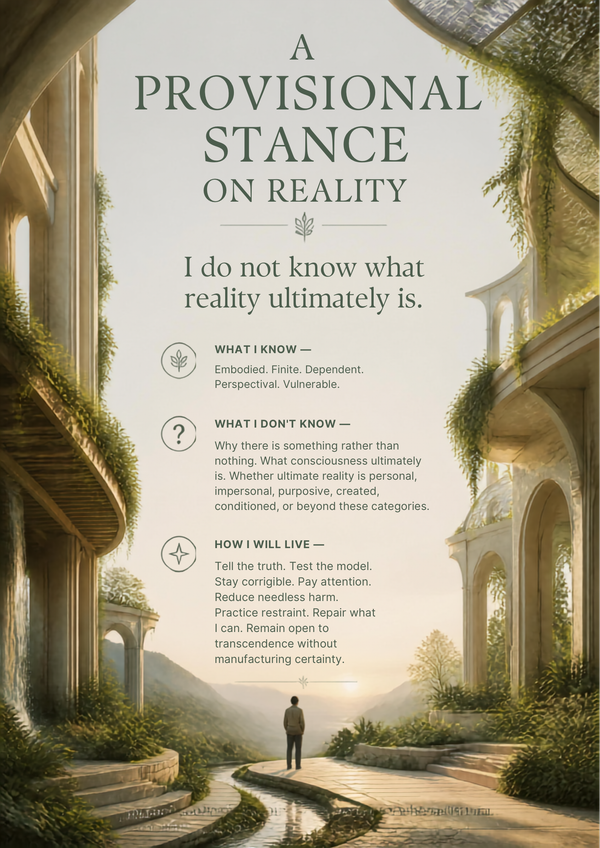
This is how I want to continue The Living Fractal: close enough to experience to take its texture seriously, and careful enough with explanation to show where a conclusion begins.
I want readers to be able to see what a piece observes, what it infers, and where it reaches into a larger philosophical or metaphysical claim. That will not eliminate mistakes. It should make them easier to locate, discuss, and correct.
An experience can change what we attend to without settling every question about why it happened. We can let it matter, examine the story we build around it, and keep listening for what that story has missed.