Seven Neighbours
On starlings at dusk, and how a flock holds together without anyone in charge.

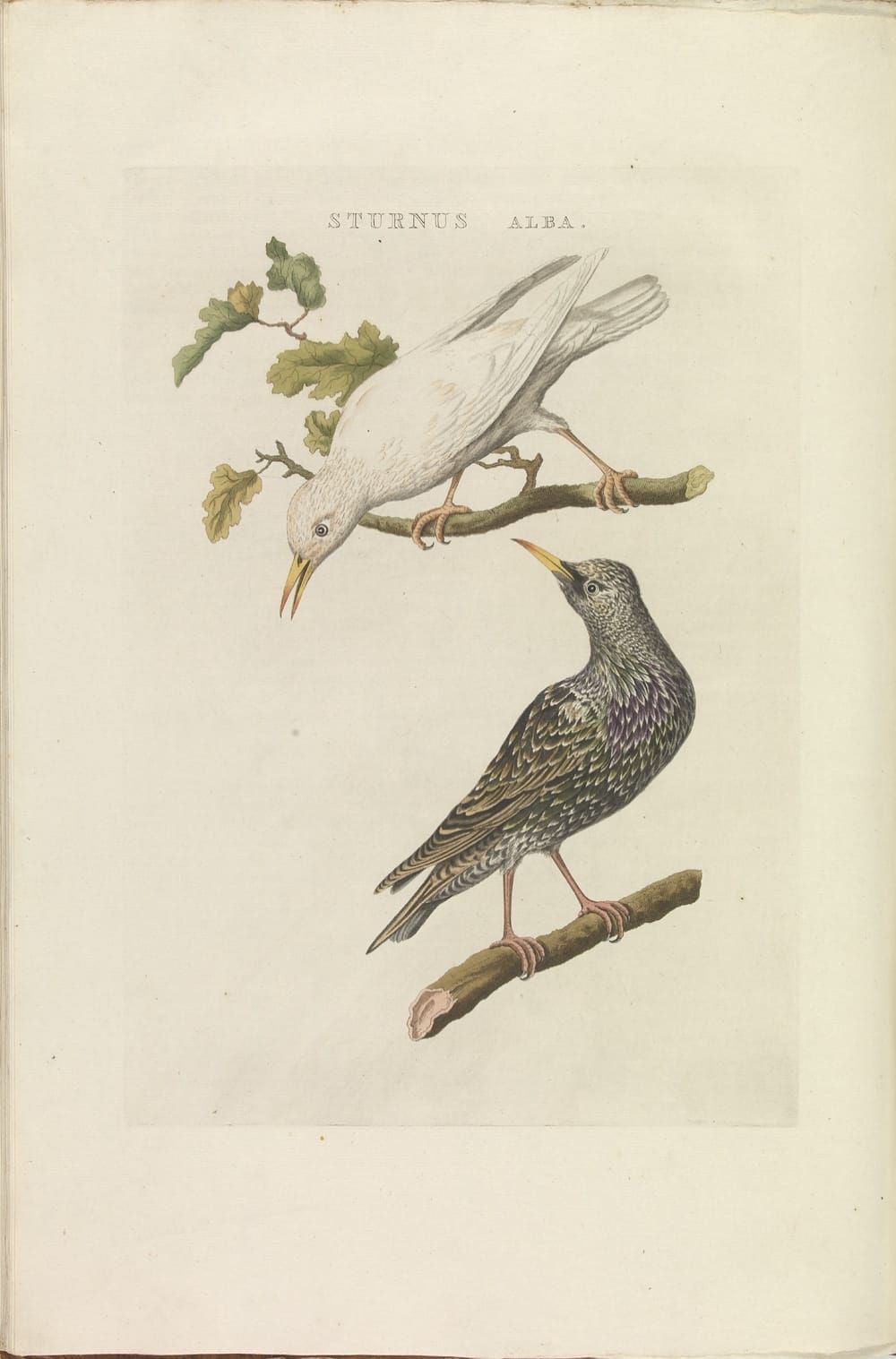
Around this time of year, in the half hour before dark, starlings gather. A few at first, then a few hundred, then a sky that seems to breathe. The flock pulls into a dark knot, stretches into a ribbon, folds over itself, thins to smoke and thickens again. Most of us have seen it at least once, on a screen if not overhead, and most of us have wondered the same thing: who is steering?
The short answer is nobody. The more interesting answer is how.
For a long time, models of flocking assumed that each bird responds to the others within a certain distance, a kind of personal bubble. In 2008, physicists and biologists in Rome, working on a project called StarFlag, tested that assumption against real flocks. Using pairs of cameras, they reconstructed the three-dimensional positions of individual starlings in flocks of a few thousand birds. What they found was not a bubble. On average, each bird was keeping track of a fixed number of neighbours, six or seven, however near or far those neighbours happened to be.
That sounds like a small distinction. It isn’t. If you follow everyone within a set distance, then when the flock spreads out you suddenly have no one to follow, and when it compresses you are flooded. If you follow your seven, the relationship holds while the distances change. The researchers argued that this is what keeps a flock whole through the sudden stretching and squeezing a predator causes, and in their simulations a count-based rule kept birds together far better than a distance-based one.
A later study from the same group found something stranger. A change of direction by one bird can be felt across the entire flock, regardless of its size. No bird sees the whole. Each sees a handful. And still, what happens at one edge reaches the other.
Why do they do it at all? In 2017, researchers at the University of Gloucestershire asked the public to report murmurations and gathered data on more than 3,000 of them, from 23 countries. A display lasted 26 minutes on average. Birds of prey were seen at almost a third of them, and when harriers, peregrines or sparrowhawks were around, murmurations tended to be bigger and to last longer. The authors concluded that murmurations are mainly a defence against predators, safety in numbers and in confusion, rather than a way of drawing more birds to a warmer roost.
That much is evidence. The rest is how I read it.
What stays with me is how modest each bird’s world is. A starling in a murmuration is not holding the shape of the flock in its head. It doesn’t need to. Its attention is local and particular: these few bodies, here, now. The shape we stand beneath and gasp at was designed by no one. It is what happens when many small, faithful attentions overlap.
Francisco Varela, Evan Thompson and Eleanor Rosch called their view of the mind enactive. In The Embodied Mind, cognition is not a picture of the world stored inside a skull. It is brought forth through a living body’s ongoing activity in its surroundings. A flock is not a mind, and I don’t want to pretend it is. But it is a good picture of how much can arise from relationship alone, with no centre and no plan.
I find that a useful thing to remember on the days when the whole feels too large. Most of us cannot hold the shape of our town, our family’s long history, or the state of the world. We were never built to. What we can do is pay close attention to our seven: the few people, animals, places and tasks that are actually near us. That isn’t a retreat from the whole. If the starlings are any guide, it may be how the whole holds together at all.
There is an old name for this. “A murmuration of starlings” is one of the collective nouns that can be traced back to fifteenth-century English lists. It describes, softly, the sound of many birds coming in to roost. Not a roar. A murmur. Many small voices, close together, at the end of the day.
Also on Substack.