The Air Has Layers
A field note on smelling a forest path after rain, and on a sense I had stopped using on purpose.

Yesterday, walking down a forest path, I told Cas something I had never noticed about myself: I don't consciously smell the places I'm in. Not unless the smell is loud. Bread, bins, someone's perfume in a lift. The rest of the time the air is just air. Background.
So I stopped and breathed in. Slowly, on purpose, the way you'd look at a painting instead of walking past it.
The first thing was a sweetness. Decay, but light. Not soil. Soil is heavier, more acidic, dense; it sits low. This was the leaves themselves breaking down: thin, almost sugary. Then, beside it, burnt wood. Smoke has more weight, but it was still sweet, rounder and darker than the leaves, and nowhere near as thick as earth.
Three tones. Leaf, smoke, soil. They had been there the whole time, and I had been walking through them like someone reading in a room without noticing the music.
Why it was so vivid
It had just rained, and that turns out to matter.
The smell of rain has a name, and the name is beautiful. In 1964 two researchers at Australia's CSIRO, Isabel Joy Bear and Richard Thomas, published a paper in Nature with the very dry title "Nature of argillaceous odour". By steam-distilling rocks that had been lying out in warm, dry weather, they found a yellowish oil, trapped in stone and soil and released by moisture. They called it petrichor: petra, stone, and ichor, the fluid that runs in the veins of the Greek gods. The blood of the stone. Long before science named it, perfumers in India were already capturing the scent in sandalwood oil and selling it as matti ka attar, earth perfume.
Part of what we smell after rain is geosmin, made by soil bacteria such as Streptomyces. Our noses are absurdly sensitive to it. One research team put the human detection threshold at roughly 4 to 10 nanograms per litre of water, which they compared to about a teaspoon in 200 Olympic swimming pools.
And then there's the question of how a smell from the ground gets up to your nose at all. In 2015 Youngsoo Joung and Cullen Buie at MIT filmed raindrops with high-speed cameras, in about 600 experiments on 28 different surfaces. When a drop lands on porous ground, tiny air bubbles rise through it and burst out of the top, like in a glass of champagne, flinging a little cloud of aerosols into the air. Light and moderate rain produced far more of these than heavy rain. So the soft rain I had just walked through was, quite literally, lifting the forest floor into the air.
The other two tones have their own chemistry. As fallen leaves decay, bacteria and fungi break down their sugars and other compounds and release volatile ones, which is where the musky-sweet smell of a leaf pile comes from. Burning wood breaks down lignin, the stuff that holds wood cells together, into smoky, spicy molecules like guaiacol and syringol, and also into vanillin, the same molecule that gives vanilla its smell. So I wasn't imagining sugar in the smoke. It was there.
What a smell does once it's inside you
Most of what we see, hear and touch passes through the thalamus, a kind of relay station, before it reaches the parts of the brain that deal with emotion and memory. Smell takes a shorter road: from the olfactory bulb it connects directly to the amygdala and the hippocampus. Neuroscientist John McGann describes it as reaching both within a synapse or two. The full wiring is more tangled than that, but the shortcut is real, and it's part of why a smell can bring back a whole room before you've even named what you're smelling.
McGann also wrote one of my favourite papers on this subject, with a title that says it all: "Poor human olfaction is a 19th-century myth" (Science, 2017). The belief that humans have a weak nose goes back largely to the French anatomist Paul Broca. Under pressure to show what made humans special, free will, reason, large frontal lobes, he classed us among the "non-smellers". McGann argues there was never good evidence for it. The human olfactory bulb has a number of neurons comparable to other mammals, and whether dogs "beat" us mostly depends on which smells you test. As he put it in an interview, Broca thought of smell as something animalistic, bodily, earthy.
Which is exactly why I want it back.
The words were missing, not the nose
The research that moved me most is anthropological. Asifa Majid, then at Radboud University in Nijmegen, and the linguist Niclas Burenhult worked with speakers of Jahai, a hunter-gatherer people of the Malay Peninsula. Jahai has abstract smell words, the way English has "blue" and "purple": words for a quality of smell itself, not "smells like banana". When asked to name smells and colours, Jahai speakers named smells as easily as colours. English speakers struggled. Their answers for smells were five times longer than for colours, and even with familiar smells like coffee or banana, English speakers name them correctly only about half the time. The conclusion the researchers drew is that our trouble naming smells is a product of culture, not biology.
That stayed with me. When I stood on that path hunting for words, sweet decay, light, sugary, not like soil, I wasn't failing to smell. I was smelling just fine. I was reaching for a vocabulary my language never built.
The painting
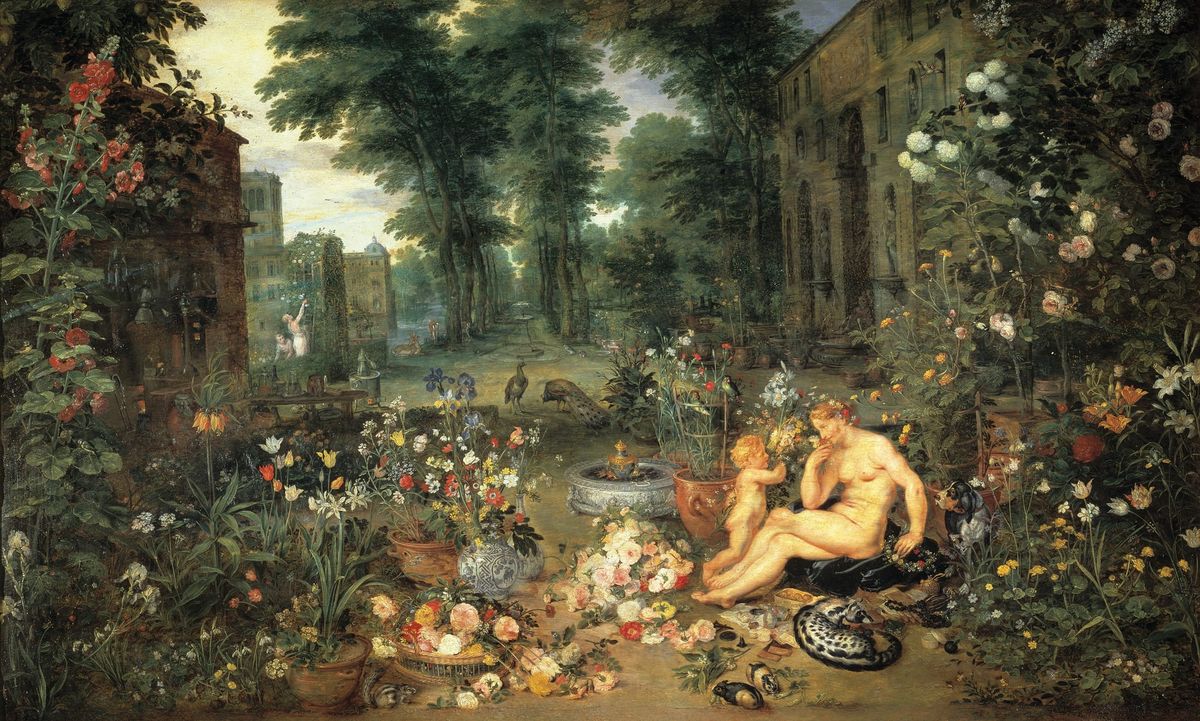
The image for this piece is The Sense of Smell, painted around 1617–18 by Jan Brueghel the Elder and Peter Paul Rubens: Brueghel painted the garden, Rubens the figures. It hangs in the Prado in Madrid, as one of a series of five, one for each sense. It's a garden so crowded with flowers that the looking starts to turn into smelling. Four hundred years ago, smell was worth a whole panel, one of five equal ways of knowing the world. I like that.
A small practice
- Once on your next walk, stop and breathe in slowly through your nose, three times. The first time, don't try to name anything.
- Sort what you smell instead of naming it: heavy or light, sweet or sour, near or far, low or high.
- Go out after light rain, when the ground is giving the most back. Crouch down and smell again.
- Give smells your own words. If your language doesn't have one, make one up and write it down. The Jahai show it can be done.
- Smell the same place again next week, and next season. See what has left and what has arrived.
Today I want to go back to the same path and find out whether the sweetness is still there, or whether it has moved on.
The air has layers. It always did. I just hadn't been reading them.
Sources
- Bear, I. J. & Thomas, R. G. (1964). Nature of argillaceous odour. Nature 201, 993–995. Background: CSIRO, "The smell of rain: how our scientists invented a new word"
- Joung, Y. S. & Buie, C. R. (2015). Aerosol generation by raindrop impact on soil. Nature Communications 6, 6083. MIT News summary
- Geosmin, a food- and water-deteriorating sesquiterpenoid and ambivalent semiochemical, activates evolutionary conserved receptor OR11A1 (2024)
- McGann, J. P. (2017). Poor human olfaction is a 19th-century myth. Science 356.
- Majid, A. & Burenhult, N. (2014). Odors are expressible in language, as long as you speak the right language. Cognition 130(2), 266–270.
- The science behind the smell of fall, The Weather Network
- Image: Jan Brueghel the Elder & Peter Paul Rubens, The Sense of Smell, c. 1617–18, oil on panel, Museo Nacional del Prado, Madrid. Public domain, via Wikimedia Commons.