What Grows Over the Names
On churchyard lichens, a partnership nobody believed in, and the patience of stone

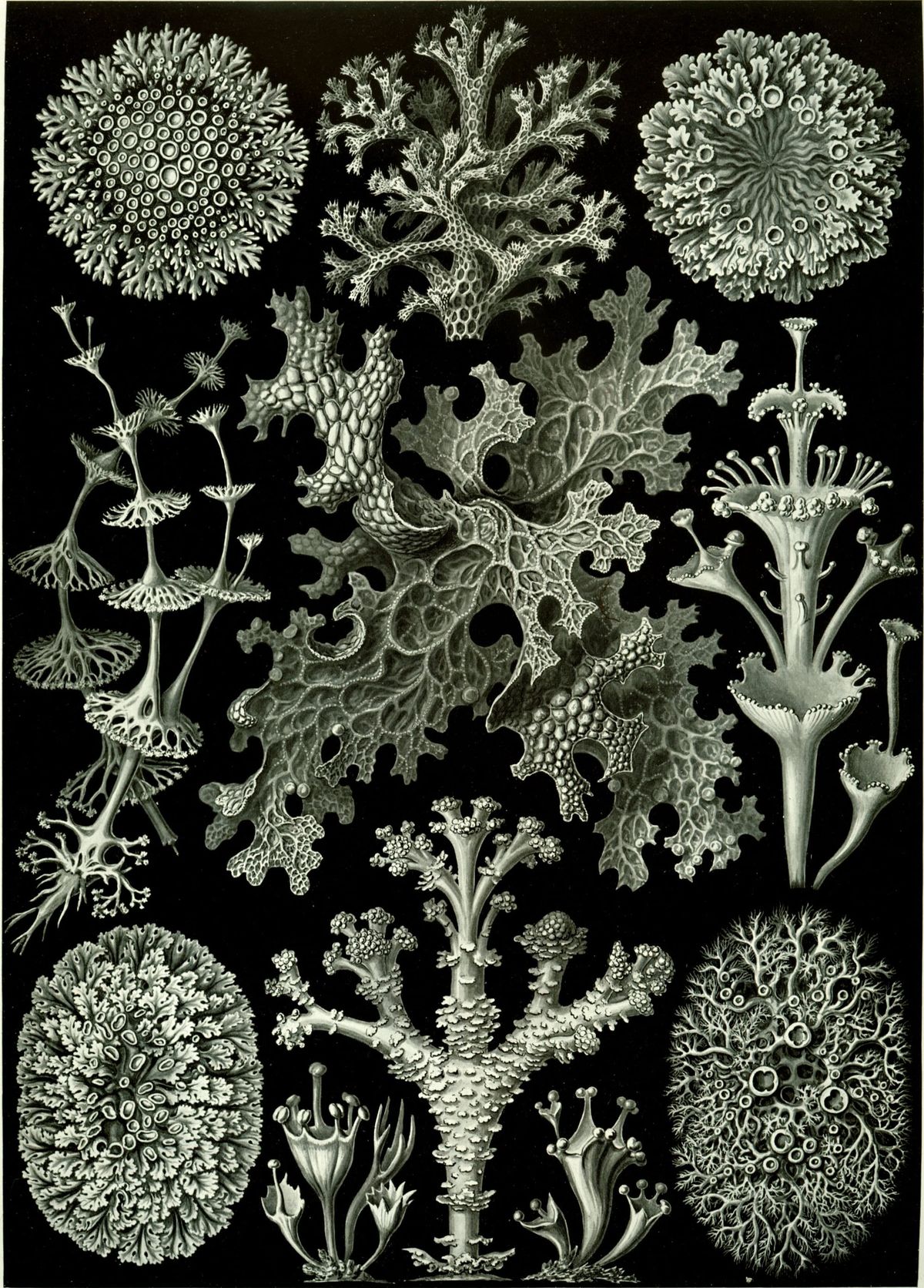
Most of us have read a gravestone through a crust of something. A pale green rosette across the dates. Orange specks in the curl of a carved letter. Grey rings, edge to edge, like coins someone set down on the stone and forgot. We tend to read past them, towards the name. But the crust is alive, and in its way it has been keeping the stone company for longer than most visitors have.
Two things that became one
For a long time, lichens were grouped with plants, or with something close to them. In 1867 the Swiss botanist Simon Schwendener looked closely under the microscope and proposed something stranger: a lichen is not one organism but a partnership. A fungus builds the body, holding water and gripping the surface. Inside it live algae or cyanobacteria, which make sugars from light and share them.
Some influential lichenologists attacked the idea for decades. It's easy to see why. It asked them to accept that something with a stable shape, a name and a place in the catalogue was really a relationship.
The story didn't end there. In 2016, a team led by Toby Spribille at the University of Montana reported in Science that many lichens carry a third partner: a single-celled yeast, found in lichens on six continents. Something studied for a century and a half had been hiding one of its members in plain sight.
I find that comforting in a quiet way. Not because anyone was foolish, but because the world keeps turning out to be more relational than our first descriptions allowed.
Why churchyards
The British Lichen Society notes that more than a third of Britain's 2,000-plus lichen species have been found in churchyards, and that many churchyards hold well over a hundred species. Where there is little natural rock, churches and their memorials are often the oldest stone structures in the landscape. Stone that is left alone becomes a refuge.
Different stones invite different lives. Limestone, sandstone, granite, the mortar between bricks: each has its own chemistry, and lichens are particular about it. From their side, a churchyard isn't a field of memorials. It's a scattered archipelago of small cliffs, each with its own sunny face and shady face, its own weather.
The pace of stone
What strikes me most is the slowness. Some species grow less than half a millimetre a year. Researchers measuring the map lichen, Rhizocarpon geographicum, in southern Iceland found an average of about two-thirds of a millimetre in diameter per year. Geologists have used rates like these to estimate how long a rock surface has been exposed. According to the British Lichen Society, some individual lichens may be nearly as old as the gravestones they grow on, and some species take hundreds of years to become established at all.
So the grey ring across a date may itself be a kind of date. A slow clock that started some time after the stone was set, and has kept going.
A marriage, or something else
Robin Wall Kimmerer writes about a rock lichen, Umbilicaria, in Braiding Sweetgrass. She describes the fungus and the alga as partners who each bring what the other lacks, and compares their union to a marriage. She is also honest that some researchers describe the same relationship as reciprocal parasitism, and that some of these partnerships seem to form only when conditions are hard.
I don't think we have to settle on one word. The fact is that two or three very different organisms live as one body on bare rock, trading sugar, water and minerals. Whether we call that love, bargaining or mutual use is interpretation, and it says as much about us as about them. What does seem clear is that none of the partners would be on that stone alone.
There's something fitting about where they settle. A gravestone is made to say: this person existed, separately, with a name and two dates. Then, slowly, a partnership grows across it. Mostly not erasing the name. Just keeping it company.
The next time you pass an old wall or a churchyard, it might be worth stopping at a single stone and looking closely, not at the words but at what has grown between them. A hand lens helps, but even without one you can see that the surface isn't blank. It's inhabited, and it has been for a long time.