A Life in Her Own Name
A small world history of unmarried women, and why I like the life I have.

A small world history of unmarried women, and why I like the life I have.
When people ask whether I’m married yet, it’s the yet I hear. It puts a little arrow through the middle of my life, pointing forward to the day it’s supposed to become recognizable. I’ve talked to women who love their children and can also tell me, in the same breath, how little time they get to themselves. I believe them about both things. When I picture their lives, I feel affection for them and relief that mine is different. It took me a while to realize how rarely I’d been invited to say that out loud.
Look back far enough and the question changes. Instead of asking why a woman would stay unmarried, I find myself asking what she would have needed to do so. Where could she sleep? Who would pay for the bread? If her father died, who could sign the papers? Who would notice if she was ill? These questions lead to some remarkable places. A courtyard in Bruges. A silk district in southern China. A library in a convent in Mexico City. A school for girls in western India. In each place, a woman’s choices depended partly on who had the keys.
A courtyard with several doors
Walk into a Flemish beguinage and the first thing you might notice is how domestic it looks. Small houses turn toward a green or a courtyard. A path leads from one door to another. Beginning in the Middle Ages, communities of beguines gave unmarried women and widows a way to live a religious life together while remaining in the world. The rules and resources varied by community. The layout gives you something the word unmarried leaves out: neighbors. UNESCO’s account of the Flemish béguinages.

Across the Channel, historian Amy M. Froide found never-married women in English towns working for wages, trading, and doing the daily work that kept extended families going. She reads their lives as a subject in their own right. That matters because a woman could be recorded as somebody’s sister and still spend most of her waking hours doing work her brother knew very little about. Enabling conditions differed even between neighbors. A woman with savings and a woman whose lodging depended on service to an employer could both be entered in the historical record as single. The word tells us very little about how freely either could use her time. Froide, Never Married.
What silk wages could buy
Between about 1860 and 1930 in the Canton Delta, paid work in the silk industry gave some women room to negotiate how marriage would change their lives. Janice E. Stockard traced the connection through interviews and the history of silk production. In some districts, a bride could remain in her natal home for years after the wedding. Other women resisted marriage itself. A wedding and a move into a husband’s household could be two distinct events, with a woman’s working life continuing in the interval. Stockard, Daughters of the Canton Delta.
I keep thinking about how concrete this freedom was. A woman had somewhere to go in the morning, a skill that earned money, and people with whom she shared the work. Her bargaining power depended on the local economy and could change when the work did. If you tell the story solely as one of unusually brave women, the silk disappears. Then the next generation is left wondering why courage alone doesn’t pay for a room.
A library inside the convent
In seventeenth-century Mexico City, Sor Juana Inés de la Cruz took vows in the convent of San Jerónimo. There she wrote poetry, plays and prose, and famously defended women’s learning in her Respuesta a Sor Filotea. The convent offered her the time and surroundings to study and write, under religious obligations that also shaped what she could say and to whom. That arrangement belongs to its own world. The part I recognize is the desire for enough uninterrupted time to follow a thought wherever it goes. Poetry Foundation’s biography.
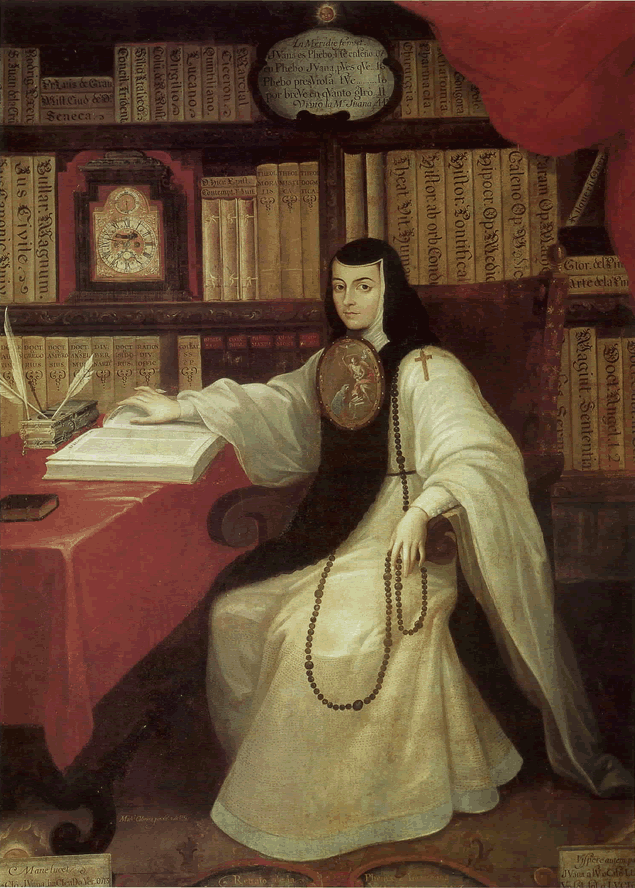
In Miguel Cabrera’s portrait, painted decades after her death, the books are packed behind her. One lies open under her hand. She looks out toward us as if we’ve arrived partway through her reading. This is also a picture of how a later generation wanted to remember her. I’m glad they gave so much of the canvas to the books.
Girls who had already been wives
Pandita Ramabai had a daughter and was widowed young. In 1887 she published The High-Caste Hindu Woman, writing about child marriage and the lives of high-caste Hindu widows. She went on to establish Sharada Sadan, a school that offered education to girls including child widows. I put her beside the women who never married because her work forces a different question: how young could a girl be when the course of her life was settled for her? Her pupils could be unmarried now and still living with the consequences of a marriage they’d had almost no power to refuse. Boston University’s biography of Ramabai.
A school offered more than a set of lessons. To be expected in a classroom the next morning was to have a future that people could begin to plan for. Ramabai was writing from a specific caste position in a specific historical moment. I want to keep that specificity, and also to notice the scale of what she was asking adults to do: make room for a girl’s life to continue after the community had already given it a name.
Who gets to continue a family?
In Male Daughters, Female Husbands, Nigerian anthropologist Ifi Amadiume describes historical practices in Nnobi, an Igbo community in present-day southeastern Nigeria. Some daughters could occupy a role in their natal lineage customarily associated with sons. Some women could take wives and hold the social position of a husband. These arrangements concerned kinship and descent, and make the English words wife and husband do work that readers may find unfamiliar. Amadiume’s study is rooted in one place. It asks a question that travels well: who has the authority to carry a family forward, and what forms can that authority take? Amadiume’s study in Yale’s eHRAF archive.
Even across these few places, household arrangements are astonishingly various. Some women had wages but little say at home. Others had status through a religious community, or a role that came with duties to a lineage. I’ve used unmarried as a door into these histories. Once inside, there are women who never married, women who had been widowed, and women whose legal status barely describes their daily lives. We would need to sit with each one for a long time to know which parts of her life she would have kept if she’d been free to decide.
The freedom to come home
It’s easy to think of that question as safely historical. UNICEF’s 2025 reporting puts the number of girls married before eighteen at around twelve million each year worldwide. An Immigration and Refugee Board of Canada review of reporting from India, covering 2022 to October 2024, describes barriers single women can face in securing housing, including in major cities. An adult can have a formal right to remain single and still struggle to find a landlord willing to rent to her. The room and the key keep turning up. UNICEF reporting. Immigration and Refugee Board of Canada review.
The word choice has to make room for a woman who dearly wanted children and couldn’t have them, a woman who is still deciding, and a woman who likes the shape of her days as they are. Their lives can look identical when someone counts the heads in a household. The same freedom that lets me say I don’t want children also makes me want mothers to have more time, practical help and room for the parts of themselves that have nothing to do with parenting. A family can be loved deeply and still need more support than it gets.
As for me, I like being unmarried and childless. I like walking long enough to see the light change. I like the thought of a home with a table big enough for dinner and for books to lie open at the same time. I like a quiet evening I can give wholly to something I’m curious about. Other people make room for those things inside family life. The particular freedom I enjoy is being able to arrange a day around them, then decide when and how I want company. The pleasure is very ordinary, which is probably why it took me so long to take it seriously.
A shelf to begin with
- Never Married: Singlewomen in Early Modern England by Amy M. Froide. Start here for the work, kinship and households an archive organized around marriage can hide.
- Daughters of the Canton Delta by Janice E. Stockard. Read for the connection between a changing industry and what women could negotiate at home.
- Male Daughters, Female Husbands by Ifi Amadiume. A book to read slowly, especially when the kinship terms seem most familiar.
- The High-Caste Hindu Woman by Pandita Ramabai. An 1887 work of advocacy whose urgency still comes through.
- The Answer / La Respuesta by Sor Juana Inés de la Cruz. Her defense of women’s study makes a fine companion to the portrait of her with a book open.
Sometimes I come home from a walk with a question about a thing I’ve passed a hundred times. There’s still light at the window. I can put the kettle on, pull a book down, and see where the question takes me. That’s part of the life I’m choosing. I’d like to be asked how it’s going.