A Smell Meant for Someone Else
On rain, soil bacteria, springtails, and overhearing a conversation in the ground

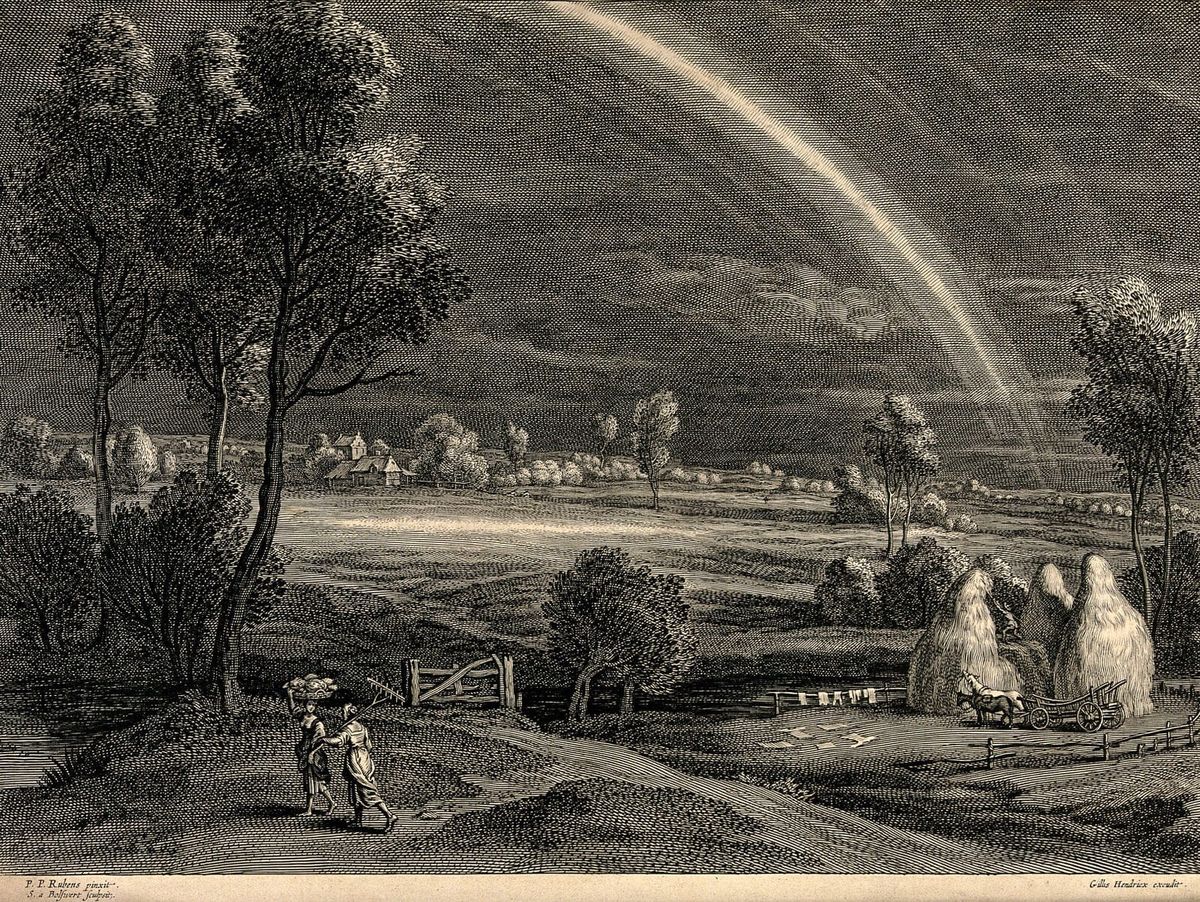
Most of us know the smell before we know its name. Rain starts after a dry spell and something rises off the ground: earthy, a little sweet, like a cellar door opening. It is one of the few smells people seem to agree on liking.
It has had a name since 1964. Two Australian scientists, Isabel Joy Bear and Richard Thomas, wrote about it in Nature and called it petrichor, from the Greek for stone and for ichor, the fluid said to run in the veins of the gods. Before that it was known as “argillaceous odour,” which is accurate and nobody’s favourite phrase.
Part of the smell is plant oils that collect on rock and soil in dry weather. The earthy note comes from a molecule described a year later: geosmin, literally “earth smell.” It is made by soil bacteria, above all a group called Streptomyces, the same thread-like bacteria that have given us many of our antibiotics.
The rain doesn’t make the smell. It lifts it. In 2015, researchers at MIT filmed raindrops landing on porous surfaces with high-speed cameras. A drop traps tiny bubbles of air against the ground. The bubbles rise through the drop, burst at the top, and throw a fine mist upward, carrying some of what was in the soil with it.
Our noses are strangely good at geosmin. The figure usually given is a few parts per trillion. It is the same molecule that makes beetroot taste of earth and some freshwater fish taste of mud.
Last week I added one line about this to my Atlas of Ordinary Wonders, and I keep coming back to it. Because the obvious question is: why would a bacterium bother to smell of anything?
In 2020 a study in Nature Microbiology offered an answer. The researchers baited traps with Streptomyces and caught springtails, six-legged soil animals a millimetre or two long that most of us have never knowingly seen. In the lab, the antennae of one springtail species responded to geosmin directly. The springtails came to the smell and ate the bacteria. Spores stuck to their bodies, and other spores passed through their guts and came out alive in their droppings. And the bacteria switched on the genes for the smell only when they were making spores.
That is what was observed. The researchers’ reading of it is that the smell is a signal. The bacterium can’t move, so it advertises a meal to something that can, and its spores leave with the guest. They suggest the arrangement may be several hundred million years old.
Here is my own reading, which goes further than the paper does. The smell I like so much was never addressed to me. I’m overhearing it. Something is being said in the ground between a bacterium and an animal the size of a comma, and I happen to have a nose that can pick it up.
I think this is what Jakob von Uexküll meant by Umwelt: the world as it shows up for a particular creature, built from what its senses make matter. One molecule, at least three worlds. To a springtail it means food. To a fruit fly, according to other research, it is something to avoid. To me it means the weather has turned and the path will be soft.
Nobody has settled why humans are so sensitive to it. There are guesses, and I’d rather leave them as guesses.
I walk the same paths most days, and November gives me plenty of rain to walk them in. What reaches me on those walks is the edge of a very old arrangement: a bacterium ready to travel, and something small on its way to dinner. I’m not part of the deal. I just get to stand in it.
— Daphne
This piece also goes out as a letter on Substack. For the small daily things, photos, words and questions, come sit with us in The Way on Telegram.
Read next · The boundary was never a wall follows another relationship across scales, through mushrooms, membranes, and the in-between.