Something Happened to the Ocean Floor
A seam of clay, a burst of ancient carbon, and what deep time asks of a species in a hurry.


A seam of clay, a burst of ancient carbon, and what deep time asks of a species in a hurry.
About 56 million years ago, the ocean floor lost some of its chalk. You can see the loss in cores drilled from the South Atlantic. A run of carbonate-rich sediment gives way to a layer of clay. The clay looks like something the ocean put there. Part of the story is what the ocean took away.
For millions of years, tiny organisms have built shells out of calcium carbonate. When they die, some of those shells sink and become part of the seafloor. In the early Eocene, a large release of carbon warmed the planet and changed the chemistry of the ocean. More of the calcium carbonate dissolved. The shells could still fall. Fewer could stay.
The ocean has more than one clock
In a 2005 Science paper, James Zachos and colleagues looked at five South Atlantic sites from roughly 2.7 to 4.8 kilometres below the sea surface. They estimated that the depth below which calcite generally fails to accumulate moved upward by more than two kilometres in under 10,000 years. It took more than 100,000 years to recover. That is the recovery of one ocean-chemistry boundary, measured from sediments. It gives us a sense of how differently the onset and the aftermath can run. Zachos et al., 2005.
Under 10,000 years sounds impossibly slow until you put it beside the thing that followed. Then it becomes the fast part. A single human lifetime barely registers against either number. Yet a human lifetime is long enough to see a shoreline retreat, a growing season shift, or a well that always supplied water start to run dry. Each clock is telling the truth about something different.
In 2016, Richard Zeebe, Andy Ridgwell and James Zachos estimated that the initial carbon release during this episode, the Paleocene–Eocene Thermal Maximum, took at least 4,000 years. They compared its estimated sustained rate with human-caused emissions in 2014. The modern rate was roughly an order of magnitude higher. That comparison depends on what ancient sediments can resolve and on how the researchers reconstruct the event. It concerns the pace of release. The ancient world had a different starting climate, and the comparison by itself cannot tell us how much warming lies ahead. Zeebe, Ridgwell & Zachos, 2016.
The last six seconds
Give Earth’s 4.54 billion years a single day. The clay seam belongs around 11:42 p.m. Our species, Homo sapiens, occupies roughly the final six seconds. In that sliver are all the people who ever tried to get home before the rain, all our names for the moon, and the few generations that built economies around burning fossil carbon. USGS, age of Earth and Smithsonian Human Origins Program.
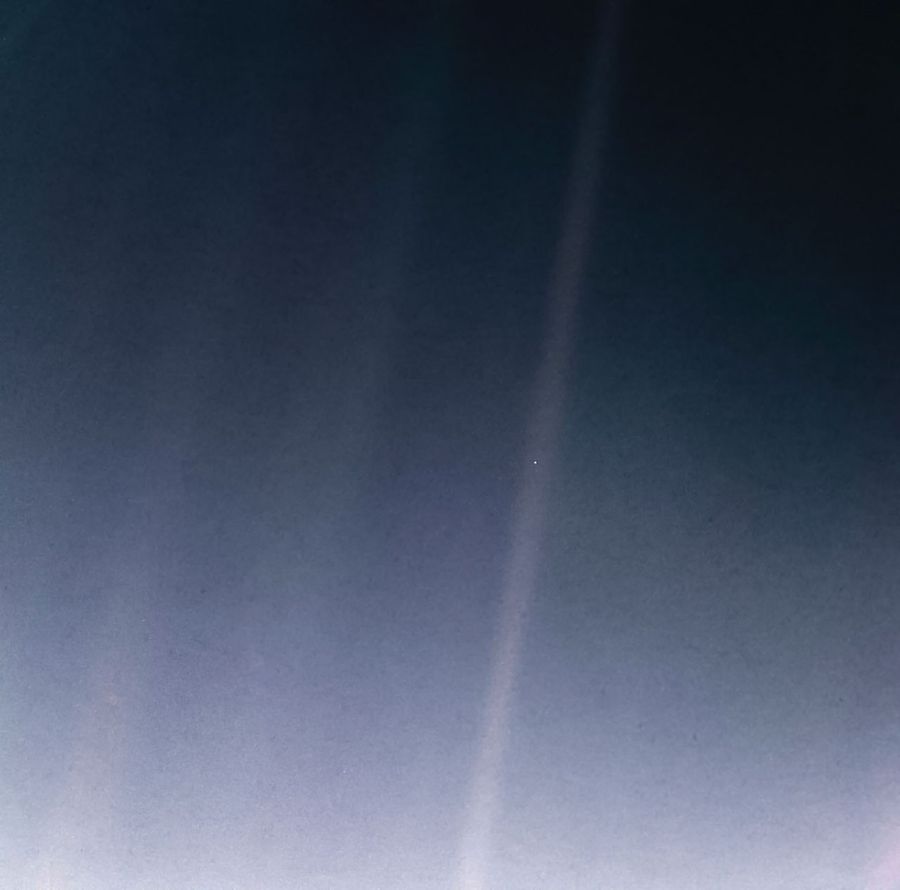
Pale Blue Dot Revisited. Voyager 1 photographed Earth in 1990. Kevin M. Gill reprocessed the image for the 2020 release. Courtesy NASA/JPL-Caltech. Image source.
On Voyager’s photograph, everybody fits in the same point of light. That makes it tempting to speak of humanity as if we’d all made the same choices. Zoom back in and you can see who built the infrastructure, who profited from it, who relies on it to get to work, and who has the least money to move when the water comes. The IPCC finds that historical and ongoing contributions to warming vary widely across and within countries. Deep time gives us a shared address. It doesn’t give us equal responsibility for what happens there. IPCC, 2023.
What will still be working?
A person looking ahead from the Eocene would have had no idea what kind of world would follow. We have a different problem. We can measure some of the consequences of what we’re doing, and still make decisions on a timetable that ends with a budget, a contract or an election. The gap between those timetables is where a lot of climate policy lives.
Think of a river in a dry summer. The questions that matter are wonderfully ordinary. How much water is left? Who gets to use it? What has to stay in the river for the things that live there? Those questions need answers before anyone knows what the river will look like a century from now. They also need answers that can be revised when five summers tell a different story from fifty years of records.
There’s a question I’d like to borrow from the clay seam and bring back to the scale of a street or a riverbank. When we make a decision today, what are we asking to keep working after we’re gone? A floodplain that can fill with water again. Soil that can hold it a little longer. A river cold enough for fish in August. Each has a timetable of its own. We’re here for six seconds. That’s enough time to change what the next seconds inherit.