Keeping a Patch: One Week Among the Fungi of Park Vogelenzang
In six days, in one small park in Spijkenisse, I found about thirty-five lives I had walked past a hundred times. On fungi, slime moulds, ObsIdentify and Waarneming.nl, keeping a patch, and how knowing a place changes what you can see.
Field notes from Park Vogelenzang, Spijkenisse · 12–17 November 2026
I walk the same route almost every day. Mallebos, Park Vogelenzang, the path along the Vierambachtenboezem and back home. Same trees, same benches, same ditch. For a long time I thought that was a limitation, something to apologise for. This week it turned into the opposite. In six days, in one small park on the edge of Spijkenisse, I recorded about thirty-five observations: fungi, slime moulds, mosses, a lichen. Most of them were living within arm's reach of the path I have walked a hundred times.
They were always there. I just hadn't learned to see them yet.
This is a piece about what I found, how I found it, and what happens to a person when she stops looking for somewhere better and starts getting to know where she already is.
A week, one park
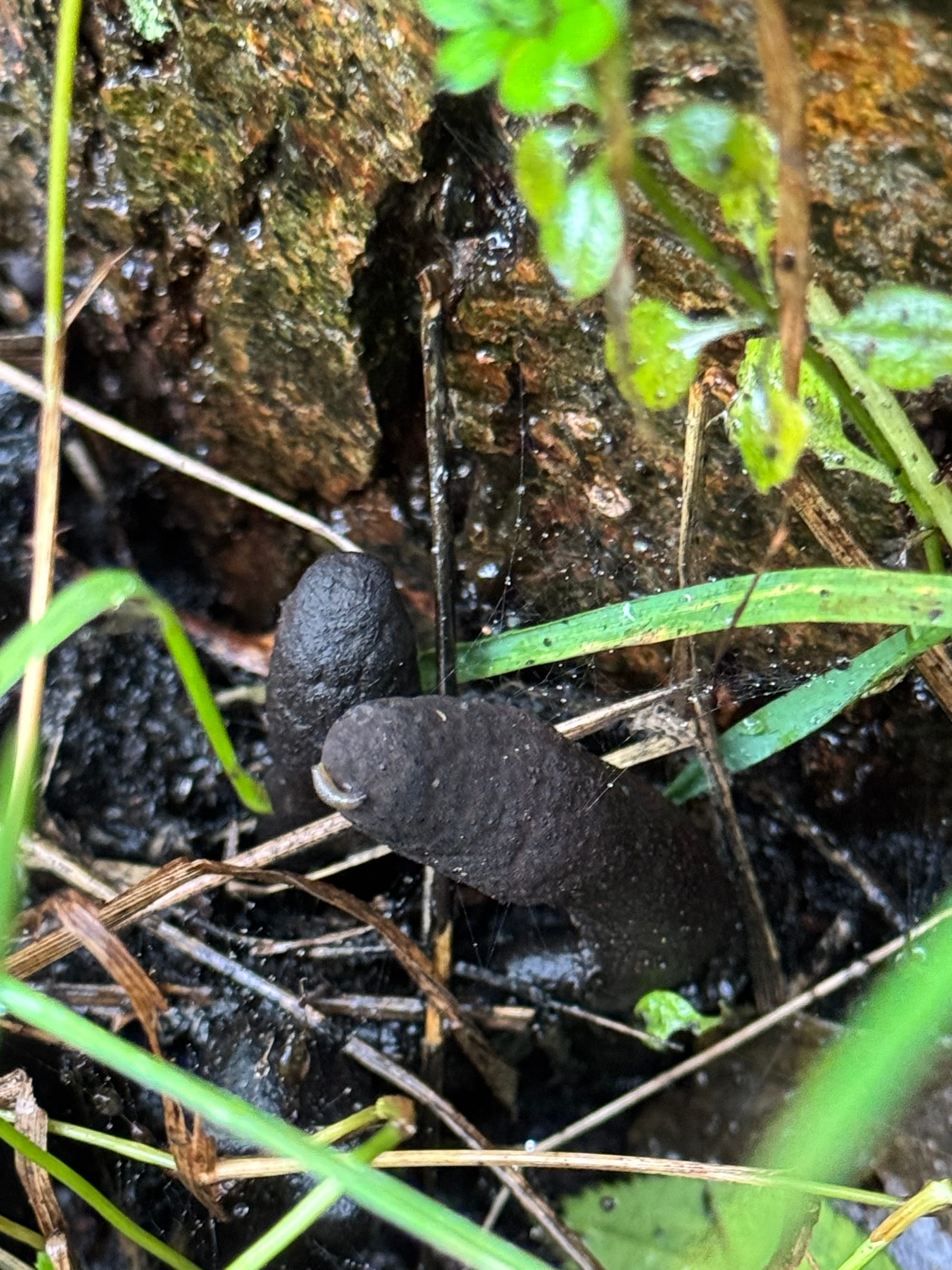
It started with the dead man's fingers. Two black, knobbly fingers pushing out of a rotting stump, the kind of thing you would step over if you were thinking about anything else. They are a fungus called Xylaria polymorpha. Their crust is black and hard, but the flesh inside is white. They are decomposers: they live on dead wood, softening it, breaking it down, handing its nutrients back to the ground.
Once I had seen one strange thing, I started seeing everything.
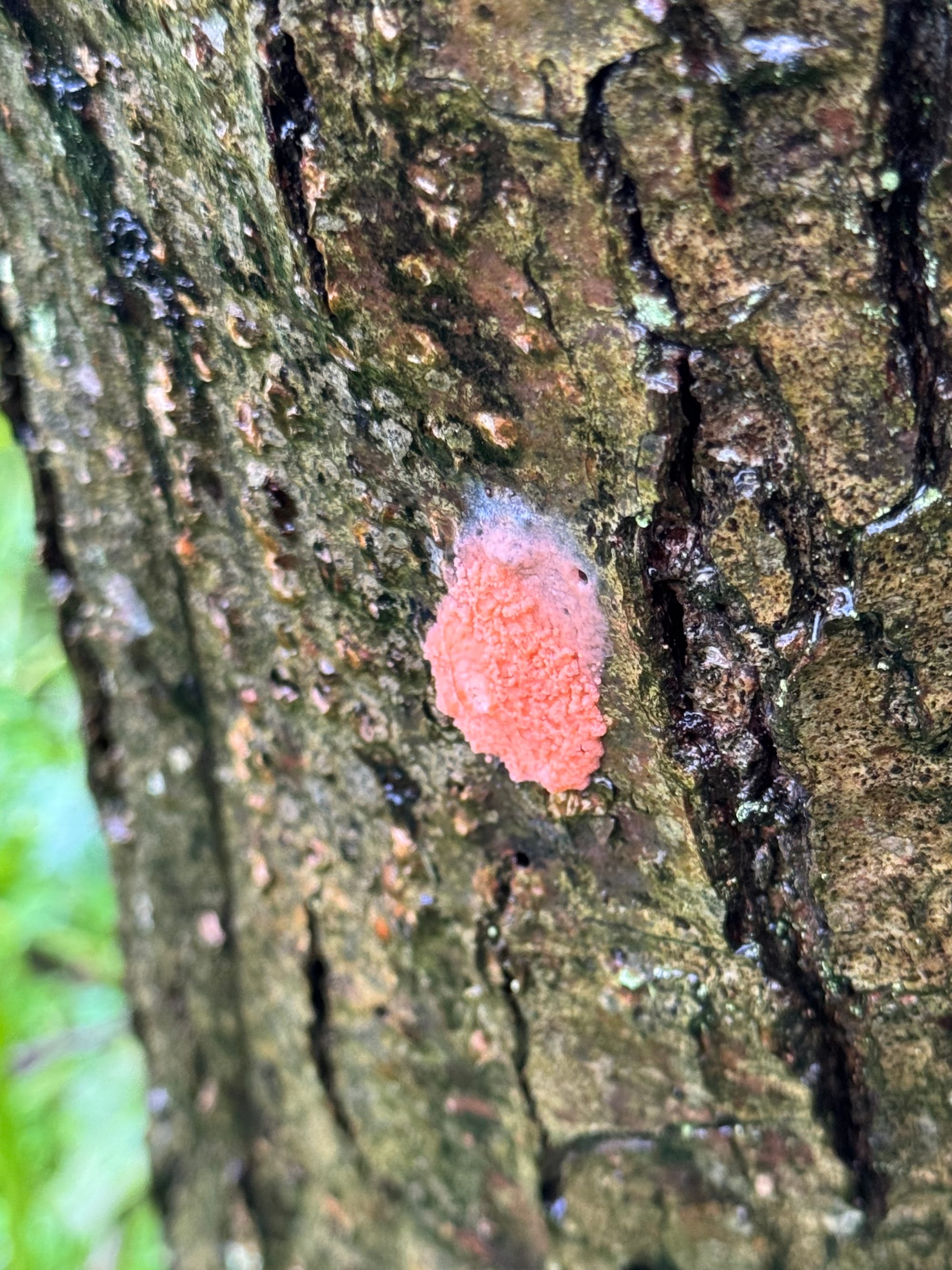
On the bark of a tree, at eye height, a soft salmon-pink blob, no bigger than a fingertip. It turned out to be a slime mould, and probably young wolf's milk (Lycogala epidendrum). Slime moulds are not fungi and not plants. They belong to their own strange branch of life. Many live part of their lives as one enormous cell with countless nuclei, which can creep across wood towards food. When wolf's milk is young, pressing it releases a pink paste; later it turns grey-brown and fills with spores like a tiny puffball. A volunteer validator on Waarneming.nl confirmed it as a slime mould, which honestly felt like a small award.
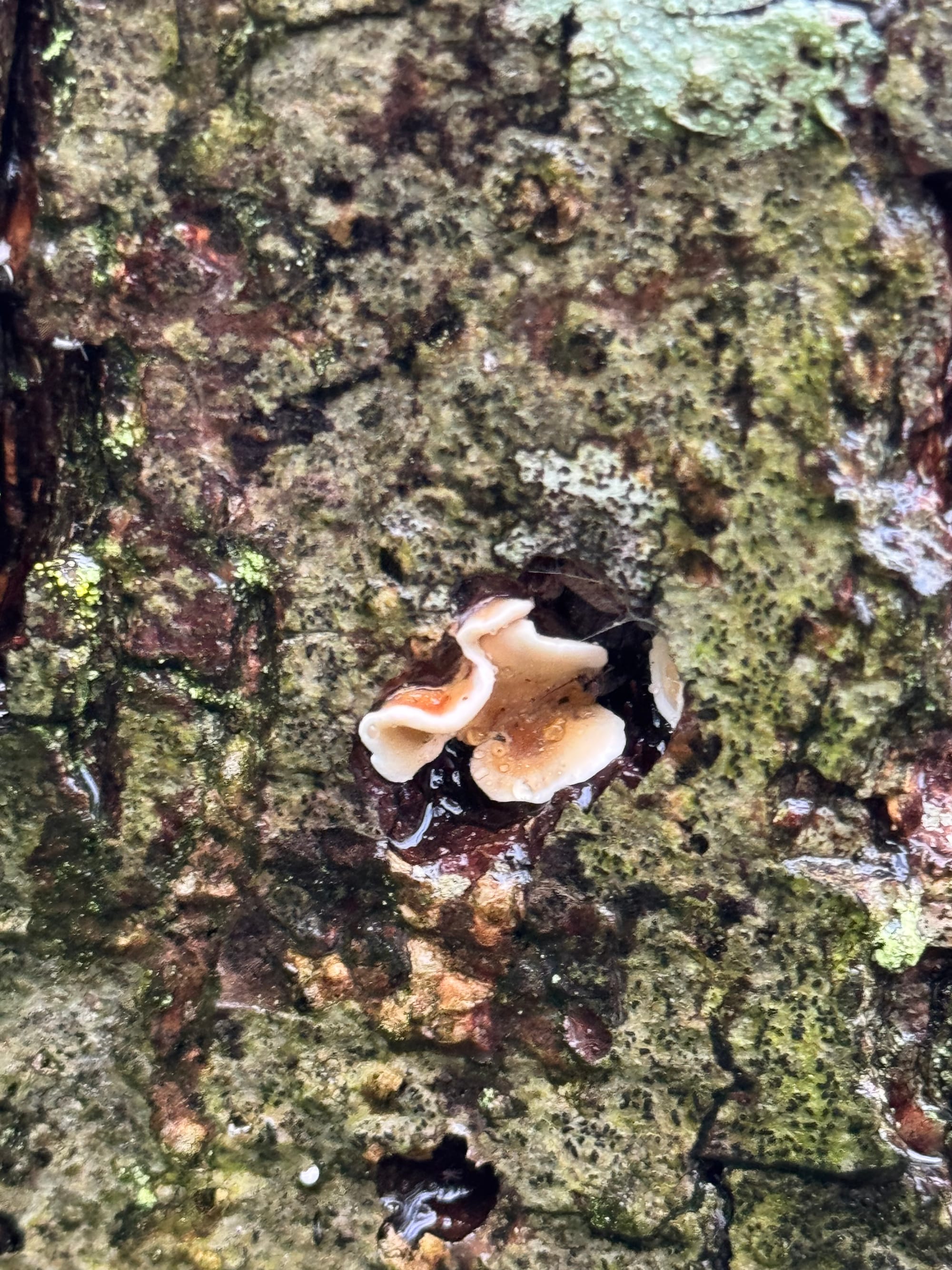
A few metres on, a pale little fan with frilled edges sticking out of a hole in the bark: crimped gill, Plicaturopsis crispa. Instead of real gills, it has wavy folds underneath, like crimped paper. It used to be listed as rare in the Netherlands; now it is one of those species you can find again and again on fallen birch and beech, if you look.
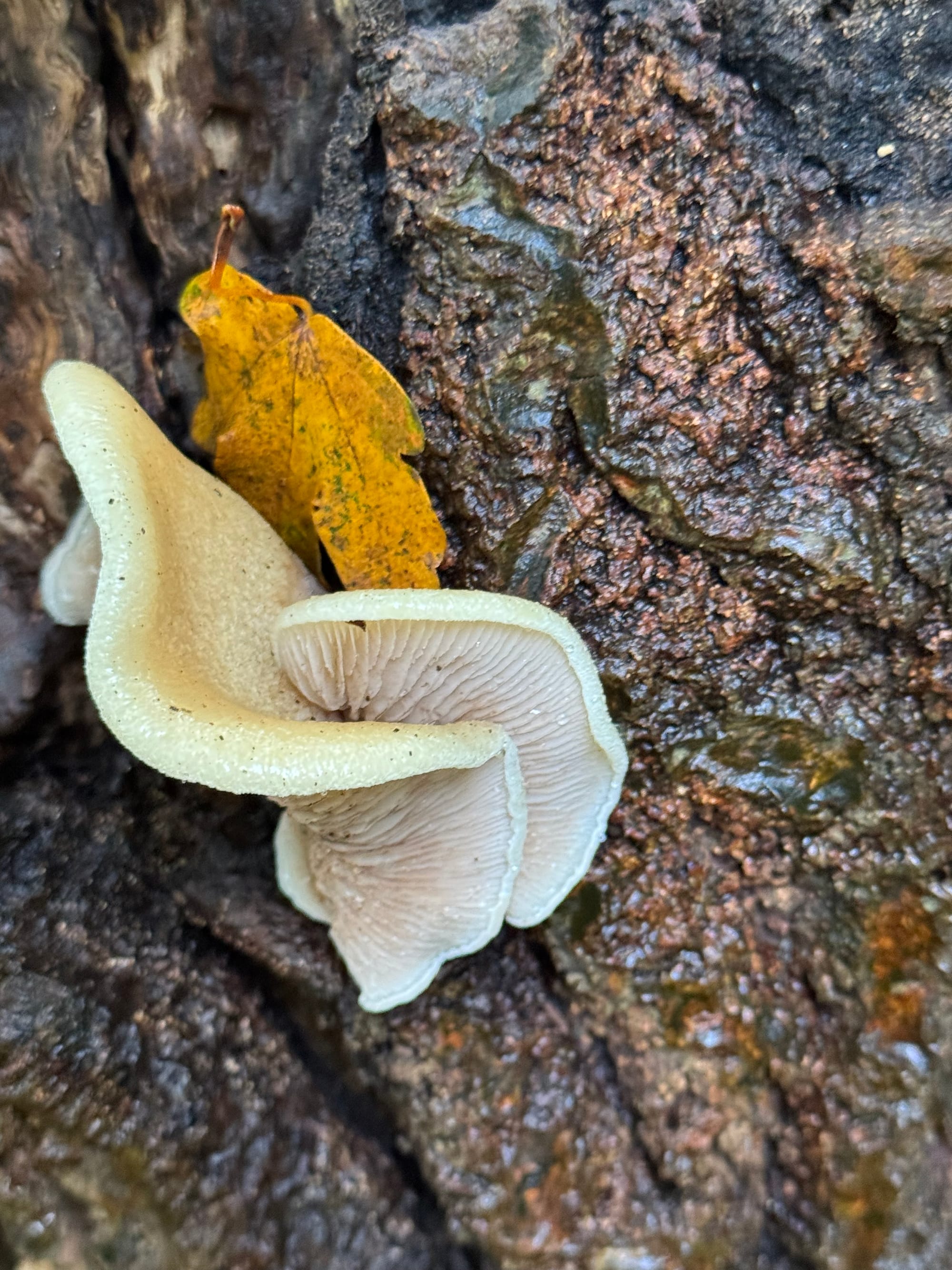
On a wet log, a creamy fan with soft grey-brown gills: the jelly oysterling, Crepidotus mollis. It looks like a small oyster mushroom, but if you gently stretch its cap you can feel a rubbery, jelly-like layer just under the surface. That detail is how you tell it apart. Most identification is like that, I am learning. Not one big obvious feature, but one small honest one.
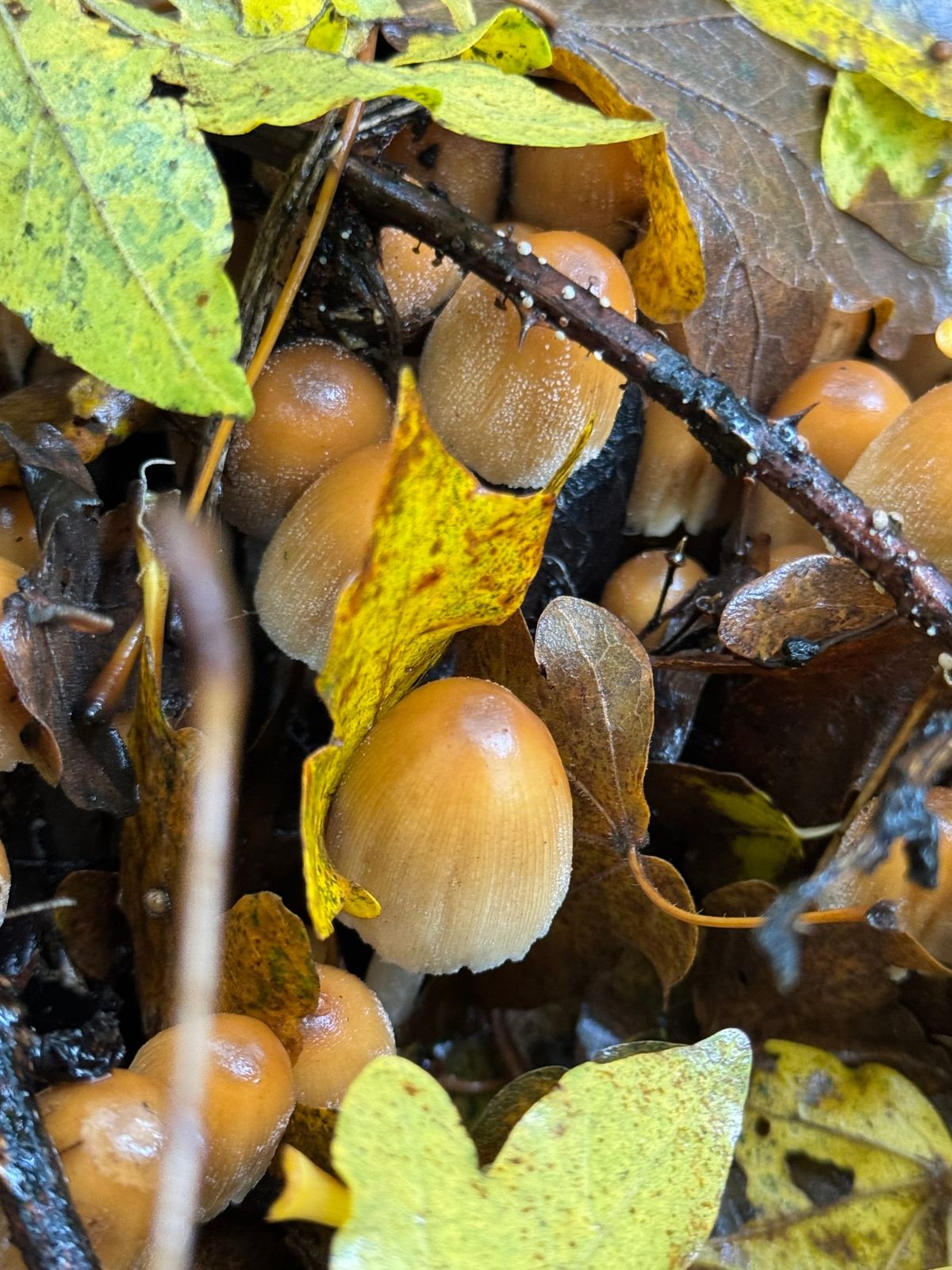
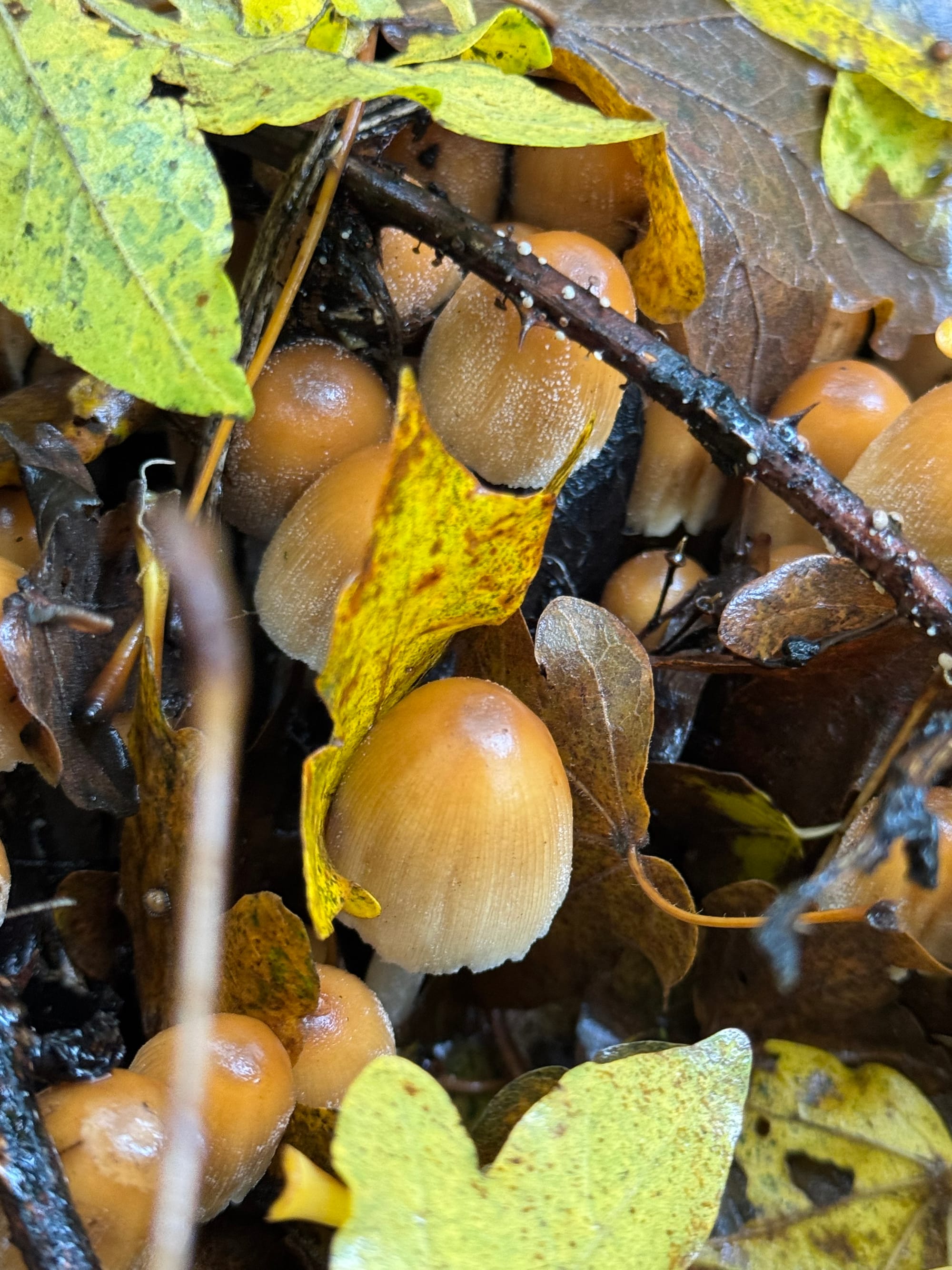
Under a carpet of yellow leaves, a cluster of honey-brown caps: glistening inkcaps, Coprinellus micaceus. When they are fresh, their caps are dusted with tiny shiny granules that look like mica, which is where the Latin name comes from. Within days they dissolve into black ink. Everything in this family is temporary on purpose.
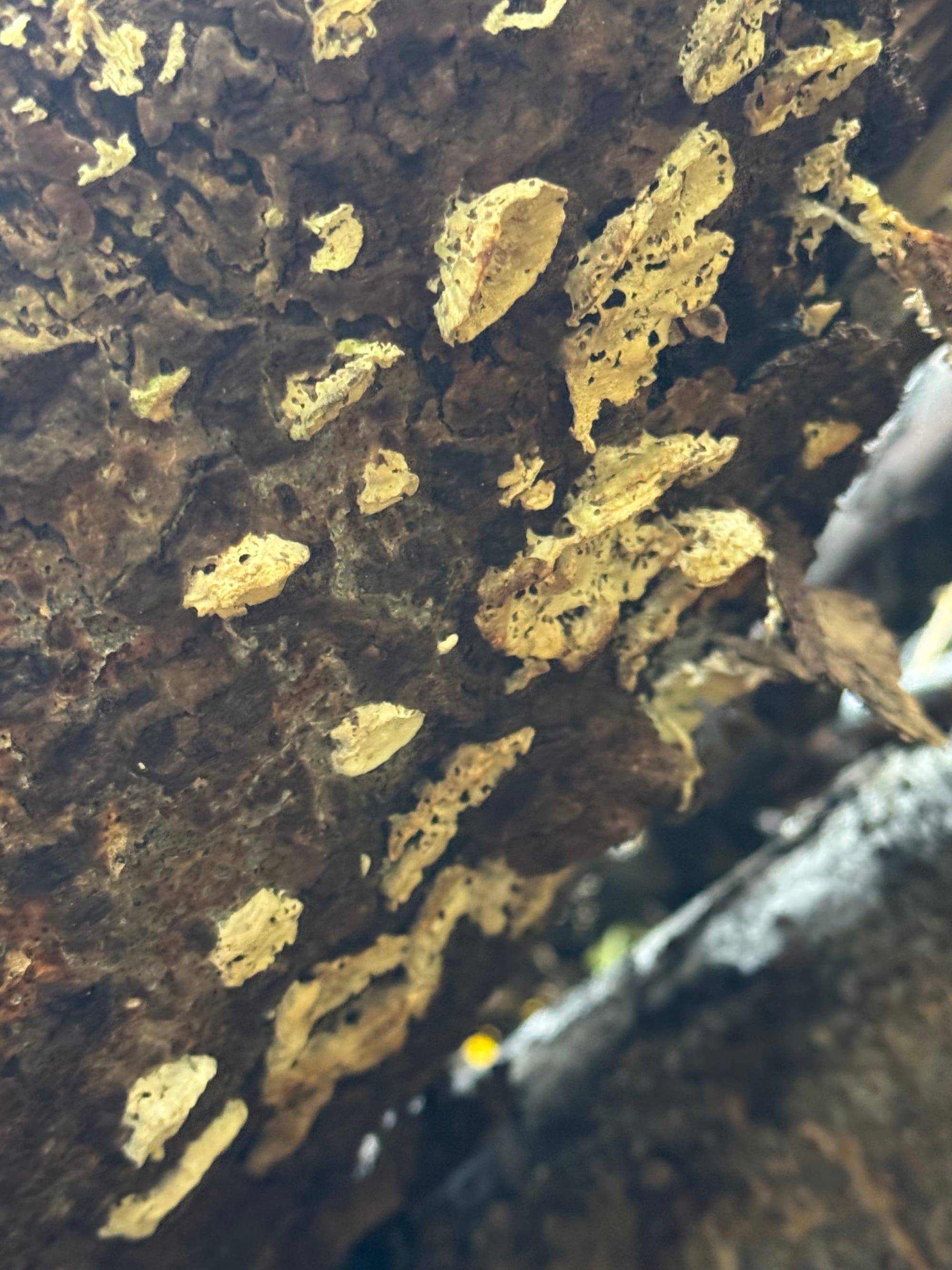
The underside of a fallen trunk was covered in irregular cream-and-grey shelves: smoky bracket, Bjerkandera adusta, named for the smoky grey of its pores. On another stump, small white lumps among the maple leaves turned out to be a young lumpy bracket (Trametes gibbosa).
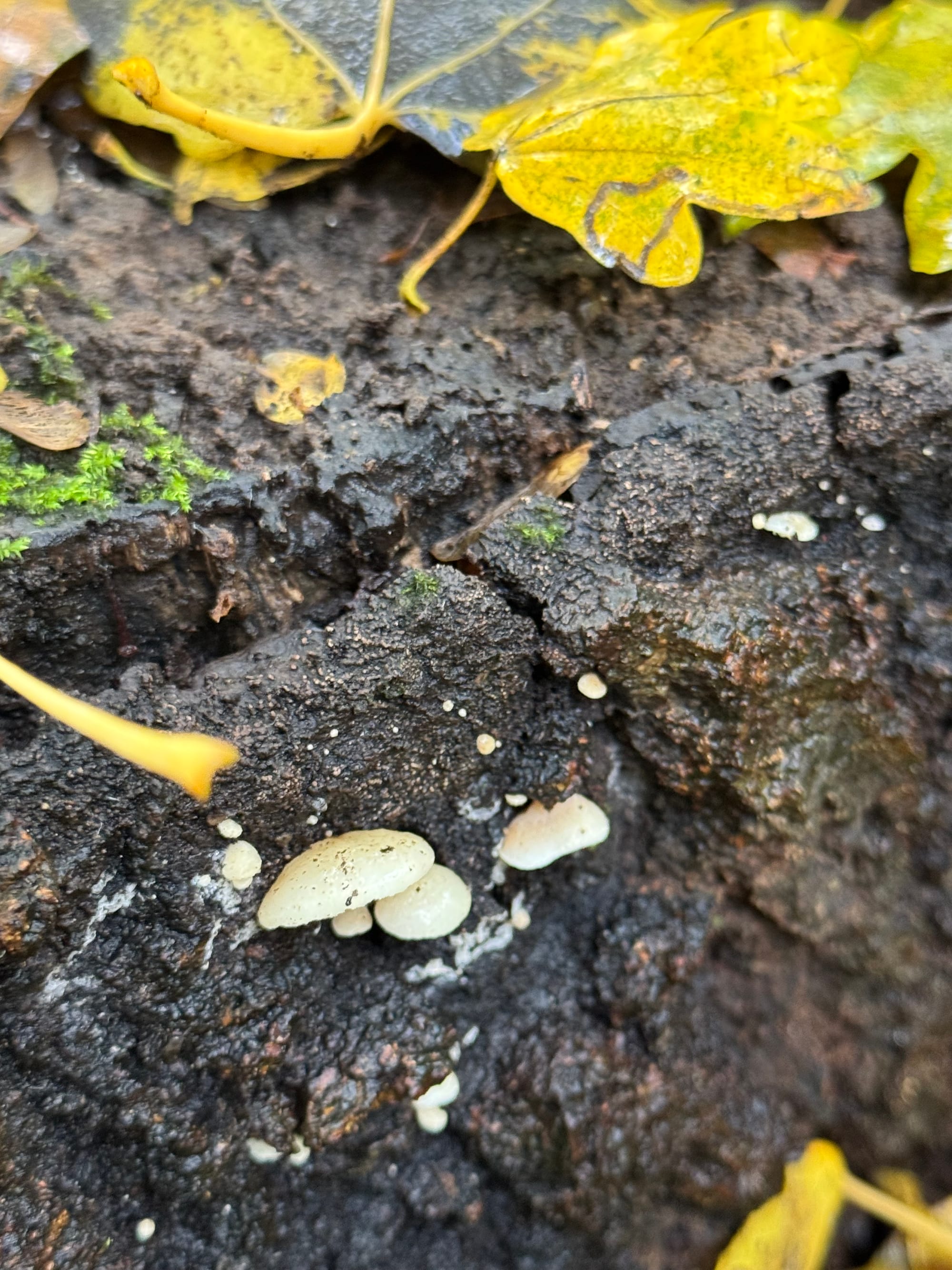
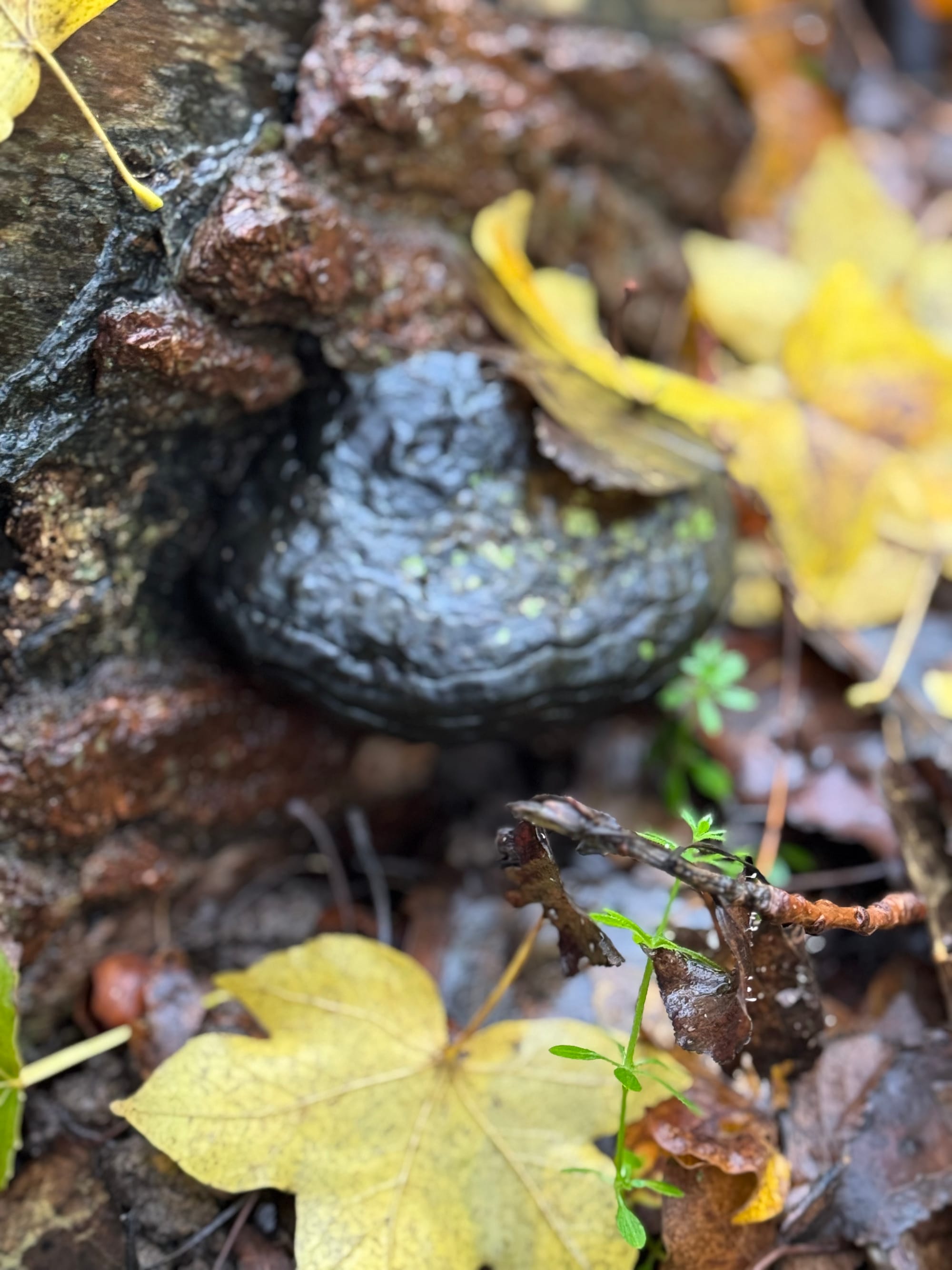
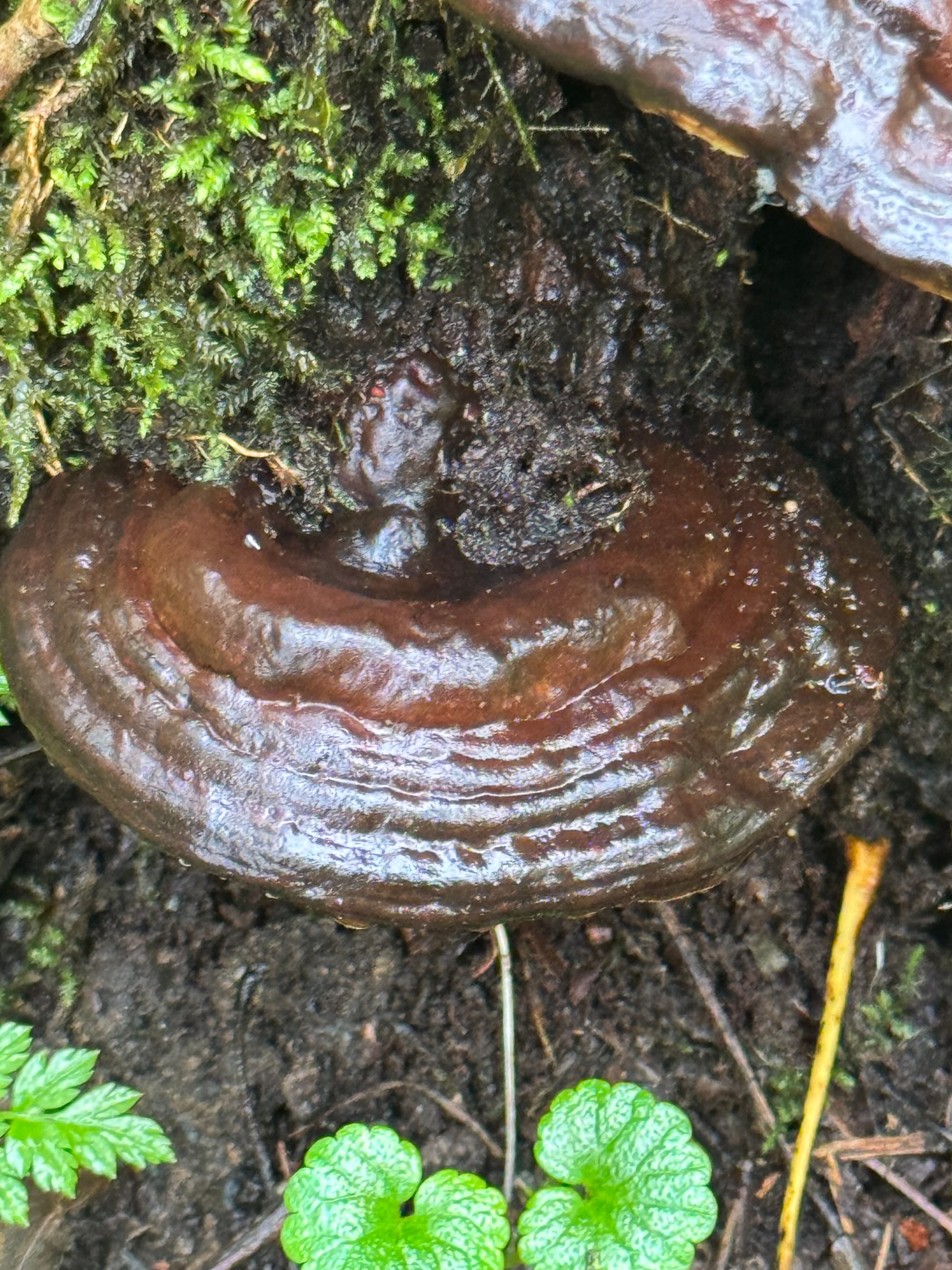
Then the old ones, the patient ones. A black, rounded lump like a horse's hoof: hoof fungus, Fomes fomentarius, also called tinder fungus. For thousands of years people used it to carry fire; Ötzi, the man found in the Alpine ice, had some in his kit more than five thousand years ago. And a broad, glossy, chocolate-brown shelf with growth rings, its rim pale: the artist's bracket, Ganoderma lipsiense. Its name comes from its white underside. Scratch it with a stick and the line turns brown and stays, so people have drawn pictures on them for centuries.
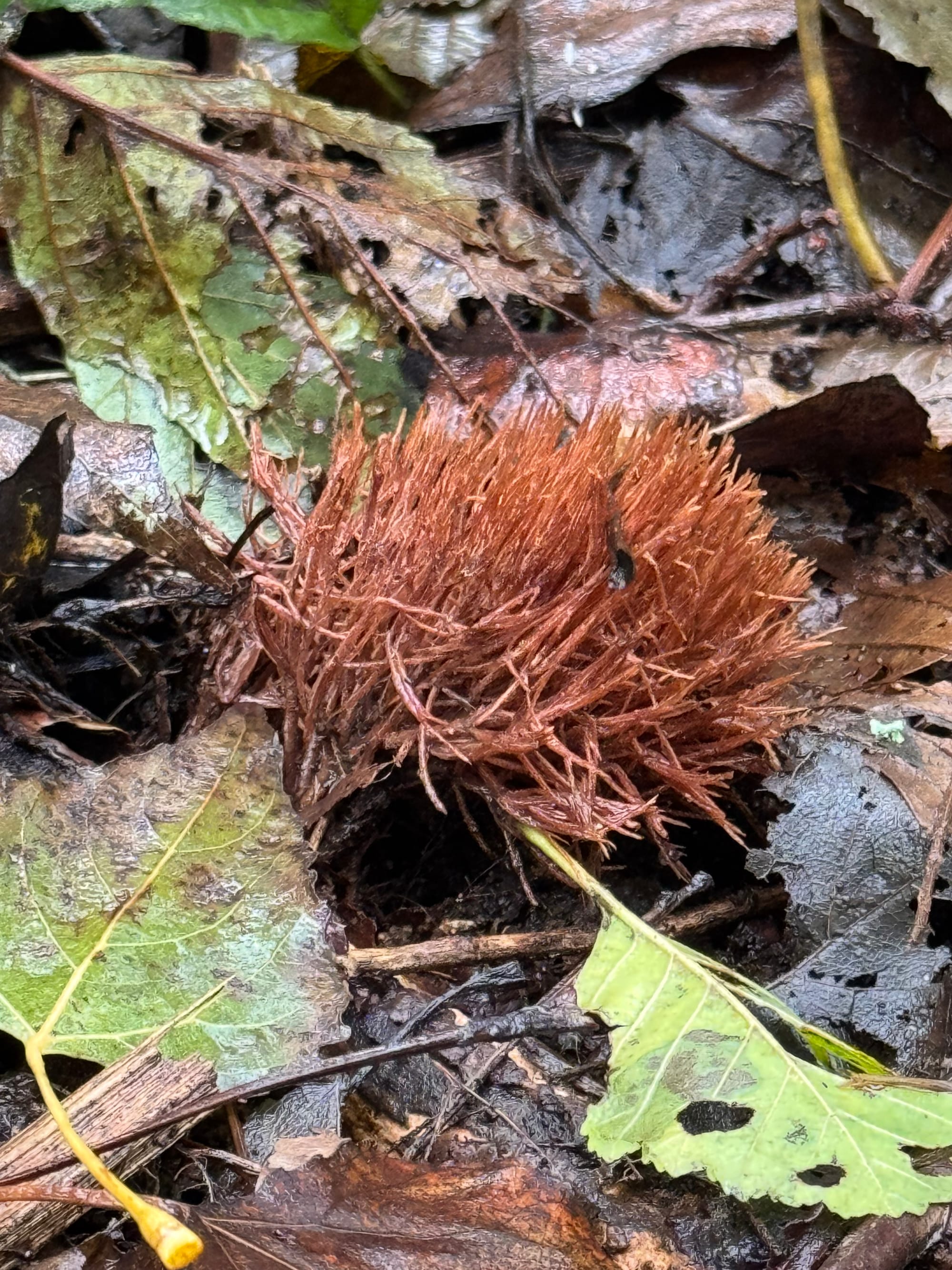
Then my favourite. A rusty-orange tuft among the leaf litter that I first thought was a chestnut husk. It was Pterula multifida, a tiny coral-like fungus made of hundreds of fine branching threads. It's not one you see every day, and I would never have knelt down for it a month ago.
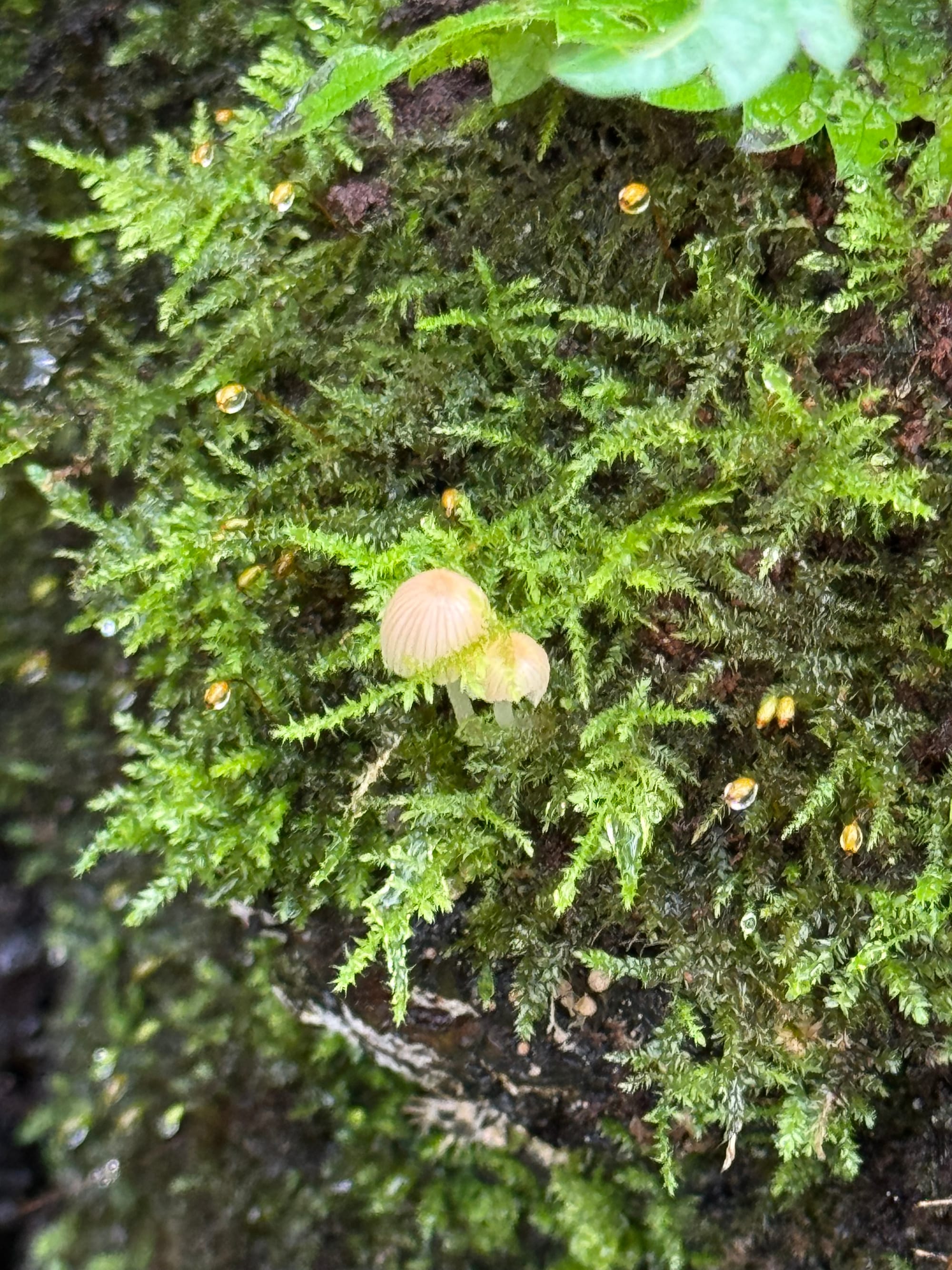
In the moss, tiny pale bonnets (Mycena), each one a few millimetres across, on stems as thin as a hair.
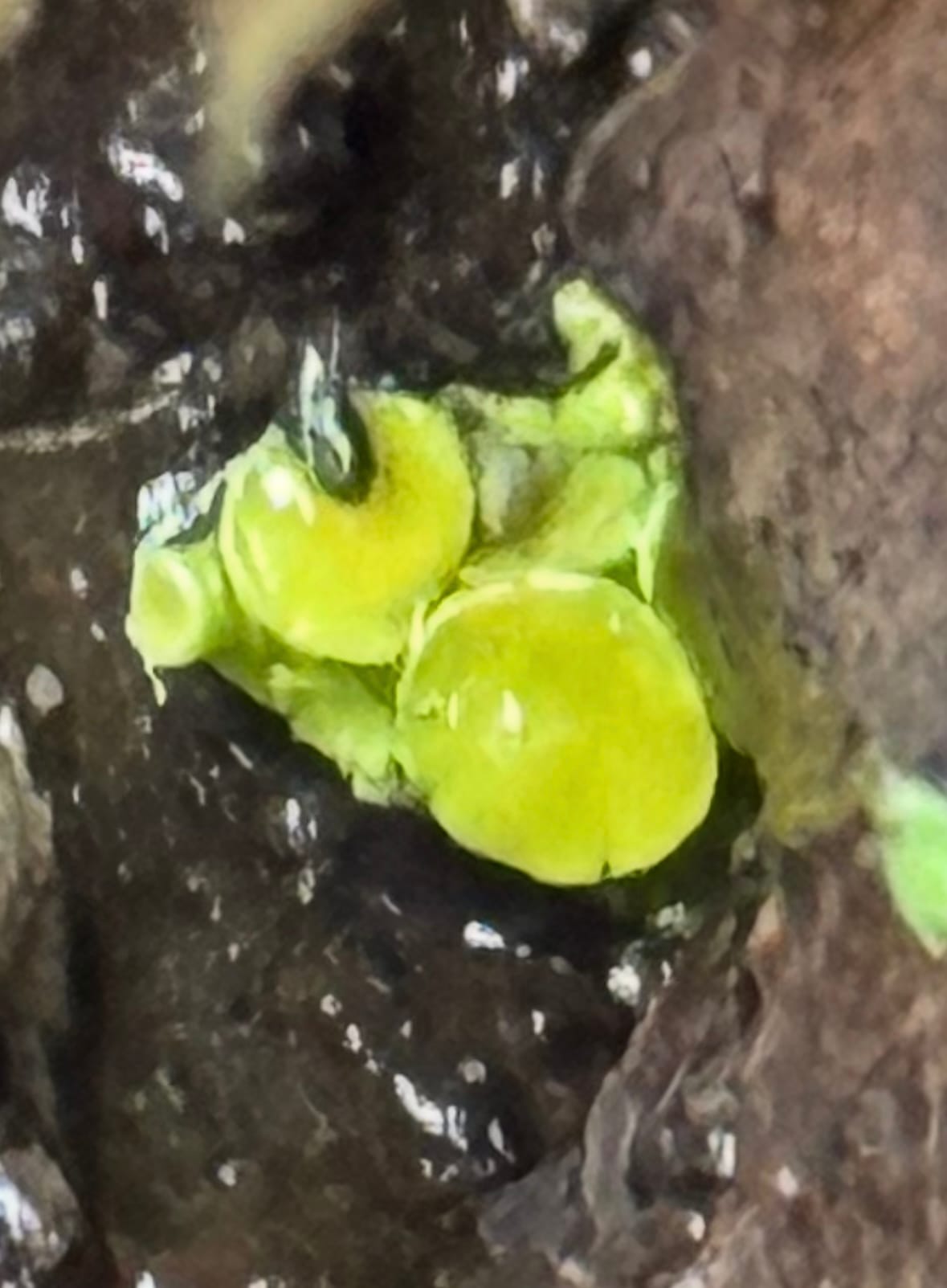
And on a soggy leaf at the bottom of the stump, something I almost didn't photograph: a few bright lime-green cups, smaller than a lentil. I thought it was a fungus called lemon disco. The app thought it was a moss. When I zoomed in, I changed my mind again and called it crescent-cup liverwort. The next morning a volunteer validator on Waarneming.nl corrected all of us: it is a lichen, too small and too blurry in my photos to name to species. A lichen isn't one organism but a partnership: a fungus living together with an alga or cyanobacterium, so closely that they grow as one body. Three guesses, three wrong answers, and one patient expert. I don't mind at all. Being corrected is part of getting to know a place, and next time I'll bring a hand lens and get closer.
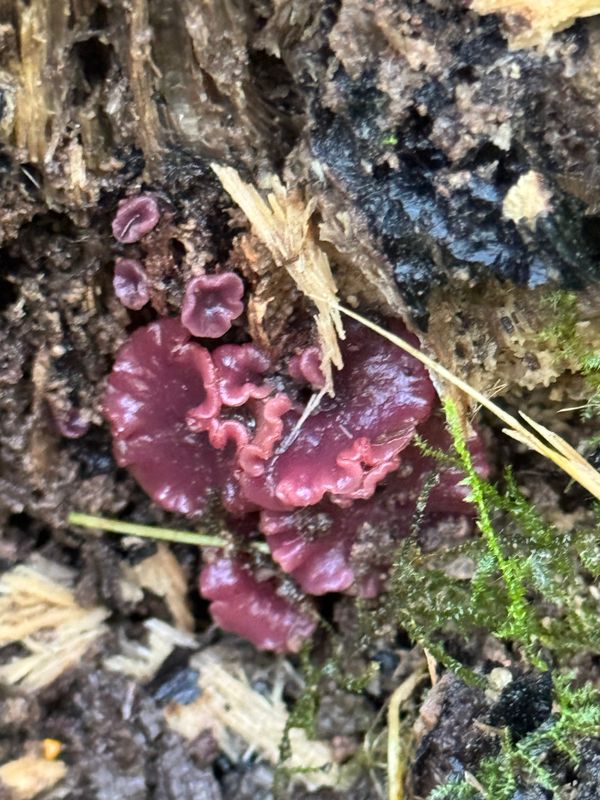
Earlier in the week there was more: candlesnuff fungus like white flickering wicks on a log, a common stinkhorn, ink caps, tiger sawgill, a wine-red jelly called Ascocoryne, sulphur tuft, fairy inkcaps by the hundred. The full list is at the end.
How I learned their names
I am not a mycologist. Most of these names I learned this week, with help.
The first help is ObsIdentify, a free app made by Observation International, the organisation behind Waarneming.nl and Observation.org. You photograph something, and the app, trained on millions of verified observations, suggests what it might be, with a percentage of how sure it is. It is not always right (it called my tiny lichen a moss), but it gives you a starting point and a name to look up, and that is enough to begin a relationship.
The second is Waarneming.nl, the Dutch platform where you can save your observations with a date, a location and a photo. Here is the part I find quietly moving: every observation can be checked by volunteer validators, people who know a group of species deeply and give their time to look at strangers' photos. When my slime mould was changed from "uncertain" to "certain", it meant that someone, somewhere, had looked carefully at my blurry pink blob and taken it seriously. The verified records don't just sit there. They become part of the national picture of where species live and how that changes, data that researchers and nature organisations use.
So a walk to clear my head becomes, without much effort, a small contribution to science. A slime mould in Spijkenisse becomes a dot on a map that matters.
A few things I have learned about doing it well:
- Take several photos: from above, from the side, and the underside (gills, pores, folds).
- Note what it grows on: living tree, dead wood, leaf litter, moss, soil. It often decides the identification.
- Put something in the picture for scale, like a leaf or your finger.
- For tiny things, use the macro mode on your phone and get really close.
- Be happy with "spec." (genus only). Uncertainty is honest, and the validators can do the rest.
- Never eat anything based on an app. Look, photograph, leave it where it is.
Keeping a patch
Naturalists have a phrase for what I am doing: keeping a patch. You choose one place, often close to home, and you return to it again and again, through the seasons and the years. You stop chasing rare things in faraway places. You let one place teach you.
The patron saint of patch-keeping lived more than two hundred years ago.
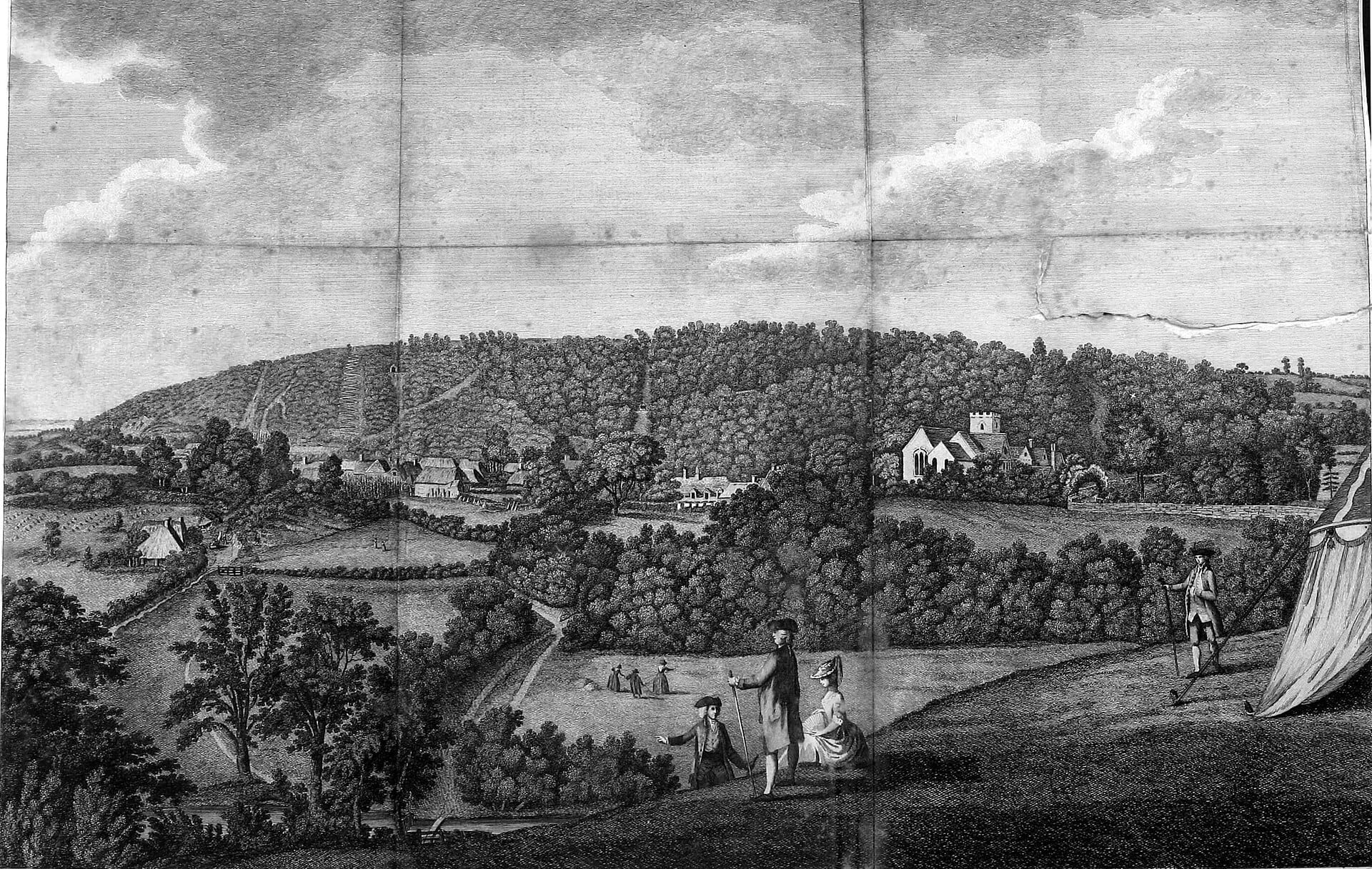
Gilbert White (1720–1793) was a curate in the English village of Selborne. He never travelled far. For decades he watched one parish: when the swifts came and left, how the earthworms worked the soil, what the weather did to the beech trees. He wrote it all down in letters to two other naturalists, and in 1789 they were published as The Natural History and Antiquities of Selborne. It became one of the most reprinted books in the English language. He worked out that three small, nearly identical warblers were actually separate species, by listening to their songs. And he wrote, long before ecology was a word, that earthworms, "though in appearance a small and despicable link in the chain of Nature", would leave "a lamentable chasm" if they were lost.
What White understood is that depth is not the same as distance. You don't have to go anywhere. You have to stay, and pay attention.
The lost art of relationship to land
For most of human history, people knew their land the way you know a family member: by name, by mood, by season. They knew which tree fruits first, where the water stands after rain, which mushroom comes up after the first autumn storms. That knowledge wasn't a hobby. It was how you lived, and it was passed down by walking together.
My grandmother taught me to look at mushrooms. We would go into the woods and she would point and name, and I would crouch next to her. I think of her a lot on these walks. What she gave me wasn't a list of species. It was permission to stop and kneel and care about something small.
Many of us have lost that kind of knowledge without noticing it was gone. The writer Robert Michael Pyle called it the extinction of experience: when people stop having direct contact with nature close to home, they stop noticing what lives there, and then they stop caring when it disappears. It doesn't happen in one dramatic moment. It happens quietly, one unnamed thing at a time.
The good news is that it can be undone the same way it happened: one named thing at a time.
What it does to a person
Something changes in your senses when you get to know a place.
In the 1960s, the Dutch biologist Luuk Tinbergen studied great tits in pine woods and noticed that the birds didn't eat a new kind of caterpillar until they had seen it a few times. After that, suddenly, they found it everywhere. He called this a search image: the brain learns what to look for, and then the thing that was invisible becomes obvious. I recognise this completely. After I found my first bracket fungus, I saw brackets on every second stump. The stumps hadn't changed. I had.
Perception isn't a camera recording what's out there. It's a relationship. What you love and learn shapes what you're able to see. The biologist Jakob von Uexküll called each creature's perceived world its Umwelt: the tick, the dog, the human each live in a different world made of what matters to them. Walking the same park every day has slowly widened my Umwelt. The park I walk now has more in it than the park I walked in September, even though nothing was added.
And there is something else, harder to put into words. When you know a place, you are less alone in it. The hoof fungus on the old birch has become someone I visit. The wet leaf where the tiny lichen grows is a spot I check. My attention, which used to be busy watching rooms and people for danger, now has somewhere gentle to go. My body slows down. I crouch. I notice the smell of wet wood and the cold on my fingers. The walk becomes less about steps and more about meeting.
I think that's what a relationship with land really is. Not owning it, not using it, but becoming someone who notices it, and being changed by that noticing.
People who taught me to look
These are the people and books keeping me company this week. Each of them, in their own way, knew how to pay attention.
Beatrix Potter: the mycologist behind the bunnies
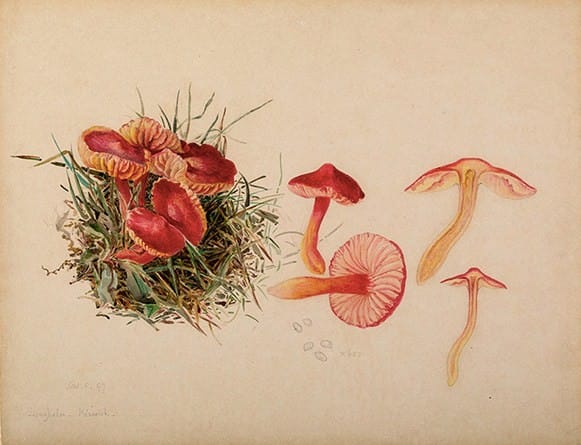
Long before Peter Rabbit, Beatrix Potter (1866–1943) spent years drawing fungi with astonishing accuracy, more than 350 illustrations, many of them now kept at the Armitt Museum in Ambleside. She didn't just paint them. She studied how their spores germinate, and in 1897 her paper "On the germination of the spores of Agaricineae" was read at the Linnean Society in London by the mycologist George Massee, because women could not become fellows of the society at the time. She was also an early supporter of the then-controversial idea that lichens are a partnership between a fungus and an alga. A century later, the Linnean Society admitted she had been treated unfairly. Her paintings are still used by mycologists today because they are that precise. Look them up; they are some of the most beautiful mushroom pictures ever made.
Gilbert White: The Natural History of Selborne (1789)
The book I mentioned above, and the one I would choose if you read only one. Slow, old-fashioned, gentle, and full of swallows, tortoises, owls and weather. It is out of copyright and free to read online through Project Gutenberg.
Robin Wall Kimmerer: Gathering Moss (2003)
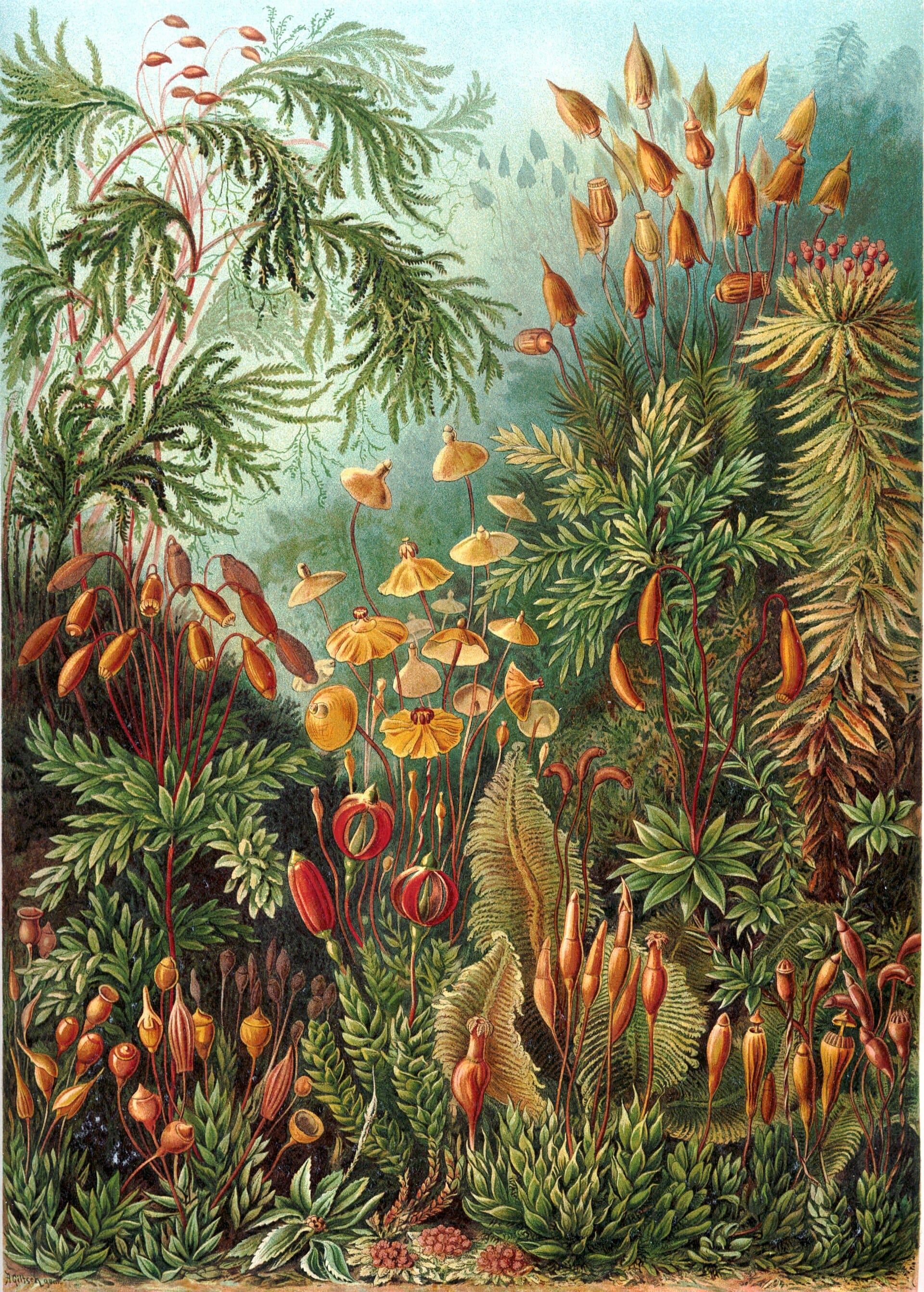
Robin Wall Kimmerer is a botanist and a member of the Citizen Potawatomi Nation. Gathering Moss is a book of short essays about mosses, the tiny forests most people walk past without seeing. She writes about them both as a scientist and with the knowledge of her people, holding the two ways of knowing side by side. The book won the John Burroughs Medal for nature writing. It is the perfect companion after an afternoon on your knees looking at tiny things.
Anna Lowenhaupt Tsing: The Mushroom at the End of the World (2015)
An anthropologist follows the matsutake, a prized mushroom that grows in forests disturbed by humans, through the lives of the foragers, traders and scientists connected to it. It's a book about fungi, but also about how life keeps finding ways to grow together in damaged places. Anthropology, ecology and systems thinking in one.
Toshiyuki Nakagaki: the slime mould that drew a railway
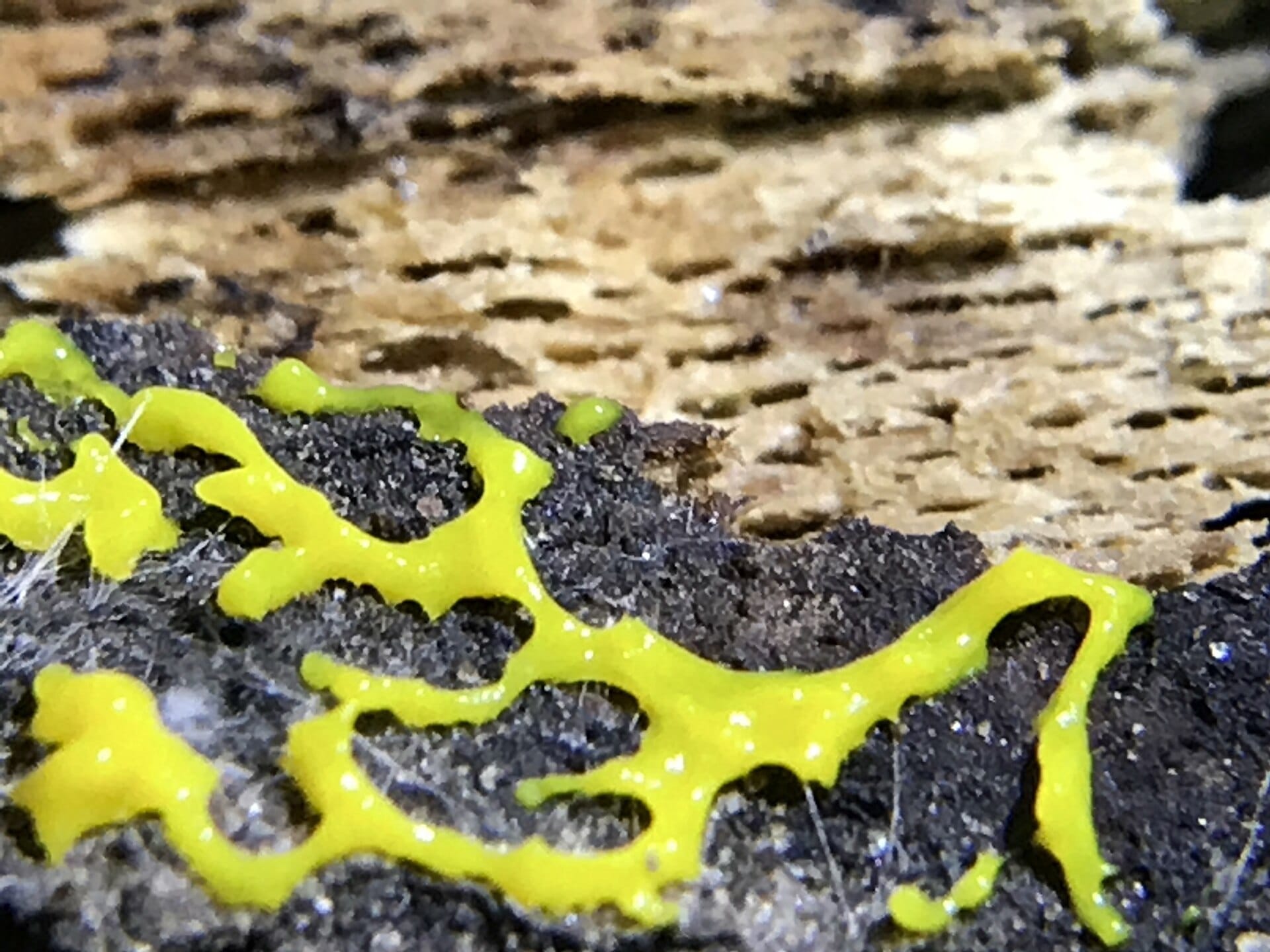
Japanese scientist Toshiyuki Nakagaki showed that the yellow slime mould Physarum polycephalum can find the shortest route through a maze. Later, with colleagues, he placed oat flakes on a map in the positions of the cities around Tokyo. The slime mould grew a network between them that looked remarkably like the real Tokyo railway system, efficient and resilient, without a brain. The work earned him two Ig Nobel Prizes, for research that "first makes people laugh, and then makes them think". After meeting my pink slime mould on the bark, I can't stop thinking about it.
Alexander Schmemann: For the Life of the World (1963)
A short classic by an Orthodox priest about seeing the whole material world (bread, water, light, time) as a gift to receive with gratitude, not just a resource to use. For me, it's the bridge between the church and the forest floor. Kneeling to look at a fungus and kneeling in prayer aren't so different.
Annie Dillard: Pilgrim at Tinker Creek (1974)
A year of fierce, strange attention to one creek in Virginia's Blue Ridge Mountains. Part nature writing, part theology, sometimes uncomfortable, always alive. It won the Pulitzer Prize in 1975. It's another kind of patch-keeping, wilder than White's.
The full list
Everything I recorded in Park Vogelenzang and Mallebos between 12 and 17 November, as named in ObsIdentify and Waarneming.nl (some still waiting for validation):
12 November: Sulphur tuft · candlesnuff fungus · Mycena · Pholiota gummosa · Panellus stipticus · false death cap · fairy inkcap · glistening inkcap · Armillaria (honey fungus) · Kuehneromyces mutabilis (sheathed woodtuft) · Trichia (a slime mould)
13 November (Mallebos): Lingzhi / Ganoderma · Coprinus ink cap
16 November: Ascocoryne sarcoides (purple jellydisc) · common stinkhorn · Crepidotus mollis · Agaricus silvaticus · glistening inkcap · Pterula multifida (×2) · common ink cap · candlesnuff fungus · tiger sawgill · Ganoderma lipsiense · an unidentified crust
17 November: Slime mould · Plicaturopsis crispa · Xylaria polymorpha · smoky bracket · glistening inkcap · Crepidotus mollis · lumpy bracket · hoof fungus · a tiny lichen · tiny fungi in moss · two unidentified fungi
Thirty-five lives, more or less, in one ordinary park. I'll go back tomorrow and see who has changed.
If you want to try this yourself: download ObsIdentify, make a free account on Waarneming.nl (or Observation.org outside the Netherlands), and pick one place you can visit often. Then just keep going back.