A Dinosaur on a November Branch

A robin in Spijkenisse, the long history of feathers, and what we learn when we count the birds we see.
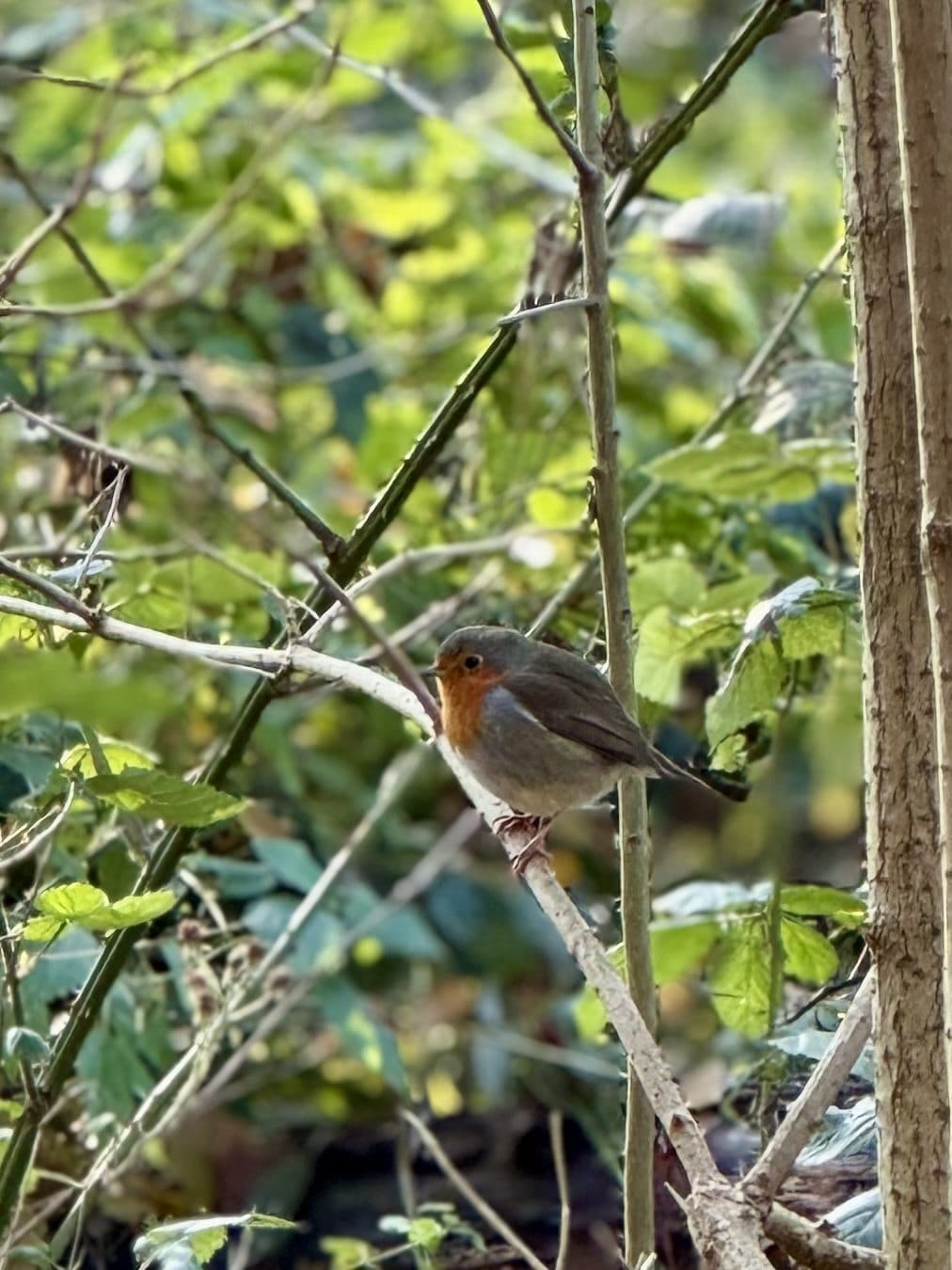
Lately I’ve been noticing birds more. The leaves have come down, and I can follow a flicker from branch to branch before it disappears. The robin in my photograph was still surrounded by green. It was low in the understory, on a pale twig that cuts diagonally across the frame. The orange of its breast is what my eye goes to first. The longer I look, the more I notice the twig.
It’s a strange thing to stand in an ordinary park in Spijkenisse and think about dinosaurs. Stranger still to realise I’m looking at one.
What the stone kept
Living birds belong to the theropods, a branch of the dinosaur family tree. That makes a robin and a heron dinosaurs in the same sense that they are birds. Their family goes back through smaller feathered theropods, on a branch that also has extinct relatives such as Velociraptor. The non-bird dinosaurs died out in the mass extinction about 66 million years ago. Some bird lineages survived, and every bird alive today descends from those survivors. American Museum of Natural History
In limestone from southern Germany, Archaeopteryx left the outlines of long feathers about 150 million years ago. Its skeleton also had teeth, clawed fingers and a long, bony tail. Those features belonged to the same animal. The fossils tell us a great deal about the shape of its wings. The exact way it used them is harder to reconstruct. Natural History Museum


Feathers were already doing other jobs before they were carrying animals through the air. Fossils preserve everything from simple filaments to feathers with a shaft and a flat vane. Insulation, display and camouflage are plausible early uses, and different kinds of feathers could do different jobs on the same animal. In one Velociraptor specimen, researchers found a row of small bumps on a forearm bone, where large feathers could anchor as they do in living birds. That is evidence of feathers on a flightless dinosaur. Fossils preserve skin and feathers unevenly, so the evidence varies from one dinosaur group to another. Natural History Museum · Turner and colleagues, Science
There’s a piece of this story close to home. A nearly complete little skull found in a Belgian quarry near Maastricht belonged to Asteriornis maastrichtensis, the “wonderchicken.” It lived about 66.7 million years ago, just before the end of the Cretaceous. Its skull combines features seen in today’s landfowl and waterfowl, placing it near the early history of the group that includes chickens and ducks. Field and colleagues, Nature
What the bare branches give away
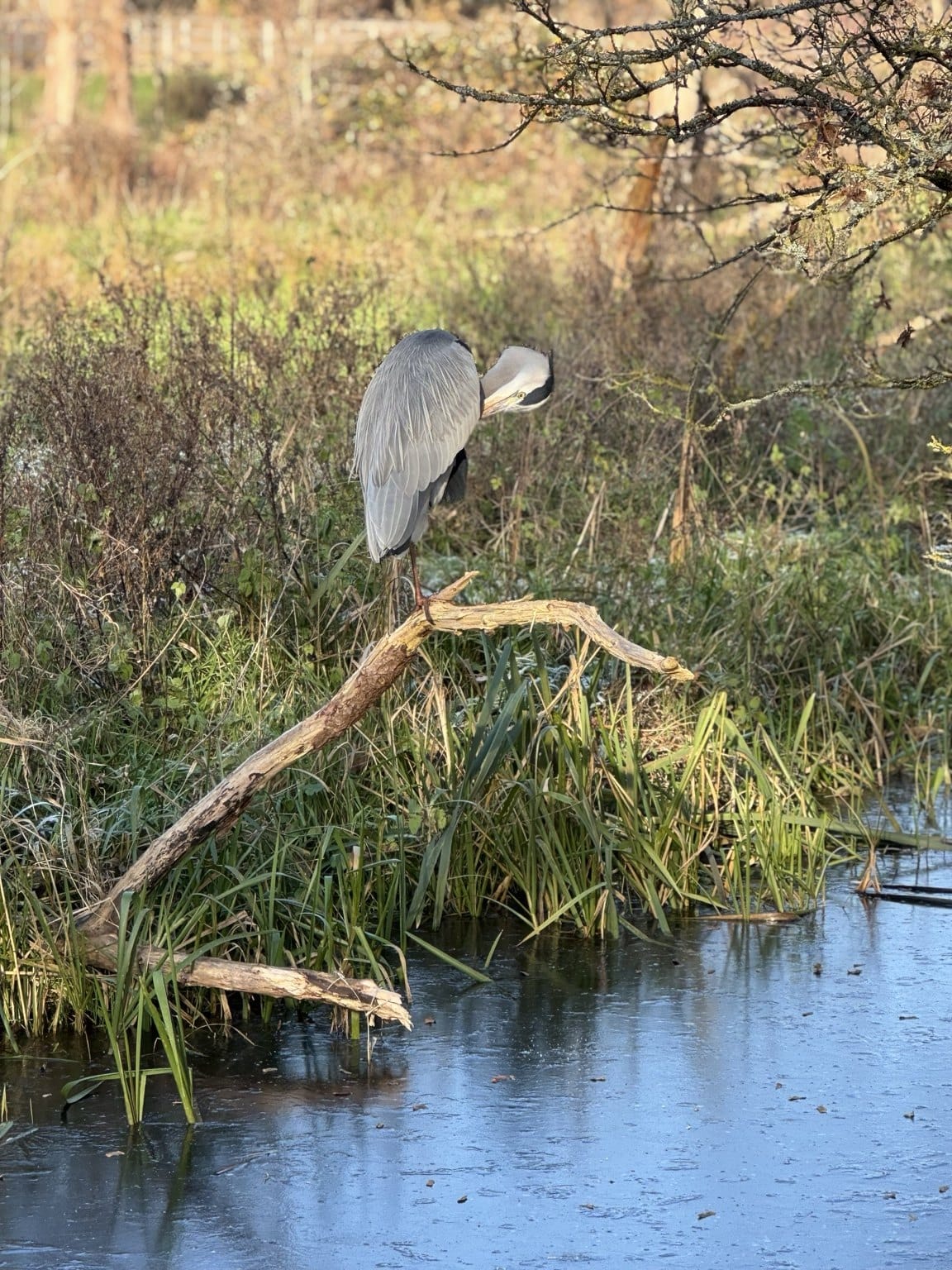
A heron over the ice tucked its beak into its feathers. The robin’s feathers, meanwhile, carry an orange patch that matters to other robins. Both sexes defend territories, even in winter, and both can sing to mark them. Some Dutch robins head south for winter while birds from farther north arrive here. The species can look like a fixture in the park even as some of the individuals change. Vogelbescherming’s robin guide
Seeing more birds on my walks could mean several things. Some might have arrived for winter. Others may have been here all along, half a metre behind a screen of leaves. I’m also spending more time looking. A notebook gives those possibilities somewhere to sit. If I make the same short round at roughly the same hour and write down what I hear as well as what I see, I have something to compare with next week.
How to count birds in the Netherlands
One sighting records a bird in a place at a time. Repeated counts using the same method give researchers a better chance of telling a change in bird numbers from a change in where, when or how long people looked. Sovon uses its urban counts alongside surveys in the countryside to track breeding birds and inform conservation and the management of urban green space. Common birds are part of the picture. Sovon
- Start on a short familiar walk. Try ten minutes at the same spot in Park Vogelenzang. Note the date, start time, duration, place, species, count and whether each bird was seen or heard. Add a detail such as “low in the shrubs” or “perched above the water.” Upload an individual sighting to Waarneming.nl if you want to share it. A photo or recording can help, and a tentative ID can stay tentative. NDFF’s guide to submitting observations
- Count from your window, garden or balcony. Vogelbescherming lists 29–31 January 2027 for the next Nationale Tuinvogeltelling. Choose one half-hour. For each species report the most individuals present at the same time. If two great tits visit and later three are there together, write down three. Leave birds that only fly over out of the count. Dates and participation · Counting rules
- Count throughout the year. With Jaarrond Tuintelling, you can report what visits your garden each week or do a timed count of five, ten or fifteen minutes. It’s a way to see what changes from season to season.
- Try a survey or a local outing. Sovon’s Meetnet Urbane Soorten is a spring survey for people who can recognise common town birds by sight and sound. Volunteers make three rounds of 8–12 fixed points in a postcode area, counting for five minutes at each stop. To learn alongside other people near Spijkenisse, the KNNV Hollandse Delta Vogelwerkgroep lists excursions and counts on Voorne-Putten. The IVN Voorne-Putten Rozenburg agenda is another place to look for a group walk.
On the next walk I’ll stop at the shrubs again. If there’s a robin, I’ll write down where it was. If the twig is empty, I’ll give it a few minutes. I might hear the bird before I see it.