How We Notice Winter Arriving in the Netherlands

In Spijkenisse, the difference between late autumn and winter can be a strip of grass. The part that caught the morning sun is green again. Along the hedge, where the light hasn’t reached, each blade still has a white edge. A few hours later the frost is gone, and there’s only the wet grass to tell you that anything happened.
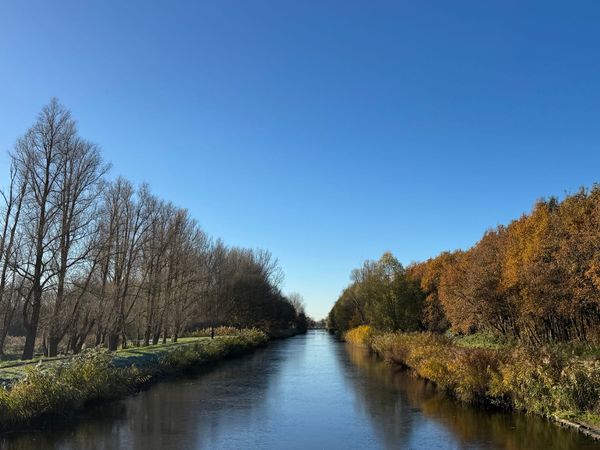
There are other ways to tell. A bicycle light comes on during the ride home. The bare trees let you see a stretch of water that was hidden all summer. After rain, a piece of bark looks almost black, and whatever is growing on it is suddenly much easier to see. The first signs depend on where you put your attention.
The light changes before the weather makes up its mind
The KNMI starts meteorological winter on 1 December so that the same three calendar months can be compared from year to year. Astronomical winter begins at the December solstice, when the sun spends the least time above the horizon here. The Earth’s tilt gives us both shorter days and a lower midday sun. Even when the air is mild, the long shadows tell you where you are in the year.
Weather keeps a different schedule. Near the North Sea, spells of damp, mild weather and sharper cold can follow each other in the same week. On a clear, still night the grass can lose enough heat to frost over while the air above it stays a little warmer. It’s possible to find winter in one corner of a field and walk out of it again ten steps later.
What people did with a frozen landscape
In Hendrick Avercamp’s Winter Landscape with Ice Skaters, painted around 1608, the frozen water has become part of the village. Someone crosses it by sleigh. There are skaters, people playing kolf, and others going about their work. At the edge of the scene, birds and a dog gather around a dead horse. It’s worth taking a moment to look at the whole painting. What first seems like a picture of people having fun gives you several different winters in one frame.
Today I’m more likely to think of winter as a series of small adjustments: turning on bike lights earlier, putting wet gloves somewhere they’ll dry, taking a walk before the afternoon disappears. Electric light and central heating change what we can do after dark. The hours of daylight still set the terms for plenty of ordinary things, including how long you can see the colour of the bark on your walk.
The body notices light, too
Specialized cells in the retina help tell the brain’s internal clock how bright it is and when. Light during the day helps keep that clock aligned with the outside world. Bright light late in the evening can delay it, shifting the body’s sense of night later. Winter changes the light we meet on a normal day, especially if we leave home early and spend the bright hours indoors. A short walk at midday gives you a chance to meet the season in its best light, and to see what the rain did overnight.
A winter elsewhere
In her film about daily life in Yakutsk, in Russia’s Sakha Republic, Kiun B shows winter through decisions about getting dressed, getting around and keeping warm. The scale of the cold is very different from ours. What I like about watching her is how much of the film is about knowing your own place well enough to go about an ordinary day in it.
Watch Kiun B’s film about living in Yakutsk
On the way home
Pick one thing on a walk you already take. A low branch, a bend in the water, a stump with something growing on it. Come back after a cold night, and then again after rain. See what you can say for certain: the edge has darkened, there’s water inside the hollow, the patch is smaller than it was. Leave a little room for the things you can’t explain yet.
By the time you turn for home, there may be lights on across the water. The tree you stopped for will already be hard to make out. You know which one it is now. You can come back tomorrow.
Sources and artwork
- KNMI’s guide to winter and its guide to frost days
- Brown and colleagues on light, circadian rhythms and sleep (PLOS Biology, 2022)
- Hendrick Avercamp, Winter Landscape with Ice Skaters, c. 1608, Rijksmuseum, SK-A-1718. Public domain.
- Kiun B’s work on life in Yakutia