The Small Forest Underfoot
On moss in November, and a life lived in the thin layer where air meets ground.

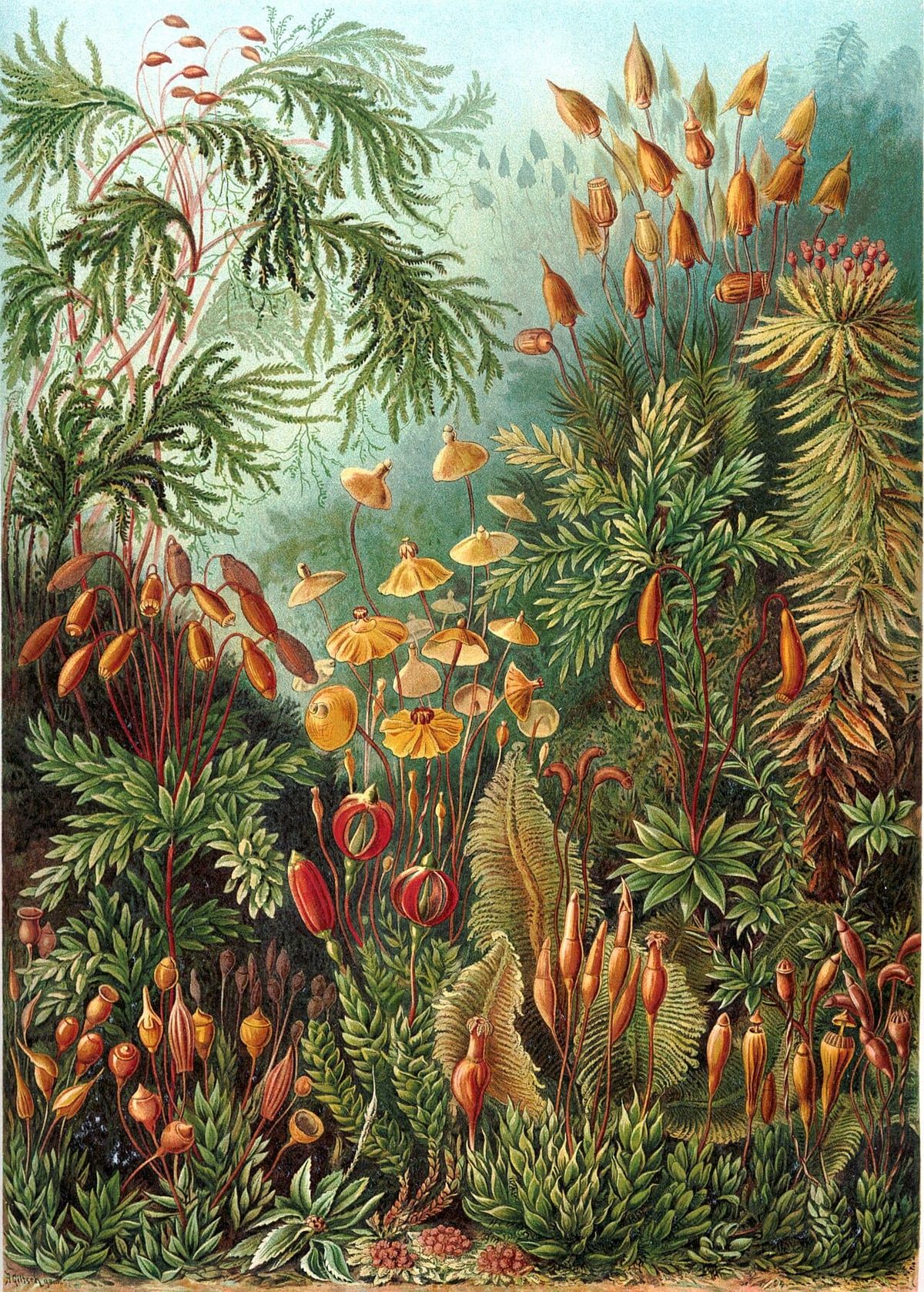
By late November most of the forest floor has gone brown. The leaves are down, the bracken has slumped, and the mushrooms are getting fewer and softer. But anyone who spends this month bent low, looking for caps under the litter, will have noticed something else: the moss is at its brightest. On stumps, on the north side of trunks, along the tops of old walls, it looks almost lit from inside.
That isn’t only a trick of contrast. For many mosses in a temperate forest, the cold, wet half of the year is a good time. To see why, it helps to know how differently a moss lives from the trees above it.
A plant without plumbing
Mosses are bryophytes, one of the oldest lineages of land plants. They have no true roots, only thread-like rhizoids that mostly hold them in place, and no well-developed plumbing for carrying water up a stem. Their leaves are often a single cell thick. A moss takes in water across its whole surface, more like a sheet of paper than a tree. Botanists call this being poikilohydric: its water content follows the world around it. When the air dries, the moss dries too. Many species can then wait, brittle and dull, for weeks or longer, and pick up photosynthesis again quickly once water returns.
That arrangement shapes a moss’s calendar. In summer, the ground under a full canopy is shaded and often dry. In November the canopy opens, light reaches the forest floor again, and the air can stay damp for days. Light and water together are what a moss needs, and late autumn and winter often offer both. Some mosses can even keep photosynthesising under a thin layer of snow, when enough light filters through and the snow keeps the cold from biting too deep.
Life in the boundary layer
Robin Wall Kimmerer, the botanist who wrote Braiding Sweetgrass, spent much of her career with mosses. In Gathering Moss there is an essay called “The Advantages of Being Small: Life in the Boundary Layer.” The boundary layer is the thin zone right where air meets a surface, where wind slows and moisture lingers. A few centimetres up, the air is moving and drying; down in the cushion, it is calmer and wetter. Mosses live in that strip. Their smallness isn’t a failure to become trees. It’s a way of living in a place that trees, at their scale, can’t occupy.
And a moss cushion is a place for others, too. Tardigrades, the eight-legged micro-animals also called water bears or moss piglets, are common in mosses and lichens. So are rotifers, nematodes and mites. When the moss is wet, they move through its film of water; when it dries, many of them dry out as well and wait with it. A patch of moss the size of a palm is a small forest with its own weather.
Two calendars on one square metre
What stays with me is the timetable. We tend to read November as an ending: the year winding down, the forest closing for the season. From the height of a person, or a tree, that’s fair. From the height of a moss it is closer to the opposite. The same falling leaves that close one growing season open the light for another. Both are happening on the same square metre of ground. Which one you notice depends partly on how far you bend down.
That isn’t a lesson the moss is trying to teach. It’s simply what it looks like when more than one kind of life shares a place and keeps a different clock. Most of the forest’s calendars are like this, layered, and we only ever stand in one of them at a time.
If you’re out this week, it might be worth crouching at a mossy stump with a hand lens, or just your phone’s camera zoomed in close. Look at how the leaves fan out when they’re wet. If you find a dry, greyish cushion on a sunny wall, drip a little water on it and wait. Often you can watch the leaves loosen and turn green again, one of the few changes in nature that happens at about the speed of attention.
Which green thing have you noticed this month that most people walk past? I’d love to hear, in the comments or on The Living Fractal on Telegram. These field notes also arrive as a free letter: The Living Fractal on Substack.
— Daphne
Sources
- Bryophyte: Ecology and habitats, Encyclopaedia Britannica
- Elizabeth Domenech, Frozen Fractals All Around: How Moss Has Adapted to Thrive in Wintertime, Montana Natural History Center / MTPR (2023)
- Robin Wall Kimmerer, Gathering Moss: A Natural and Cultural History of Mosses (Oregon State University Press, 2003)
- Tardigrade, Wikipedia