The Leaves That Stay
On beech hedges in November, and the careful work of letting go.

Walk down almost any street with front gardens in late November and you'll pass a hedge that hasn't got the message. The birches have dropped everything. The maples are bare sticks over a wet orange carpet. And there, at hip height, a beech hedge stands fully dressed in leaves the colour of paper bags, dry and rattling a little in the wind, holding on.
It's easy to read that as stubbornness, or as a plant that got the timing wrong. But the more you look into how trees lose their leaves at all, the less either explanation fits.
How a tree lets go
Leaf fall isn't something that happens to a tree. It's something the tree does. Weeks before a leaf comes down, the tree starts taking it apart from the inside. Chlorophyll is broken down, and much of what it held, nitrogen above all, is drawn back into the twigs to be used again. The yellows and oranges we call autumn colour are partly what's left behind: carotenoids break down more slowly than chlorophyll, and with the green gone, they finally show.
At the base of each leaf stalk sits a narrow band of cells called the abscission zone. As the season turns, less auxin flows down from the leaf, and the zone becomes sensitive to ethylene, a plant hormone that helps switch on enzymes which loosen the walls between cells. Underneath, on the twig's side, the tree builds a layer of cork, waterproofed with suberin and lignin. So when the leaf finally goes, there is no open wound, only a small sealed scar.
You can find those scars on any bare twig this winter, just below each bud: little shields, often dotted with the cut ends of the old veins. The falling leaf is not a loss the tree simply suffers. It's a separation prepared from both sides, over weeks.
The ones that hold on
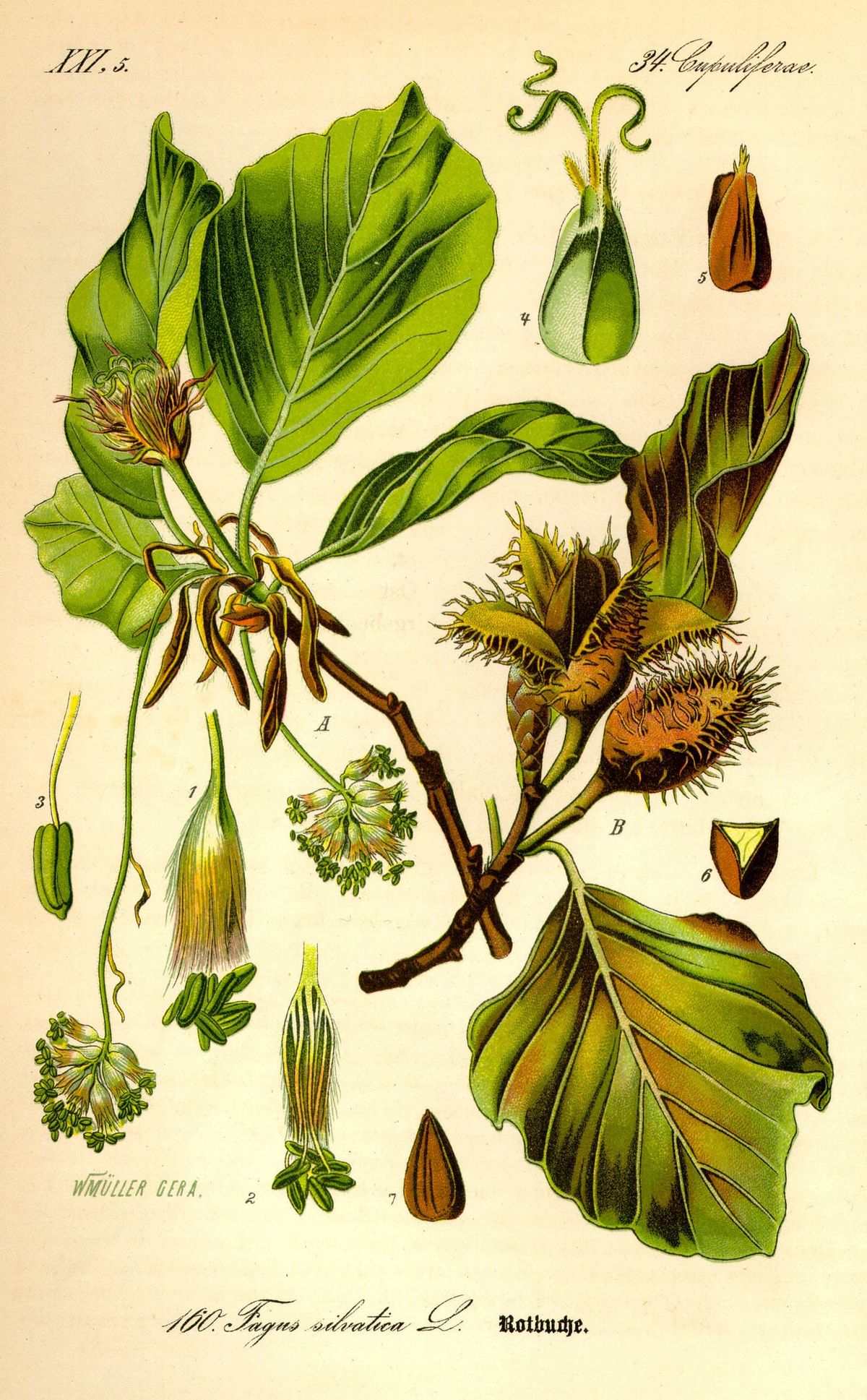
Keeping dead leaves through winter has a name: marcescence, from the Latin for withering. It shows up mostly in beech, oak and hornbeam, and mostly in young trees and on lower branches. A tall old beech in a park will often stand bare while the saplings beneath it stay brown. Hedges are a special case. Clipped year after year, they're kept small and young in form, and they hold their leaves the way young trees do.
What makes marcescence interesting is that nobody is quite sure what it's for. There are good guesses. Dry, papery leaves may make twigs less appealing and noisier to browse, so deer move on. The leaves might catch snow, or shelter buds from drying winds. They may also work as a delayed parcel: kept off the ground through winter, they drop closer to spring, near the tree's own roots, when growth starts again.
People are still counting. A 2026 column from the University of Hamburg's botanical garden described an international survey, led by the Missouri Botanical Garden with 18 botanical gardens across Europe, Asia and North America. The pattern reported so far: marcescence is more common in small young trees than in old large ones, more common near the base of a tree than in the crown, and more common in colder, drier climates. Even so, a Vermont forester's summary from back in 2010 still holds: we don't know whether it gives beech and oak a competitive advantage.
Two timetables
It would be easy to turn this into a lesson about holding on, or about letting go. I'd rather not. Trees aren't doing either for our benefit. But it's worth noticing that a tree doesn't treat letting go as one single thing. A birch lets go by building a seal and cutting cleanly in autumn. A young beech keeps its old leaves through the dark months, and in many marcescent trees they finally come away in spring, around the time the new buds swell.
Those buds are already there now. On a beech they're easy to spot once you know to look: long, slender, pointed, copper-brown, sitting just above where each old leaf joins the twig. Next year is already on the branch, right beside the last one.
So if you pass one of these hedges this week, it might be worth stopping for a moment. Rub one of the leaves between your fingers; it's thinner than you expect. Look for the bud tucked behind it. The hedge isn't late. It's keeping a timetable it hasn't explained to us, and that we're still, slowly, learning to read.
If you pass a beech hedge this week, look for the long copper bud tucked behind a dry leaf. I would love to hear what you notice. This piece is also on Substack, and new field notes are shared on Telegram at The Way.