The World Is Not What It Looks Like
On perception, participation, and the extraordinary strangeness of ordinary reality.
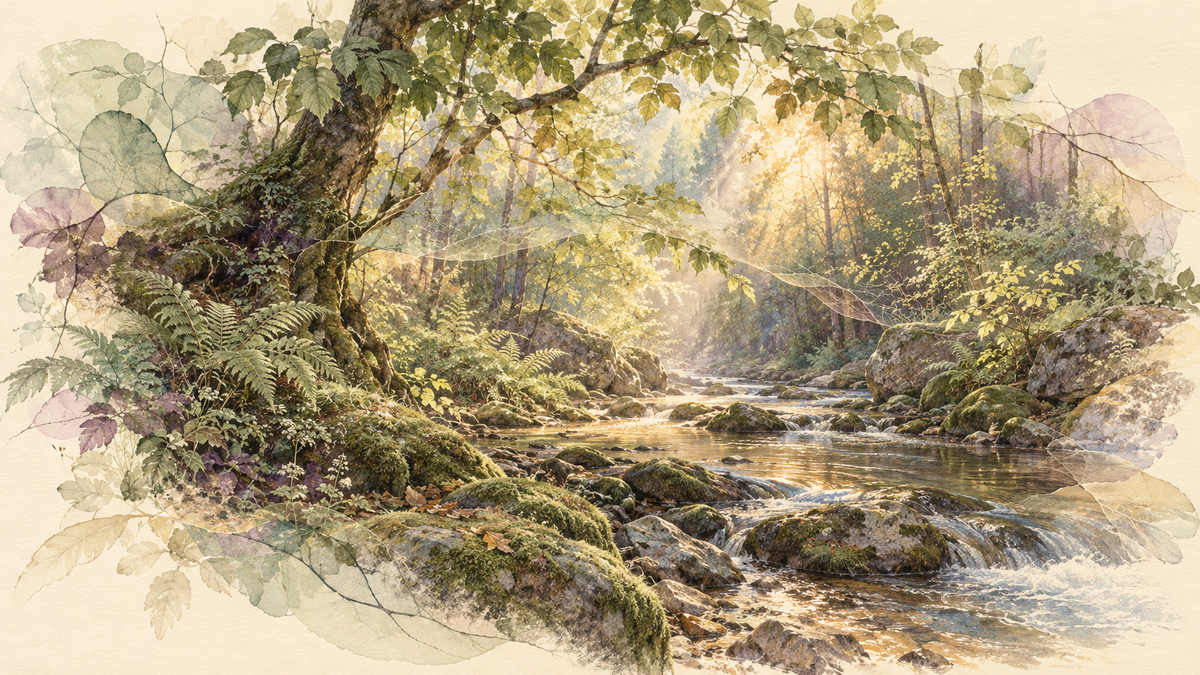
Imagine standing beside a stream. Light catches a leaf. Water moves over stone. Somewhere beyond the path, a bird calls. The scene seems to arrive whole: green, bright, cool, alive.
Yet an extraordinary amount happens between sunlight reaching a leaf and your experience of seeing it.
The forest exists beyond your encounter with it. Your experience of the forest depends on that encounter: on light and surfaces, on sensory organs and nervous systems, on where you stand and what draws your attention. What appears immediately given is also an achievement of a living body.
That is the strangeness I want to spend time with. We participate in how reality becomes experience, while what we experience never exhausts what exists.
1 · A world beyond this view
Before we describe the green, there is sunlight interacting with leaves. Before we describe the sound of the stream, there is moving water producing vibrations. Before we describe warmth, there is energy being exchanged between the sun, the surroundings, and our bodies.
These descriptions tell us something about physical processes. They do not require the forest to wait for a human observer before anything happens.
There is also a limit to the picture we can draw. A scientific description is a model supported and corrected by evidence, rather than a view from nowhere. The fact that our knowledge is mediated does not make every explanation equally good. The world can resist our expectations.
2 · What reaches a living body
Our senses respond to particular kinds of physical interaction. They do not deliver an inventory of everything around us.
In vision, light is focused onto the retina, where photoreceptors convert it into electrical signals. Those signals enter neural pathways leading towards the brain. In hearing, pressure variations set structures in the ear in motion; sensory cells help translate that motion into signals carried by the auditory nerve. [1] [2]
Even this familiar scene depends on the kind of body encountering it. A human view is a view from somewhere, with particular capacities and limits. It is not the only possible encounter with the same surroundings.
3 · Perception is active
Processing has already begun in the retina. Vision involves networks that select and interpret information, with attention and previous experience contributing to what we perceive. We also move our eyes to change what information becomes available. [3]
This is why “the brain constructs experience” needs care. It does not mean a little person inside the skull paints a picture for another little person to watch. Nor does it establish that the forest itself is invented.
Consider colour. The green you experience depends on the light, the leaf’s interaction with it, and your visual system. Colour perception involves processing in both the retina and brain. Calling green simply “unreal” loses the relationship that makes it possible. Calling it a complete description of the leaf loses just as much. [4]
4 · A world experienced
What you encounter is a stream you can hear, a patch of shade you can step into, a leaf you can turn in your hand. There is a felt quality to being there.
We can investigate mechanisms of perception without pretending that consciousness is fully explained. Researchers continue to test competing accounts of its neural basis. A large collaboration published in 2025 tested predictions from two prominent theories as part of this continuing investigation. [5]
The four stages here are a guide for thinking, not four sealed compartments or a complete theory of consciousness. Sensory processing, attention and action overlap. Turning your head changes the input; what catches your attention can change where you look next.
What participation means here
Participation can be as ordinary as moving closer. Look at a tree from the path, then stand beneath it. Touch its bark. Notice which details become available through each encounter.
This does not require a claim that consciousness creates matter. It asks us to notice how much our access to the world involves doing, sensing, and relating.
For me, it also opens a question about meaning. The tree may become a landmark, a memory, a place of shelter. Those meanings belong to relationships and histories; they are not measurements hidden inside the bark. That is a philosophical reflection, rather than a result established by the biology of vision.
Still room for awe
God or no god, we are embodied beings. We encounter the world through capacities we did not choose, and we keep learning how partial our perspectives are.
I want to make room for both curiosity and gentleness here. We can question an interpretation without dismissing an experience. We can recognise the limits of perception and still take evidence seriously. We can admire a forest without asking it to settle every question we carry.
The green is experienced. The leaf has a life beyond this moment of looking. Both thoughts can remain with us.
Let’s continue feeling awe—and exploring what being human is.
Illustration created with AI as a botanical interpretation of the essay, not a scientific diagram. The numbered links distinguish the scientific sources from the personal and philosophical reflections.