The Ground Remembers: Cain, Abel, and the Consequences of Being Human
We construct entire worlds of meaning, but our interpretations do not make us sovereign over reality. A reading of Genesis 1–4 explores human limits, responsibility, violence, mercy, and the consequences that ripple beyond us.
On creatureliness, the worlds we construct, and the reality that remains when our explanations fail.
The ground remembers.
Not, perhaps, in the way a human being remembers. The earth does not sit in judgment, weighing our intentions or assigning moral worth. But it receives what happens. Seeds take root in it. Water moves through it. Bodies return to it. The consequences of our actions become part of a world that continues long after we have finished explaining ourselves.
In the fourth chapter of Genesis, after Cain kills his brother Abel, God asks him a question:
Where is Abel, your brother?
Cain responds with one of the most unsettling questions in biblical literature:
Am I my brother’s keeper?
Then comes the answer that has stayed with me:
Your brother’s blood cries out from the ground.
There is something extraordinary about this image.
Cain can refuse to answer. He can attempt to distance himself from his brother’s life. He can behave as though the relationship no longer places any responsibility upon him.
But Abel is dead.
The ground has received his blood.
Whatever Cain believes, whatever explanation he might construct, the event has happened. Another human life has been irreversibly changed, ended, in fact, by his actions.
The world has changed with it.
And perhaps that is where we should begin: not with the assumption that Genesis contains a complete explanation of human nature, but with the possibility that these ancient stories preserve difficult observations about what it means to exist in a world that does not belong to us.
Before we arrived, there was already a world
Genesis does not begin with humanity.
It begins with a world being brought into order.
Light and darkness. Water and land. Vegetation, living creatures, the rhythms of days and nights.
The first creation account, Genesis 1:1–2:3, unfolds through a carefully structured sequence of distinctions. God speaks, separates, names, blesses. The world gradually takes recognizable form.
And repeatedly, God sees that it is good.
This is a detail worth lingering over.
The seas are not good because they are useful to human beings. The vegetation does not wait for human approval before receiving its place in the narrative. Birds and fish are blessed before humanity appears.
Within the story, goodness precedes the human gaze.
That is a peculiar and potentially consequential way to begin an account of existence.
We human beings live extraordinarily local lives. We perceive from particular bodies, within particular cultures, through particular histories. We name things, distinguish them, organize them into categories, and construct hierarchies of significance.
These capacities are indispensable. Without them, we could scarcely navigate an ordinary afternoon.
But a useful abstraction can become a dangerous one when we begin mistaking it for the entirety of what exists.
We can become so accustomed to viewing the world through our own concerns that we forget the world was never organized around those concerns in the first place.
Genesis interrupts that assumption.
Humanity enters late in the story.
We did not make the light. We did not establish the seasons. We did not invent the conditions that make life possible.
We arrived within them.
The narrative does grant humanity a special position. In Genesis 1:26–28, human beings are created in God’s image and given dominion over other living creatures.
The notes in The Jewish Study Bible explain that such imagery has an ancient Near Eastern political background: kings could be understood as representatives of divine authority. Genesis extends something resembling this royal status to humanity more broadly.
This is not a wholly egalitarian picture of the natural world. It contains hierarchy and authority, and the language of dominion has a complicated history. It has been used both to justify exploitation and to argue for responsible stewardship.
Nevertheless, the distinction remains important.
Human beings are given authority within a world they did not create.
They are not presented as the ultimate source of its existence.
And then, strikingly, the first creation account concludes not with unlimited activity, but with Sabbath.
God ceases from the work of creation.
The story makes room for rest.
Even here, where divine creative power is celebrated, existence is not represented simply as an endless project of production.
There is a world to inhabit, not merely a world to control.
Dust, breath, and the limits of being human
The second creation account, beginning in Genesis 2:4, offers a different picture.
Where the first account is cosmic and highly structured, the second is intimate and earthy.
The human is formed from the dust of the ground.
The Hebrew words adam and adamah draw attention to this relationship between humanity and earth.
God breathes life into the human, and the human becomes a living being.
Modern biblical scholarship generally understands these accounts as preserving different literary traditions. The Jewish Study Bible discusses the conventional association of the first account with the Priestly source and the second with the Yahwist tradition. Their precise compositional histories remain debated, and traditional Jewish interpretation has often read the stories together.
We need not erase their differences to appreciate what each contributes.
One account portrays humanity as possessing extraordinary dignity.
The other emphasizes humanity’s dependence.
The human is formed from something already present. Life is received. Food is provided. Work is given. Companionship is needed.
Before anyone eats forbidden fruit, before shame enters the narrative, before exile, human existence already has conditions and limits.
Creatureliness is not introduced as a punishment. It is there from the beginning.
This brings us to an old human difficulty.
We are capable of imagining ourselves almost anywhere. We can create elaborate symbolic worlds, develop sciences, organize societies, and contemplate events billions of years beyond our own lives.
Yet we remain organisms.
We need water. We need nourishment. We need sleep. Our bodies become ill. Our relationships affect us. Our knowledge remains incomplete. We cannot simply decide to stop being dependent.
There is no contradiction in possessing remarkable capacities while remaining finite.
The trouble begins when we mistake those capacities for sovereignty.
The fruit and the promise of becoming more
In Genesis 3, the serpent suggests that God has withheld something valuable.
The humans are told that eating from the forbidden tree will open their eyes and make them like divine beings, knowing good and evil.
What does this knowledge mean?
The answer is less straightforward than many familiar retellings suggest.
The expression may concern moral discernment, a comprehensive kind of knowledge, mature understanding, or authority associated with divine beings.
The Jewish Study Bible also draws attention to the woman’s perception of the tree. She sees it as suitable for food, delightful to look at, and desirable as a source of wisdom.
The commentary suggests that this progression—from sensory attraction through aesthetic pleasure toward intellectual justification—may represent rationalization.
That qualification matters.
We do not possess a transcript of her inner thoughts. And we should be wary of treating the story as a straightforward condemnation of curiosity, particularly when later interpretations have so often placed disproportionate blame upon the woman.
Still, the narrative presents something worth considering.
Human beings do not only use reasoning to investigate reality. We can also use it to justify what we already want.
We become attached to a possibility. We develop explanations in its favour. We begin to imagine that obtaining it will resolve something fundamental about our condition.
Then we act.
And something happens that complicates the simple moral lesson.
The serpent is partly right.
Their eyes really do open.
In Genesis 3:22, God acknowledges that the human has become like one of the divine beings in knowing good and evil.
The humans have gained something.
But acquiring knowledge has not made them independent of the world in which they live.
They still have bodies. They still need food. They remain vulnerable. They cannot secure immortality simply by understanding more.
The narrative then describes painful childbirth, difficult agricultural labour, domination within human relationships, and exclusion from Eden.
These are presented as consequences pronounced by God. Historically careful reading must acknowledge that the ancient text depicts an acting, speaking deity; it does not simply describe impersonal natural laws.
Nor should we mistake the story for a scientific explanation of biological history.
Childbirth was painful long before anyone composed Genesis. Difficult agricultural conditions do not originate in an ancestral act of disobedience. Male domination is neither an inevitable feature of nature nor something the story’s authority should be used to justify.
But there is another way to encounter the narrative—one that does not require treating its account of origins as literal history.
Perhaps we can read it as a meditation on what happens when beings capable of extraordinary understanding confront the conditions they cannot escape.
We can know more without becoming unlimited.
We can expand our capacities without becoming the source of our own existence.
We can imagine a world organized according to our preferences, while continuing to live within a world that makes demands upon us.
And eventually, our abstractions encounter something they cannot overrule.
The world remains.
When our interpretation becomes someone else’s suffering
The story of Cain and Abel brings this question out of the garden and into human relationships.
Two brothers make offerings. God favours Abel’s offering but not Cain’s.
Why?
The text does not say.
That silence is important.
It would be easy to invent a reason, to assume Abel must have been morally superior or Cain secretly corrupt. Later interpreters have offered explanations, but the narrative itself leaves the preference unexplained.
What it gives us instead is Cain’s response.
He becomes angry and distressed.
Perhaps he experiences the rejection as a personal injustice. Perhaps he feels diminished by his brother’s acceptance. Perhaps his understanding of what has occurred makes Abel appear responsible for something Abel did not cause.
These are psychological possibilities, not established facts about Cain’s inner life.
What matters is that the narrative places a warning between Cain’s anger and his action.
Sin is described as crouching at the door. Cain is told that he can resist it.
There is, in other words, a moment in which his response is not yet inevitable.
Then he kills his brother.
And suddenly the consequences of Cain’s experience are no longer confined to Cain.
Abel has become the victim of an interpretation, an emotion, and an action that were not his own.
This is one of the most troubling features of being human.
Our internal worlds do not remain internal.
What we believe about another person shapes how we respond to them. Our judgments affect what we notice, what we overlook, what we permit ourselves to do.
An individual can begin treating another human being not as someone with an independent existence, but as an obstacle, a rival, a threat, an explanation for disappointment.
Sometimes the transformation is subtle. A person becomes a category. A relationship becomes a contest. An institution comes to regard certain people as expendable.
Sometimes the consequences are catastrophic.
A human being’s interpretation of reality can become another human being’s material reality.
Cain’s anger is real.
But Abel’s life is real too.
Whatever Cain feels cannot make Abel’s existence less consequential.
And when Cain is asked where his brother is, his response attempts to evade the relationship itself.
Am I my brother’s keeper?
The question is almost astonishing.
Cain and Abel are separate people. Neither can possess the other’s inner life. Neither can be responsible for satisfying every need the other might have.
Yet their separateness exists within a relationship.
Cain cannot make that relationship disappear simply by denying responsibility for it.
And he cannot make Abel alive again.
The ground remembers
Then comes the image that gives this essay its title.
Abel’s blood cries out from the ground.
In the ancient narrative, God hears that cry and pronounces judgment. The earth, which Cain has cultivated, will no longer yield its strength to him. He will become a wanderer.
It is important to preserve that textual meaning.
Genesis depicts divine judgment, not merely a predictable ecological reaction to murder.
But the literary image also invites a philosophical reflection.
Our actions alter the conditions within which we and others must continue living.
A violent act can rupture a family. It can change how people trust, how they organize their lives, what they fear, and what they teach their children.
A practice of exploitation can reshape an institution. An institution can normalize habits that survive long after their original justification has been forgotten.
An entire society can organize itself around assumptions that obscure its dependence upon other people or the natural world.
And the consequences may spread beyond the people who first acted.
This is not a mysterious moral mechanism through which the universe reliably distributes deserved suffering.
Reality does not guarantee justice.
Innocent people suffer. People who do harm sometimes prosper. Disastrous consequences may fall upon those who had little power to prevent them.
Abel, after all, is dead.
Cain survives.
The biblical story itself refuses a neat moral equation.
But consequences need not be deserved to be real.
The ground remembers in this more limited sense: an action enters the history of the world. It changes what follows.
We may deny it, reinterpret it, excuse it, or attempt to forget.
But the event is not undone.
Our descriptions are not sovereign over what has happened.
Mercy does not erase the crime
Cain fears that someone will kill him.
And then the narrative takes an unexpected turn.
God protects him.
A mark is placed upon Cain, and vengeance against him is prohibited.
The person who killed his brother is not himself immediately destroyed.
This is difficult to reconcile with a simple theory that reality always delivers punishment proportionate to wrongdoing.
But perhaps that difficulty is valuable.
We often want the world to operate as though goodness and suffering were distributed according to a comprehensible moral system.
The good should be protected. The cruel should be punished. The innocent should survive.
But that is not how existence consistently unfolds.
Cain lives.
Abel does not.
And even within the story’s theological framework, mercy is extended to someone responsible for terrible harm.
The protection does not make the murder acceptable. Nor does it restore Abel.
It also doesn’t mean Cain ceases to be human.
A person may commit an appalling act and remain a person—still embodied, still dependent, still capable of relationships, still inhabiting a world in which future choices are possible.
Recognizing this does not require us to excuse violence or abandon accountability.
It requires us to distinguish a human being’s worth from our judgment of their actions.
The narrative holds Cain’s responsibility and continued existence together.
It does not resolve the terrible absence left by Abel.
And perhaps we should resist any interpretation that resolves it too easily.
The echo continues
Cain’s story does not end with Cain.
His descendants build a city. The genealogy names figures associated with pastoral life, musical instruments, and metalworking.
Civilization develops.
Creativity develops.
And violence develops too.
Later in the chapter, Lamech boasts about killing a man and invokes vengeance on an even greater scale.
We should not mistake this for a documented historical genealogy of inherited violence. Genesis is giving us a literary sequence, not an empirical account of how aggression was transmitted between generations.
But the juxtaposition is striking.
The people who create culture are also capable of perpetuating cruelty.
The same human capacities that allow us to organize, imagine, construct, and transform the world can serve radically different purposes.
Our symbolic worlds are not merely decorative additions to existence.
They participate in organizing our behaviour.
The stories we tell about ourselves, the hierarchies we establish, the categories we use to understand other people, and the institutions we construct can acquire lives of their own.
We inherit them.
We act through them.
We pass them onward, sometimes without examining the assumptions they contain.
And gradually, what began as one person’s understanding can become the environment in which others must live.
That is how a pattern can echo through history.
Not because every generation is condemned to repeat the same actions.
But because every generation inherits conditions shaped partly by those who came before it.
And each generation, within its own limitations, participates in changing what comes next.
Is God the name we give to what exceeds us?
There is another question running beneath this reading.
What if the concept of God can function, among other things, as a way of directing human attention beyond the self?
Genesis begins with a world that precedes us, attributes goodness to beings apart from our judgments, and portrays humanity as receiving life rather than generating it independently.
Its God questions, commands, judges, and protects.
This is not an impersonal God in the original narratives. The biblical authors portray a deity who acts intentionally and enters relationships.
But a modern reader might still ask whether the language of divine judgment can illuminate something about the relationship between human understanding and the reality that exceeds it.
Perhaps the story’s theological framework challenges the conviction that our own standpoint is ultimate.
Perhaps it reminds us that we are not the authors of every condition under which we live.
Perhaps it invites us to recognize that our descriptions of the world, however useful, are not the world itself.
That would not prove that God is identical with reality, that reality possesses a divine intelligence, or that Genesis secretly intended a modern philosophy of systems and feedback.
Those would be additional claims requiring their own arguments.
But a religious narrative can shape attention without every reader first resolving its metaphysics.
We can enter into conversation with a text, allow it to challenge us, disagree with parts of it, and remain uncertain about its ultimate claims.
Its significance need not be absolute for the encounter to be transformative.
There is also a danger here. Replacing an unquestionable personal authority with an unquestionable abstraction called Reality would solve very little.
Reality does not speak in propositions. Our understanding of its supposed judgments remains an interpretation.
We can be mistaken even when we are certain that we are merely describing what is real.
That is precisely why humility matters.
To be a creature is to participate
Perhaps one of the deepest human temptations is not curiosity, ambition, or the pursuit of knowledge.
Perhaps it is the desire to become the final authority over an existence we did not bring into being.
We build models because we must. We develop understandings, create institutions, form attachments, and make decisions with incomplete information.
There is no way to live without doing so.
But we can forget that our models are provisional.
We can mistake the territory we have mapped for the whole of the earth.
We can forget that other people exist beyond the categories through which we understand them.
We can imagine that our independence is absolute, while remaining dependent upon relationships and conditions that continue whether we acknowledge them or not.
And when our actions harm those relationships, the consequences become real.
Yet creatureliness is not the same as helplessness.
We may not be sovereign over reality, but we are participants within it.
Our actions can destroy.
They can also protect, repair, nourish, and cultivate.
We cannot undo Abel’s death.
But we can ask what it would mean to recognize Abel’s humanity before Cain raises his hand.
We can ask how anger becomes violence, how humiliation becomes domination, how institutions normalize cruelty, and how the stories we inherit shape the choices we consider possible.
We can learn to recognize the moment when an interpretation is beginning to take precedence over the living person in front of us.
And perhaps we can sometimes choose differently.
None of this requires imagining human beings as perfectly rational or endlessly compassionate.
We are finite creatures, capable of remarkable understanding and equally remarkable misunderstanding.
We depend on a world we cannot entirely control.
We depend on other beings whose lives are no less real than our own.
We are affected by histories we did not choose, and we contribute to histories we will never fully witness.
The ground remembers.
Not because it guarantees justice.
Not because every instance of suffering conceals a lesson.
Not because existence always corrects wrongdoing in ways we can recognize.
But because what we do matters beyond the boundaries of our own intentions.
Because actions enter a world that continues.
Because other lives are real.
And because the stories we tell about reality never give us the power to make reality ours.
Perhaps that is part of what it means to accept our creatureliness.
Not to become less human.
But to learn, slowly and imperfectly, how to be human within a world that was never ours alone.
A note on the reading
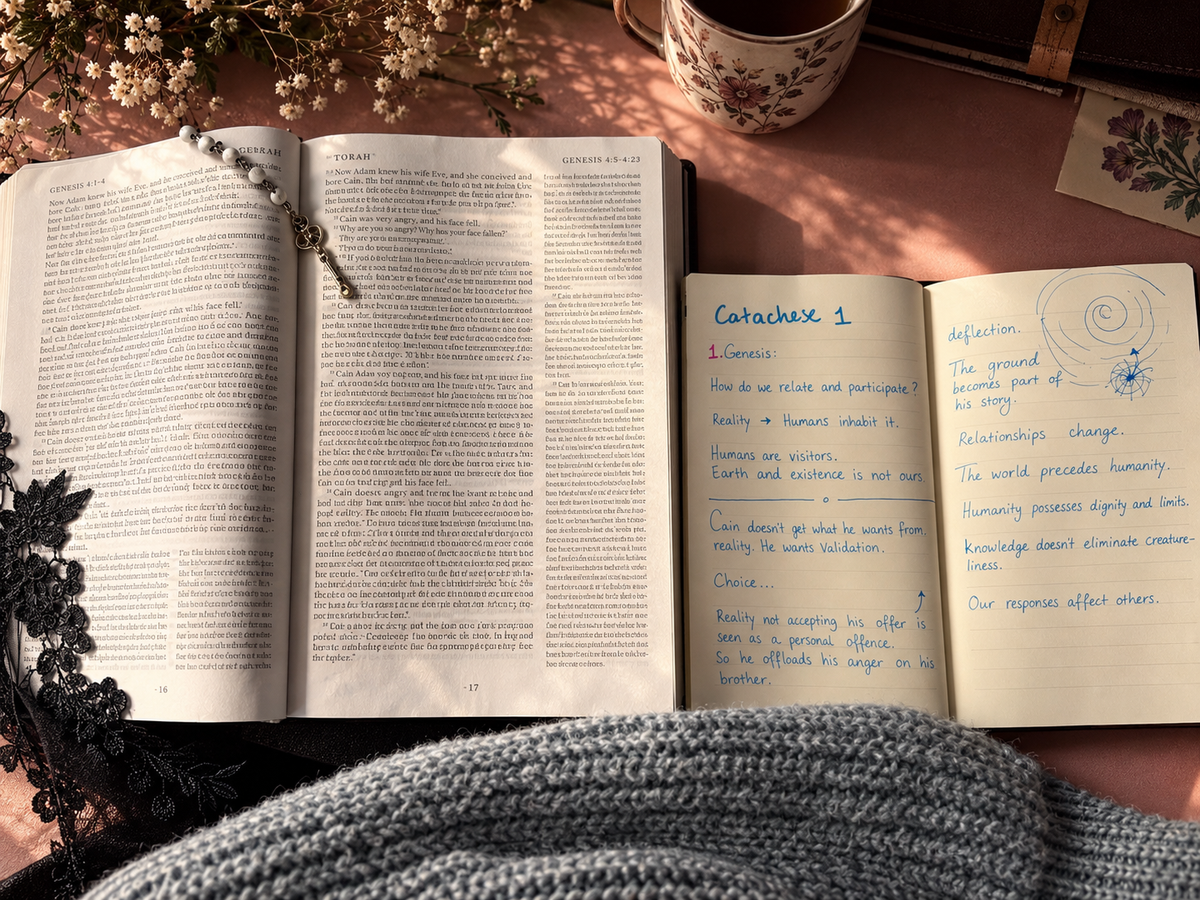
This essay emerged from a close reading of Genesis 1–4 alongside The Jewish Study Bible, second edition, edited by Adele Berlin and Marc Zvi Brettler (Oxford University Press), particularly its introductory discussion of the Torah and commentary on Genesis, pp. 7–17.
The study notes distinguish the two creation accounts, discuss humanity’s divine image within ancient Near Eastern royal imagery, explore the ambiguous meaning of knowing good and evil, and emphasize the Torah’s ethic of responsibility in Cain’s response to God’s questioning.
The reflections on conceptual models, interdependence, reality’s constraints, feedback, and the long-term consequences of human action are contemporary philosophical interpretations developed in conversation with those texts. They are not presented as the definitive intentions of the ancient authors.
Likewise, the suggestion that divine judgment can be considered alongside the consequences of actions in a relational world is an interpretive proposal. Genesis itself depicts God as an acting, speaking agent. Its judgments cannot simply be equated with scientifically established natural laws.
The purpose of this reading is neither to establish the existence of God nor to explain all suffering as deserved consequence, but to investigate what these ancient stories may illuminate about human finitude, responsibility, and the worlds our actions help create.