
Reality Never Agreed to Our Terms


On the sovereignty of our abstractions, the living world, and humanity’s struggle to accept correction.
There is something rather extraordinary about the way human beings relate to reality.
We build models of the world. We name things, categorize them, assign values, establish institutions, draw borders, develop economies, and construct elaborate systems for organizing our collective existence.
These are remarkable achievements. Our capacity for abstraction allows us to cooperate across continents, anticipate events that have not yet happened, develop medicine, protect one another through laws, and transform our environments.
But somewhere along the way, something peculiar can happen.
We begin behaving as though our models are sovereign.
As though reality must answer to the systems we have constructed to describe and organize it.
As though the world itself were another participant at the negotiating table.
We establish targets for 2030. We negotiate what amount of ecological destruction is economically acceptable. We debate how much we can afford to preserve, how rapidly we are willing to change, and which compromises will be politically convenient.
And beneath all these negotiations lies a rather inconvenient fact.
Reality never agreed to our terms.
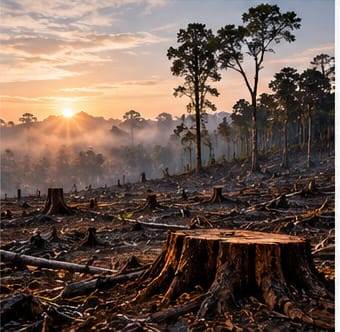
A forest does not remain ecologically functional because we have decided that preserving it would be economically inconvenient.
A river does not become less polluted because an institution has announced its intention to clean it.
An ecosystem does not suspend its biological processes while governments debate deadlines.
The world continues to respond to actual conditions.
And so do we, whether we recognize it or not.

The Map That Mistook Itself for the Territory
Human beings cannot live without abstraction.
A map helps us navigate territory. A scientific model helps us anticipate how systems behave. An economic model helps us coordinate the production and distribution of goods.
But models are necessarily incomplete.
They are selective representations of an extraordinarily complicated world.
Their usefulness depends on whether they remain sufficiently responsive to the reality they represent.
The problem begins when maintaining the model becomes more important than correcting it.
Consider an economy.
An economy is not an independent organism with needs that supersede those of the living beings participating in it. It is a system of human relationships, material resources, productive activities, institutions, and exchanges.
Yet we frequently speak about economic growth as though it were an end in itself, rather than one possible means of improving human life.
We measure production, consumption, efficiency, employment, and financial returns.
These measurements tell us important things. But they do not tell us everything.
A forest can disappear while economic activity increases.
Pollution can create profitable industries devoted to cleaning it.
An activity can appear economically beneficial while imposing ecological costs that remain outside its market price.
None of this means economic measurement is useless. It means we must understand what our measurements include, what they omit, and what consequences follow when we organize society around them.
When an abstraction becomes the ultimate authority, the conditions that give it meaning can become invisible.
We have not escaped reality.
We have become exceptionally skilled at constructing representations that sometimes obscure our dependence upon it.
What the Living World Is Telling Us
In October 2026, the United Nations Convention on Biological Diversity published State of Biodiversity Action, its first global assessment of collective progress under the Kunming-Montreal Global Biodiversity Framework.
The Framework, adopted in 2022, established 23 targets intended to halt and reverse biodiversity loss by 2030 and support a longer-term vision of humanity living in harmony with nature by 2050.
The report documents genuine engagement.
By its March 2026 reporting cut-off, 162 Parties to the Convention had submitted national biodiversity targets. Conservation projects are expanding. Ecosystems are being placed under restoration. Governments, scientists, communities, and organizations are developing new methods of protecting and monitoring the natural world.
Yet the overall conclusion is troubling.
Collective implementation remains too slow to achieve the 2030 biodiversity mission without substantial acceleration.
And perhaps the most revealing findings concern not the preservation of nature directly, but the economic structures surrounding it.
Target 18 calls for the identification and reform of incentives harmful to biodiversity, including reducing such incentives by at least $500 billion annually by 2030.
Only 5% of Parties had set quantified national targets for reducing harmful incentives.
Meanwhile, considerable public resources continue to support activities that damage biodiversity.
This reveals a contradiction.
We establish programmes to protect and restore ecosystems while maintaining some of the financial incentives contributing to their deterioration.
We attempt to repair consequences without sufficiently changing the conditions producing them.
It is not that restoration is meaningless. Restoration matters enormously. The report documents approximately 193 million hectares placed under restoration by 2025, although this does not mean those ecosystems have already recovered.
But we must distinguish repairing damage from preventing its continued production.
Planting trees is valuable.
Preventing the unnecessary destruction of mature forests is also valuable.
And changing the economic conditions that make their destruction profitable may be more consequential still.
The question is not simply whether humanity knows that biodiversity matters.
The question is whether our institutions are organized to act consistently with that knowledge.
Four Questions for a Civilization
Perhaps we can examine our predicament through four questions.
What are we orienting toward?
What are we maintaining?
What are we correcting?
What are we ignoring?
They sound simple.
But applied honestly, they reveal some remarkable tensions.
1. What are we orienting toward?
At the level of our stated ideals, humanity frequently orients toward prosperity, peace, security, freedom, health, justice, and wellbeing.
These are meaningful aspirations.
But the priorities embedded in our institutions are not always identical to the purposes those institutions claim to serve.
We may declare that healthcare exists to support human wellbeing, while evaluating its success through financial efficiency and throughput.
We may declare that education exists to cultivate understanding, while increasingly orienting institutions around standardized performance indicators.
We may declare that economic systems exist to support human flourishing, while treating uninterrupted growth as the primary measure of success.
None of these measures is necessarily wrong.
The danger arises when the measure gradually replaces the purpose.
When the means becomes the end.
When we begin asking how human life can be arranged to maintain a system, rather than whether the system continues to serve human life.
2. What are we maintaining?
Civilization requires continuity.
We need institutions, infrastructure, shared expectations, knowledge, laws, and stable relationships.
Not every structure should be abandoned whenever conditions change.
But continuity can become rigidity.
An institution may defend its procedures because changing them threatens its authority.
An industry may resist transition because livelihoods, investments, and political influence depend upon existing arrangements.
Individuals may cling to familiar beliefs because abandoning them threatens their sense of security.
These responses are understandable.
Human beings are vulnerable creatures. Stability matters.
But there is a difference between preserving something valuable and preserving an arrangement simply because we have become dependent upon it.
An agricultural system that gradually undermines the fertility of its own soil is threatening the material conditions of its continued existence.
An economy that depends on ecological processes while degrading them is creating risks to its own foundations.
A structure can become highly effective at maintaining itself while becoming progressively less effective at fulfilling its original purpose.
3. What are we correcting?
Here we should recognize something hopeful.
Humanity does correct itself.
We develop scientific knowledge. We revise medical practices. We reform laws. We restore ecosystems. We create new technologies and institutions.
The question is what kind of correction we are undertaking.
There is a difference between correcting the consequences of a system and correcting the system that produces those consequences.
We can restore a wetland without addressing the policies encouraging its destruction.
We can regulate pollution after it occurs without sufficiently changing the processes generating it.
We can respond to repeated crises while preserving the arrangements that make those crises more likely.
Sometimes treating consequences is urgent and necessary. A polluted river cannot wait for the complete transformation of an economy.
But if we repeatedly repair damage while continuing to produce it, the scale of our corrective efforts may never catch up.
We need both immediate repair and deeper learning.
And this requires a willingness to question not only our actions, but the assumptions, incentives, and measures of success that organize them.
4. What are we ignoring?
Perhaps the most dangerous feature of ecological deterioration is that its consequences do not always appear immediately.
An ecosystem may continue functioning long after important relationships within it have begun to deteriorate.
A species may survive for years while its population loses the genetic diversity necessary for long-term resilience.
An aquifer can be depleted faster than it is replenished without an immediate interruption to water supplies.
The delay between cause and consequence can create a false sense of security.
Our institutions often operate within electoral cycles, annual budgets, quarterly earnings, and short-term priorities.
Ecological processes may unfold across decades or centuries.
And reality does not necessarily provide immediate feedback in a form that fits our decision-making calendars.
We also tend to overlook relationships that our institutional boundaries divide.
Agriculture is connected to water.
Water is connected to ecosystems.
Ecosystems are connected to public health.
Public health is connected to economic conditions.
Climate, biodiversity, food systems, human livelihoods, and political stability are not independent worlds merely because we have established separate departments to manage them.
Our administrative divisions do not divide the underlying reality.
This is perhaps one of the most important lessons of systems thinking:
The world is interconnected regardless of whether our models acknowledge those connections.

We Are Not Outside Nature
There is another assumption hidden beneath our negotiations.
We often imagine humanity and nature as two separate entities.
Humanity acts. Nature responds.
Humanity manages. Nature is managed.
But human beings are organisms.
Our bodies require water, oxygen, nutrients, temperature regulation, and functioning biological relationships.
Our technologies depend upon physical materials and energy.
Our economies depend upon the continued availability of resources and the functioning of ecological processes.
Even our extraordinary capacity for symbolic thought emerges from living bodies.
We are not external observers who have somehow transcended the systems that sustain us.
We are participants within them.
And that changes the nature of the question.
It is not simply how humanity should manage nature.
It is how one extraordinarily influential species might learn to participate responsibly within the ecological relationships of which it is already a part.
This does not require romanticizing nature.
Nature is not always gentle. Disease, competition, predation, extinction, and destruction are also part of the living world.
Nor does nature provide a complete moral philosophy.
Ecological facts can tell us what particular actions are likely to cause. They cannot, by themselves, resolve every ethical question about justice, dignity, responsibility, or competing human needs.
Those judgments remain ours to make.
But they must be made in contact with the conditions in which their consequences unfold.
We can negotiate our responsibilities to one another. We cannot negotiate away the physical conditions under which those responsibilities must be fulfilled.
Learning Before Catastrophe
There is something particularly unsettling about systems that become incapable of accepting correction.
At first, an institution may be remarkably successful.
Its assumptions correspond sufficiently well to reality. Its procedures achieve their purposes. Its participants benefit from the stability it provides.
Over time, conditions change.
New evidence emerges.
The environment to which the institution originally adapted is no longer quite the same.
But the institution has developed interests, dependencies, and identities around its existing arrangements.
What began as an instrument of adaptation can become an obstacle to adaptation.
Corrective evidence is interpreted as a threat.
The preservation of the structure takes priority over the purpose the structure was meant to serve.
And eventually, change becomes more difficult and more costly than it needed to be.
This is not an unavoidable destiny. Institutions can learn, and humans have demonstrated an extraordinary capacity for cooperation and reform.
But it raises a question we should take seriously:
Can we learn to accept correction while our systems are still functioning, or must we wait until their contradictions become impossible to ignore?
We have an opportunity to design institutions that respond to evidence before damage becomes irreversible.
Institutions that measure more than economic output.
That recognize ecological dependencies.
That incorporate long-term risks into short-term decisions.
That make participation and accountability meaningful.
That allow those affected by decisions to help shape them.
And that treat their own policies, assumptions, and priorities as revisable.
Not because we can construct a perfect civilization.
But because we cannot.
An Ordinary Human Being on an Extraordinary Planet
All of this can feel enormous.
There is a temptation, when confronted with planetary problems, to respond either with despair or an exhausting demand for personal perfection.
Neither is particularly helpful.
An individual cannot personally correct the incentives of an entire global economy.
Nor should responsibility for structural problems be transferred entirely onto private consumption choices.
But individuals are not without agency.
We participate in communities, institutions, political processes, economic relationships, and cultural life.
We can learn.
We can question what is being measured and what is being neglected.
We can support effective conservation and responsible public policy.
We can participate in scientific observation, democratic deliberation, education, and collective action.
We can help preserve places and relationships that matter.
And we can recognize that rest, pleasure, beauty, friendship, and the enjoyment of existence are not betrayals of responsibility.
After all, what exactly are we trying to preserve if not the conditions in which life can continue to unfold?
A child discovering an insect.
A forest full of relationships no single person could completely understand.
A river moving through a landscape.
An ordinary person stepping outside and feeling the autumn wind.
The possibility of living, learning, loving, mourning, laughing, creating, and participating in a world that does not belong exclusively to us.
Perhaps the point was never to become sovereign over reality.
Perhaps the point is to become better participants within it.
To create models that help us understand without mistaking them for the world itself.
To build institutions capable of learning rather than merely defending their continuity.
To hold our convictions seriously without making them immune to evidence.
To care enough about life that we are willing to change how we live.
And to remember that our abstractions, however useful, remain dependent upon a world that does not require our permission to be what it is.
Reality never agreed to our terms.
But we can still learn to respond to its conditions with intelligence, humility, responsibility, and love.
Sources and further reading
- Secretariat of the Convention on Biological Diversity (2026). State of Biodiversity Action: The Global Report on Collective Progress in the Implementation of the Kunming-Montreal Global Biodiversity Framework. Particularly the summary (pp. 14–16), ecosystem restoration (pp. 63–73), harmful incentives (pp. 257–265), biodiversity financing (pp. 267–279), and conclusions (pp. 385–401).
- Intergovernmental Science-Policy Platform on Biodiversity and Ecosystem Services (IPBES). Global Assessment Report on Biodiversity and Ecosystem Services (2019), and Transformative Change Assessment (2024), as discussed in the 2026 biodiversity report.
The Living Fractal. An independent exploration of life, reality, and the strange experience of being human.