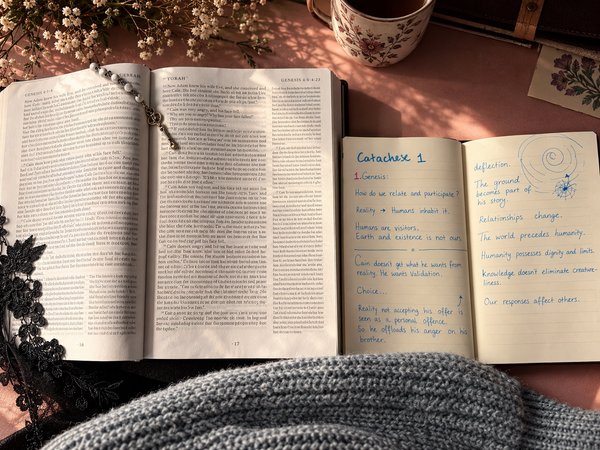
Must the World Be Good for Us to Love It?
Walt Whitman, Genesis, Job, and the difficult art of loving creation without demanding that everything within it be good.

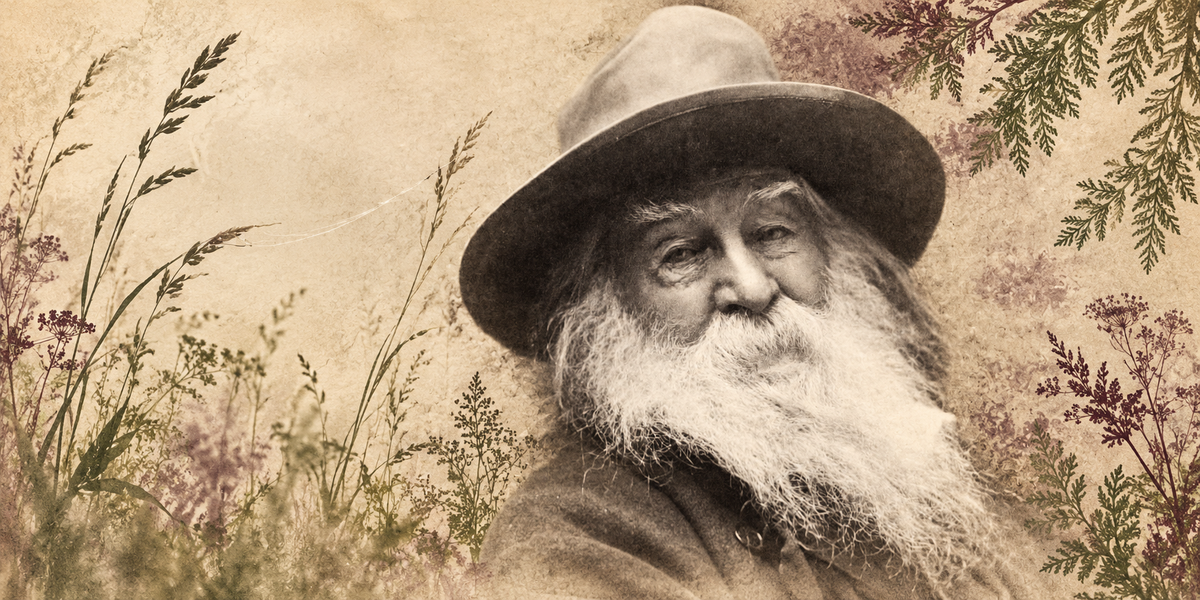
I. A Poet in the Grass
There is something wonderfully audacious about Walt Whitman.
He looks at the world—its bodies, rivers, insects, lovers, labourers, trees, and ordinary streets—and seems almost unable to contain his affection for it.
In Leaves of Grass, existence becomes an astonishing gathering of things worthy of attention.
Nothing appears too ordinary to enter his poetry.
The human body is not merely a vessel carrying something more important. The grass beneath his feet is not simply scenery. The stranger passing through the street is not an insignificant figure in somebody else’s story.
Whitman wants to encounter them all.
And there is something deeply attractive about this orientation.
We spend so much of our lives explaining, categorizing, evaluating, and arranging existence according to our expectations that we can almost forget to experience it.
We develop elaborate accounts of what life means while overlooking the living world immediately before us.
Whitman seems to ask us to reverse that relationship.
Look first.
Listen.
Encounter.
Allow the world to surprise you.
But as I continued reading him, I encountered a tension that I could not quite dismiss.
Whitman does not merely celebrate the existence of things.
At times, he seems to require existence to belong to an ultimately harmonious and meaningful whole.
And that raises a question.
Must the world be good for us to love it?
Or can we learn to love reality without requiring reality to confirm our hopes about what it ultimately means?
II. The World Is Not Our Explanation of the World
In A Song of the Rolling Earth, Whitman makes a remarkable distinction between human language and the world to which language refers.
He suggests that the earth possesses a kind of expression more fundamental than the words we use to describe it.
The ground, the sea, the air, the bodies of living creatures: these exist before our explanations.
We may name them, classify them, write poems about them, construct scientific models of their behaviour, and develop entire philosophical systems around them.
But none of those representations is identical to the thing represented.
A description of a forest is not a forest.
A theory of a human being is not a human being.
A theological account of creation is not creation itself.
This does not make our explanations useless.
Quite the opposite.
Our capacity for abstraction allows us to investigate relationships, anticipate consequences, communicate discoveries, and correct mistakes.
But abstraction becomes dangerous when we forget what it is.
A model is a way of understanding reality. It is not an authority over reality.
And when reality contradicts our models, we face a choice.
We can revise our understanding.
Or we can defend the model against the evidence.
This tension appears not only in science and politics, but in philosophy, morality, and religion.
We may become so attached to what we believe the world ought to be that we stop attending to what is actually happening.
And sometimes, even our most beautiful convictions become ways of avoiding an encounter with reality.
III. And God Saw That It Was Good
The opening chapter of Genesis offers a very different kind of encounter with existence.
Again and again, the creation narrative declares that what God has made is good.
Light.
Land.
Vegetation.
Living creatures.
The great variety of life.
And finally, the whole of creation is described as very good.
It is a remarkable affirmation of material existence.
The world is not presented as a regrettable prison from which the spiritual must escape.
The physical world matters.
Bodies matter.
Animals matter.
The earth matters.
Life is not treated as an unfortunate interruption of some supposedly purer, immaterial reality.
Yet there is a distinction here that I think deserves careful attention.
To say that creation is good is not necessarily to say that everything occurring within creation is good.
Genesis itself does not permit such a simple conclusion.
The opening affirmation is followed by accounts of alienation, violence, rivalry, mortality, and human beings refusing responsibility for their actions.
Cain kills Abel.
And when confronted, Cain asks whether he is his brother’s keeper.
The narrative does not respond by declaring the murder another beautiful expression of cosmic harmony.
Abel’s blood cries out from the ground.
Something has happened.
A life has been destroyed.
The consequences cannot be dissolved into an attractive explanation.
There is a difference between affirming the worth of existence and approving of every event that occurs within it.
And perhaps this is one of the most important distinctions we can make when speaking about goodness.
A living world may be worthy of care without every process, action, or consequence within it being morally desirable.
Indeed, caring about the world may sometimes require us to resist what is happening within it.
To protect a vulnerable creature.
To interrupt violence.
To acknowledge damage.
To repair what can be repaired.
To mourn what cannot.
Love need not mean approval.
Sometimes love is precisely what makes indifference impossible.
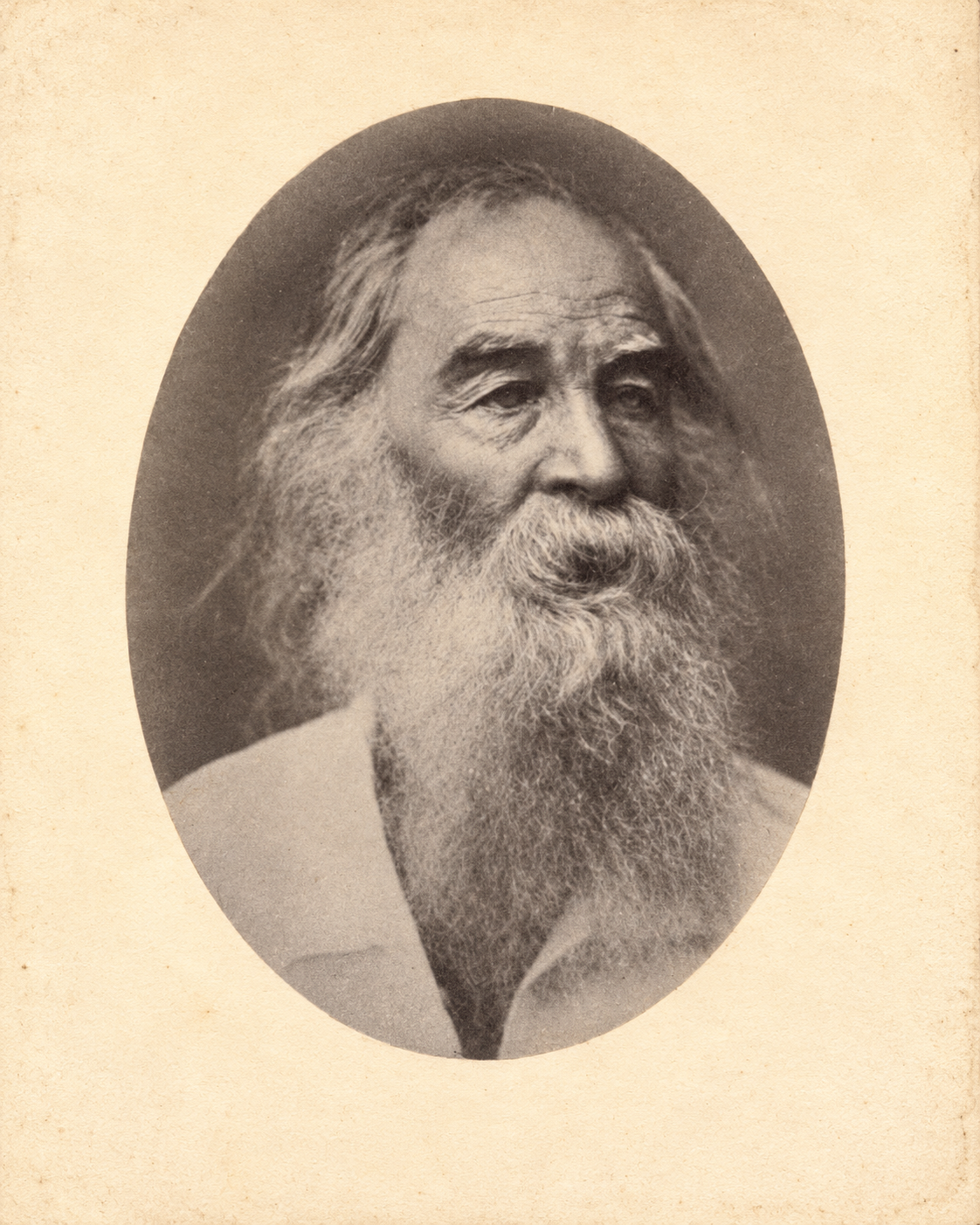
IV. The Temptation of a Perfect Universe
Whitman’s poetry sometimes approaches a much more sweeping affirmation.
In To Think of Time, he imagines a universe in which existence, death, transformation, and even the categories of good and bad belong to an ultimately perfect order.
He declares his conviction that immortality pervades everything.
The trees.
The animals.
The material world.
Human identity.
Life itself.
There is something extraordinarily moving about this vision.
It is difficult not to feel the appeal of a universe in which nothing is finally lost.
A universe in which suffering, mortality, and separation do not have the last word.
But the appeal of a belief is not evidence of its truth.
And here I find myself hesitating.
When Whitman declares the whole of existence perfect, what exactly is he claiming?
Does he mean that everything belongs to the same natural reality?
That every event has causes?
That every creature participates in a larger ecological or cosmic process?
Or that everything which occurs is ultimately good?
Those claims are not interchangeable.
Something can belong to nature without being beneficial to every organism affected by it.
Something can be causally explicable without being morally justified.
And something can be meaningful to one person while causing profound suffering to another.
We should be particularly careful when an account of universal harmony begins to make suffering appear necessary, deserved, or insignificant.
The danger is not wonder.
The danger is turning wonder into a justification.
V. The Redwood That Agreed to Die
One of the most revealing moments in Whitman’s poetry appears in Song of the Redwood-Tree.
The poem imagines an ancient redwood yielding to the arrival of human civilization.
Its destruction becomes part of a grand historical transition.
The old world gives way to the new.
Nature appears to consent to the advance of human progress.
But consider what is happening.
The tree does not actually speak.
Whitman gives it a voice.
And that voice conveniently endorses the human project that will destroy it.
This is where the poet who urges us to encounter reality risks imposing an interpretation upon it.
The living tree becomes a character in a human narrative of destiny.
Its destruction is transformed into a contribution to progress.
But the ecological reality is not resolved by the poem.
A tree can be cut down regardless of whether the people cutting it down believe they are advancing civilization.
The consequences extend beyond the story they tell themselves.
There are organisms that depended upon it.
Relationships altered by its absence.
Material changes that cannot be undone merely by describing them as necessary.
We can understand why Whitman, writing within the nineteenth-century imagination of expansion and progress, found this vision compelling.
But understanding his historical perspective does not require accepting it.
And the contradiction is worth preserving.
Even a philosophy that celebrates nature can become a philosophy that speaks over nature.
Perhaps this is one reason truthfulness requires more than affection.
It requires a willingness to let the world contradict us.
VI. Then There Is Job
If Whitman sometimes seeks reassurance in cosmic harmony, the Book of Job offers a profound challenge to easy explanations of suffering.
Job is introduced as a righteous man.
Yet he loses his possessions, his children, and his health.
His friends attempt to make sense of what has happened.
They defend an intelligible moral order in which suffering must somehow correspond to wrongdoing.
If Job suffers, they reason, there must be a reason that makes his suffering fit their understanding of divine justice.
But Job refuses to accept their explanation.
He knows that their account does not adequately describe his situation.
He protests.
He grieves.
He argues.
He demands an encounter with God.
There is something striking about this refusal.
Job does not preserve a comforting theory at the expense of his experience.
He will not simply declare that everything is fine because his friends require the universe to be morally predictable.
His suffering remains suffering.
His losses remain losses.
And his protest becomes part of the religious text itself.
When God finally answers from the whirlwind, Job does not receive a neat explanation accounting for each tragedy.
Instead, he encounters questions about the foundations of the earth, the boundaries of the sea, the behaviour of wild animals, and the vast complexity of a world beyond human management.
This is not a straightforward solution to the problem of evil.
Nor does it establish that suffering is justified because human beings cannot understand everything.
That would simply replace one premature explanation with another.
But the divine speeches profoundly unsettle the assumption that reality must conform to the explanatory capacities of a single human observer.
The world is larger than Job’s understanding.
And larger than the explanations offered by his friends.
The difference is that Job has not pretended otherwise.
He has brought his suffering into the encounter.
His friends have tried to explain it away.
VII. The Wild Creatures of Job
There is another aspect of Job that I find especially beautiful.
When God speaks from the whirlwind, the discussion turns repeatedly toward nonhuman life.
Wild goats.
Deer.
Donkeys.
Oxen.
Ostriches.
Horses.
Hawks.
Eagles.
Creatures that do not organize their existence around human expectations.
Some are dangerous.
Some are difficult to understand.
Some inhabit places beyond human settlement.
They do not exist merely to illustrate human moral lessons or provide resources for human civilization.
The divine speeches present a world overflowing with lives, processes, and relationships that exceed human control.
And here, unexpectedly, Job begins to resemble Whitman.
Both direct our attention beyond the human self.
Both invite us to consider a world larger than our immediate concerns.
But there is an important difference.
Whitman sometimes seems eager to gather everything into a universal affirmation.
Job leaves us standing before a reality that resists such easy reconciliation.
The wild creature does not need to become a symbol of human progress.
It is already there.
Living.
Acting.
Responding to its environment.
Participating in a world that does not revolve around us.
And perhaps learning to encounter such creatures without immediately making them serve our interpretations is itself a form of humility.
VIII. Does Love Require Certainty?
I keep returning to another Whitman poem: Of the Terrible Doubt of Appearances.
Here, the poet considers the possibility that our perceptions may be unreliable.
That appearances may deceive us.
That even our hopes concerning identity and existence beyond death may not be secure.
And yet, rather than solving these questions, he describes an experience of companionship.
Two people together.
A hand held.
An intimacy that does not require the universe to disclose all its secrets.
This is a different kind of affirmation.
It does not demonstrate immortality.
It does not prove that the cosmos is ultimately benevolent.
It does not explain away suffering.
It describes a relationship that matters even while the questions remain unanswered.
I find that considerably more compelling than a declaration that everything must be perfect.
Because perhaps we have been asking love to do something it was never required to do.
Perhaps loving something does not mean knowing its ultimate purpose.
Perhaps caring for another creature does not require believing that its suffering belongs to a beautiful plan.
Perhaps we can be grateful for a moment without insisting that the moment guarantees eternity.
We can love what is finite.
We can cherish what is vulnerable.
We can participate in relationships without knowing how long they will last.
And we can resist what harms those relationships without needing to pronounce the whole universe either good or bad.
IX. Creation, Goodness, and the Refusal to Explain Away Harm
This brings us back to Genesis.
When the creation narrative calls the world good, it offers a theological affirmation.
Within that tradition, creation possesses value because it is created and sustained by God.
But that affirmation should not be confused with the claim that every occurrence within creation deserves moral approval.
The biblical texts themselves contain lamentation, protest, judgment, repentance, mercy, and demands for justice.
They do not speak with only one emotional voice.
Job protests.
The Psalms lament.
The prophets condemn exploitation.
Genesis portrays human beings attempting to evade responsibility for the consequences of their actions.
These responses would make little sense if goodness simply meant approving of everything that happens.
To affirm creation may therefore involve a responsibility toward creation.
Not merely admiration.
Not merely gratitude.
But attention to consequences.
A willingness to recognize injury.
A willingness to reconsider our actions.
A willingness to accept that our understanding may be incomplete.
And a refusal to use theological language to make another creature’s suffering disappear.
That distinction matters enormously.
Especially when we are tempted to defend our beliefs by demanding that reality conform to them.
X. The Little Spider
Near the end of Leaves of Grass, Whitman offers a much smaller image.
A spider stands alone, extending threads into the surrounding space.
It does not possess a complete map of where its filaments will land.
It reaches.
It ventures.
It attempts to establish a connection.
Whitman compares the spider’s activity to the soul seeking relationships across an immense and uncertain existence.
I love this image because it does not require the grand assurance that everything is already reconciled.
The spider acts within uncertainty.
It responds to the conditions around it.
Its efforts may succeed or fail.
Yet it continues participating in the world.
Perhaps that is a more honest image of our own situation.
We are finite creatures.
Our knowledge is incomplete.
Our interpretations can be mistaken.
Our actions have consequences that extend beyond our intentions.
We can love deeply and still cause harm.
We can attempt to do good and discover that our understanding was inadequate.
We can suffer without deserving our suffering.
We can encounter beauty without knowing why beauty exists.
And none of this requires us to withdraw from life until we have solved it.
Perhaps the task is not to construct a worldview in which everything becomes acceptable.
Perhaps it is to become more capable of responding truthfully to what we encounter.
To notice.
To investigate.
To care.
To correct ourselves.
To oppose harm where we can.
To grieve what has been lost.
To delight in what is beautiful.
And to remain open to being surprised.
XI. Must the World Be Good for Us to Love It?
I don’t think we need to settle the ultimate metaphysical character of existence before we can participate in it.
This does not mean that questions of goodness, truth, and meaning are unimportant.
Nor does it mean that all interpretations are equally justified.
Some descriptions of reality are better supported than others.
Some actions cause avoidable suffering.
Some relationships sustain life, while others damage it.
These distinctions matter.
But perhaps loving reality truthfully begins with refusing to confuse our affection for existence with a requirement that existence satisfy our expectations.
The world does not become less real when our explanations fail.
A creature does not become less worthy of care because we cannot establish its ultimate purpose.
A moment of tenderness does not become meaningless because it is temporary.
And suffering does not become good simply because we can place it inside a beautiful story.
Whitman teaches us something important about wonder.
Genesis offers a language for affirming the value of creation.
Job reminds us that suffering cannot always be reconciled with our explanations of goodness.
None of them eliminates the difficulty.
Together, however, they leave us with a question worth living alongside.
Can we love a world that does not promise to be what we want it to be?
Can we participate without pretending to possess the final explanation?
Can we remain responsive to reality even when it corrects us?
I don’t know whether the universe is ultimately arranged according to a purpose that would satisfy our understanding.
I don’t know whether every loss is redeemed.
I don’t know whether every question has an answer available to us.
But I do know that we encounter a world containing living creatures, relationships, vulnerability, beauty, suffering, and consequences.
And that our responses matter within it.
Perhaps we do not have to call everything good.
Perhaps we do not have to understand everything.
Perhaps we can begin with something smaller.
A willingness to encounter what is here.
A willingness to love without possessing.
A willingness to act without certainty.
A willingness to be corrected.
Like Whitman’s little spider, extending its threads into the unknown.
Not because it knows that every thread will find a place to hold.
But because this is how it participates in the world.
And perhaps, for now, that is enough.
Notes and reading
Walt Whitman
- Leaves of Grass, particularly Song of Myself, A Song of the Rolling Earth, Song of the Redwood-Tree, To Think of Time, Of the Terrible Doubt of Appearances, and A Noiseless Patient Spider.
- The Complete Writings of Walt Whitman, Volume X (1902), including Notes and Fragments (Parts III continued, IV and V), Oscar Lovell Triggs’s “The Growth of Leaves of Grass,” and his bibliography of Whitman.
Biblical texts
- Genesis 1–4: creation, human responsibility, violence, and consequences.
- Job 1–2: the opening account of Job’s suffering.
- Job 3–31: lamentation, protest, and disputes with his friends.
- Job 38–41: the divine speeches concerning creation and the nonhuman world.
- Job 42: the conclusion and God’s rebuke of Job’s friends.
Further historical context
- Walt Whitman, The Book of Heavenly Death (1905), compiled from Leaves of Grass by Horace Traubel: a posthumous selection of Whitman’s writing on death and immortality.
- Mathilde Montpetit, “There is Nothing but Immortality!”: Walt Whitman and The Book of Heavenly Death (1905), The Public Domain Review.
An ongoing investigation from The Living Fractal.