The beauty of an ordinary doorway
The Education of Beauty, no. 1. A close look at Vermeer’s The Little Street, the work of keeping life going, and what attention might ask of us.

The Education of Beauty · 01
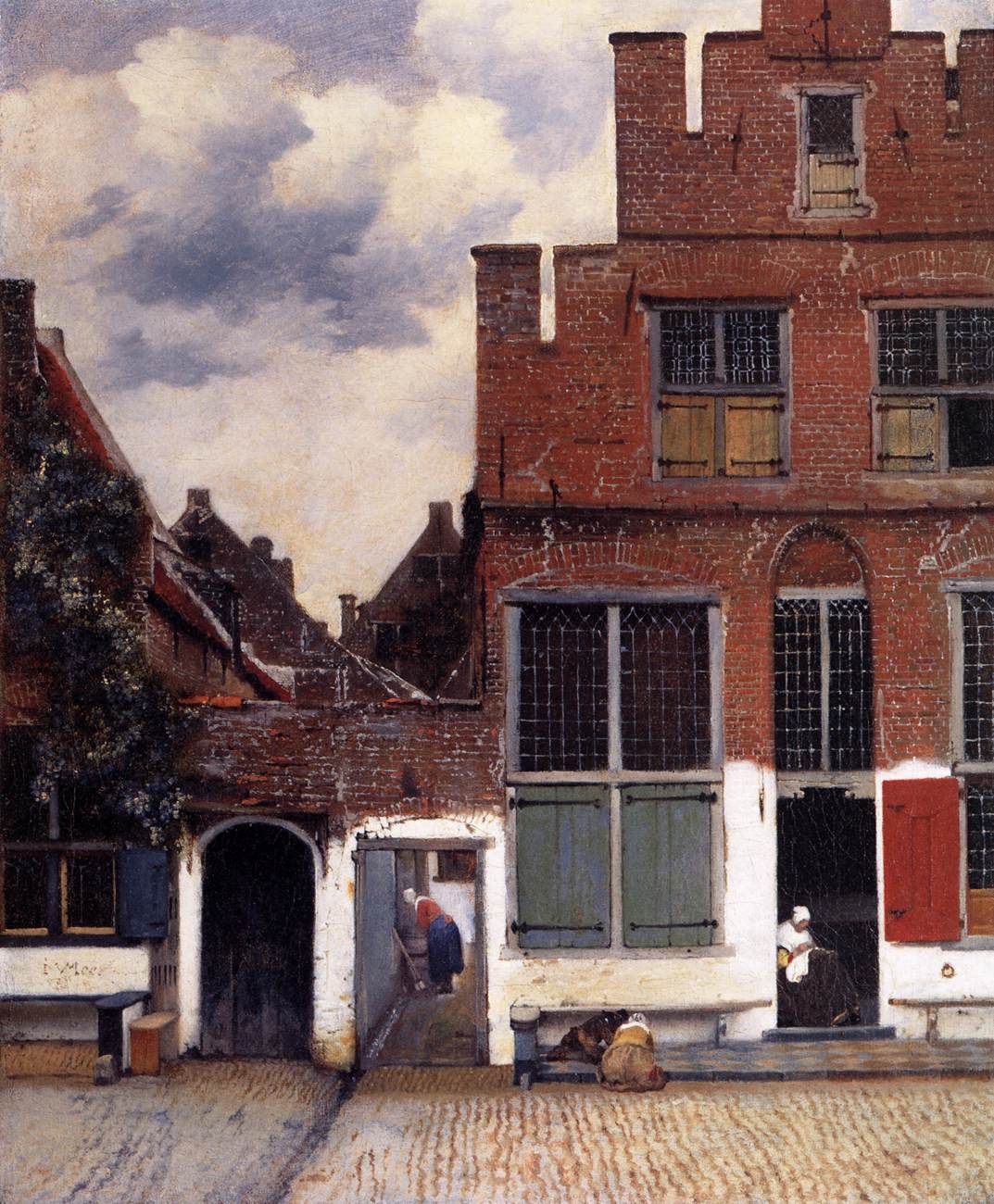
There is a red shutter open against a white wall. Nearby, two children bend close to the ground. A woman sits in a doorway with something in her hands. Above them, the brickwork rises into a sky full of clouds.
Johannes Vermeer painted The Little Street around 1658. It is a view of houses in Delft, now in the Rijksmuseum. You can recognise the scene almost immediately. Staying with it takes a different kind of attention.
A wall with a history
Look at the wall on the right. The bricks shift in colour. Pale lines run through the red; the whitewash at street level is uneven. Windows and shutters divide the surface into rectangles, but age keeps interrupting their order.
The house has edges, marks, repairs. Those particularities give the eye somewhere to go. There is enough difference in one wall to keep looking.
I find a useful question here: how much of what we call ordinary is something we have stopped examining?
That question reaches beyond paintings. A cup acquires a chip. A sleeve wears thin. A familiar voice changes when someone is tired. Familiarity can make these details disappear into the background, although they are where much of a life is happening.
Someone is keeping life going
The Rijksmuseum identifies the seated woman’s activity as needlework, another woman in the passage as working over a washtub, and the children as playing. The people are absorbed in their own activities. They have something to do.
It is tempting to turn the whole scene into a feeling: quiet, lovely, peaceful. Those are responses a viewer might have. They cannot tell us how the people pictured felt, how tiring their work was, or what their lives were like beyond this moment.
That limit matters to me. Looking at someone’s labour can be pleasurable from a comfortable distance. Care asks another question: who is doing the work that makes a place habitable, and what would make their day easier?
A beautiful image can bring that question closer. Answering it belongs to what we do afterwards.
An education in looking
This is where I want The Education of Beauty to begin: with particular things we can spend time with. A painting, a song, a garment, a garden, an object made by someone’s hands. We can notice what attracts us, learn something about it, and ask what changes as we come closer.
There will be room for pleasure here. I don’t want every encounter to become homework. Sometimes a colour or a passage of music is enough to stay with. Sometimes it opens a question about craft, history, desire, or care.
For now, try looking at the painting once more. Choose a detail you missed the first time. Describe it before deciding what it means.
Then look around the place where you are. What has someone made, maintained, mended, or quietly kept going? Is there one small part of that work you could share?
Artwork & source: Johannes Vermeer, View of Houses in Delft, Known as “The Little Street”, c. 1658, oil on canvas, Rijksmuseum, SK-A-2860. Artwork information and identification of the figures: Rijksmuseum collection record. The reflections above are my reading of the painting. Public-domain reproduction via Wikimedia Commons / Web Gallery of Art.